
Nvidia's Shocking $12.9B Play to Own the Open-Source AI Stack.
Nvidia's Trillion-Dollar Chess Move: Buying Open-Source AI While Amazon Triples Down on Its Silicon.
Inside the $12.9B Hugging Face deal and the 2-million-GPU AWS expansion reshaping enterprise AI infrastructure.
$12.9B: Reported Nvidia bid for Hugging Face
2M GPUs: New Nvidia chips heading to AWS by 2028
$279B: Nvidia's committed supply & manufacturing capacity
1: Nvidia Moves to Own the Open-Source AI Stack:
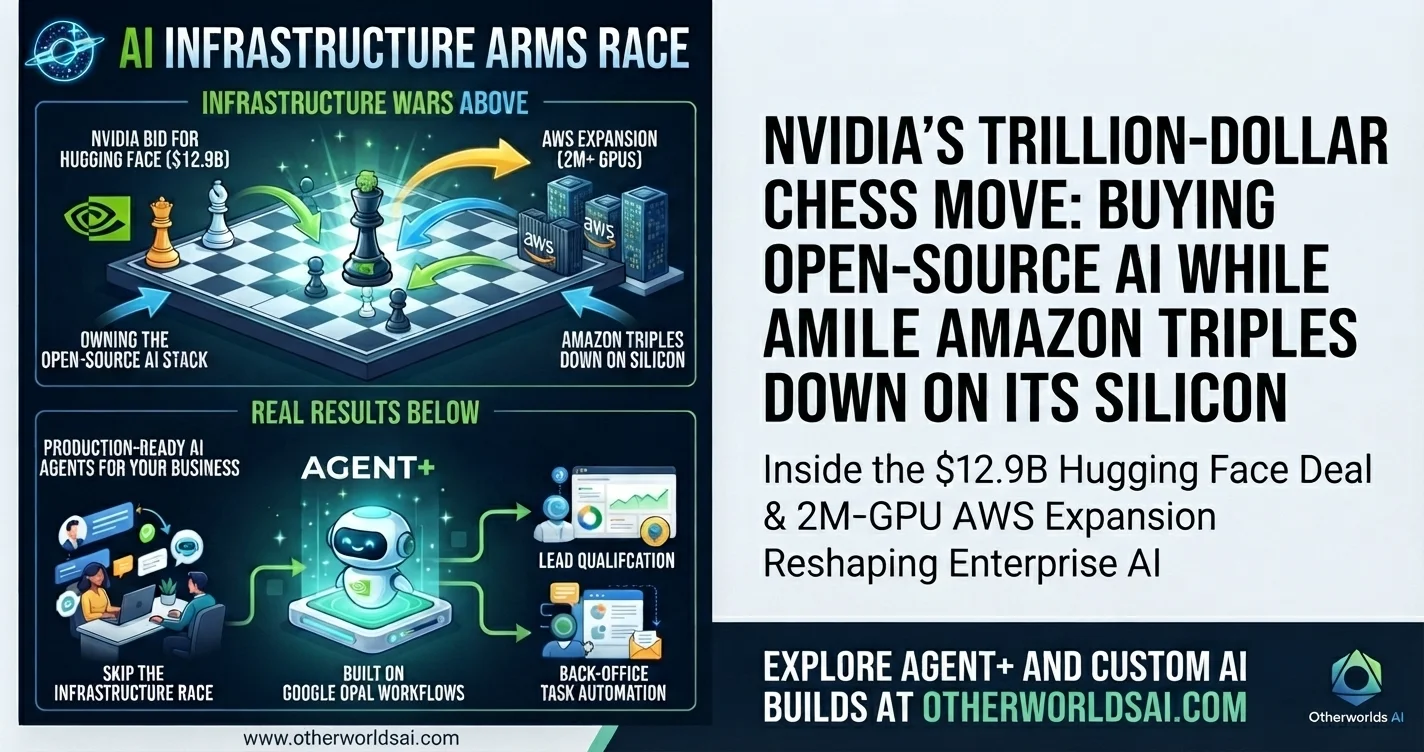
Nvidia is reportedly closing in on a $12.9 billion deal to acquire Hugging Face, the open-source hub where developers share and download AI models — a move that would reshape who controls the infrastructure beneath the open AI ecosystem.
Talks were still unsigned as of Wednesday night and could still fall apart, but the strategic logic is hard to miss. Nvidia's dominance in AI chips faces mounting pressure as OpenAI, Google, Amazon, and Anthropic all build custom silicon to reduce their reliance on Nvidia hardware. A thriving open-source ecosystem keeps more of the market anchored to Nvidia's GPUs, which is also why the company has already poured tens of billions of dollars into its own open models.
Hugging Face CEO Clem Delangue has spent much of 2026 publicly aligned with Nvidia's open-source push, amid a broader Washington debate over restricting open-weight models as Chinese labs release systems that rival U.S. benchmarks at a fraction of the cost.
The company turned down a $500 million Nvidia investment last year rather than cede control to a dominant backer — but a full buyout, paired with revenue that's grown from roughly $100 million to $150 million a year in just two months, appears to be a different calculation entirely. The deal would also hand Nvidia a re-entry point into cloud computing and a way to offload unused capacity from its own massive cloud commitments.
2: Amazon Triples Its Nvidia GPU Order as Demand 'Exceeds Expectations':
Amazon and Nvidia announced an expanded partnership adding another 2 million Nvidia GPUs — including Blackwell Ultra, Rubin, and Rubin Ultra chips — to AWS data centers through 2027 and 2028, just five months after a prior deal for more than 1 million GPUs.
Neither company disclosed financial terms, but at typical GPU unit costs the expansion is worth tens of billions of dollars. Nvidia said demand has “exceeded those expectations” set just five months ago, even as Amazon simultaneously builds out its own competing chips — its Trainium line for deep learning and Graviton CPUs — with a custom chip business now running at a $25 billion annualized revenue rate, backed by $225 billion in total commitments from AI labs including Anthropic and OpenAI.
3: Nvidia's Physical AI and Enterprise Stack Push Into AWS:
The Amazon deal extends well beyond raw chip volume, folding Nvidia's networking hardware, open models, CPUs, data processing software, and robotics platform directly into AWS infrastructure.including Omniverse, Cosmos, Isaac, and Jetson — the last of which just got a new, more accessible version aimed at entry-level edge AI. On the enterprise side, AWS will serve Nvidia's Nemotron open models through Amazon Bedrock and SageMaker.
Nvidia CEO Jensen Huang has also been touting the company's Vera CPUs as a “brand-new $200 billion TAM,” with Kress saying Wednesday that Vera deployments are already underway across hyperscalers, neoclouds, AI labs, and system OEMs, including Oracle and SpaceXAI.
4: The Broader Consolidation Wave Reshaping AI Infrastructure:
Nvidia and Amazon aren't the only ones consolidating around AI infrastructure — Stripe's recent acquisition of OpenRouter, the model-routing startup, for a reported $7 billion signals the same trend playing out across the sector.
OpenRouter was valued at just $1.3 billion during its Series B round in May, underscoring how quickly valuations are moving as infrastructure players get absorbed into bigger balance sheets. Hugging Face's own trajectory fits the pattern: the company raised $235 million in 2023 at a $4.5 billion valuation from backers including Salesforce Ventures, Alphabet's GV, IBM Ventures, and Nvidia itself, then turned down a $500 million Nvidia investment last year rather than accept a dominant outside backer.
A full acquisition avoids that control problem while still giving Hugging Face access to deeper pockets — a pattern likely to repeat as more AI infrastructure startups get pulled into larger platforms.

Move Over Nvidia: Anthropic and Samsung Team Up to Break the AI Chip Monopoly
“AI is generating profitable tokens.” — Nvidia CEO Jensen Huang, on why hyperscalers keep expanding compute spend.
5: What the Infrastructure Arms Race Means for Your Business:
Multibillion-dollar chip deals and acquisitions are the headline story, but they're really a bet on one thing: that businesses will keep needing more AI compute to run agents, automate workflows, and serve customers.
For most enterprises, the practical question isn't which chip architecture wins or who owns which open-source hub — it's how to actually put AI to work without building out infrastructure at Amazon or Nvidia's scale. That's the gap between the compute arms race happening in data centers and the AI agent that answers a customer inquiry, qualifies a lead, or automates a back-office task tomorrow morning.
The Enterprise Takeaway: Infrastructure Wars Above, Real Results Below:
Nvidia bidding billions for Hugging Face and Amazon tripling its GPU orders are both bets that AI compute demand keeps climbing — but neither deal puts a working AI agent in front of your customers or your team.
Support our research
Independent analysis fueled by you.
That gap is exactly what Agent+ closes. Built on Google Opal automated workflows and priced at $297/month, Agent+ gives businesses a production-ready AI agent platform without the infrastructure arms race, the chip shortages, or the multibillion-dollar M&A headlines. Need something more tailored? Otherworlds AI also builds custom enterprise AI solutions matched to your workflows.
Explore Agent+ and custom AI builds at otherworldsai.com