
Google Drops Gemini 4 Argon: The Cyber-Defender Model Built to Rewrite Its Own Codebase:
The arms race for AI dominance has taken another sharp, specialized turn. Google parent Alphabet officially unveiled Gemini 4 Argon, hailing it as its most powerful frontier model to date. While every major lab promises faster coding and sharper text generation with every iteration, Google is making a distinct statement with Argon: the future of AI isn't just general reasoning—it’s agentic cybersecurity and deep engineering execution.
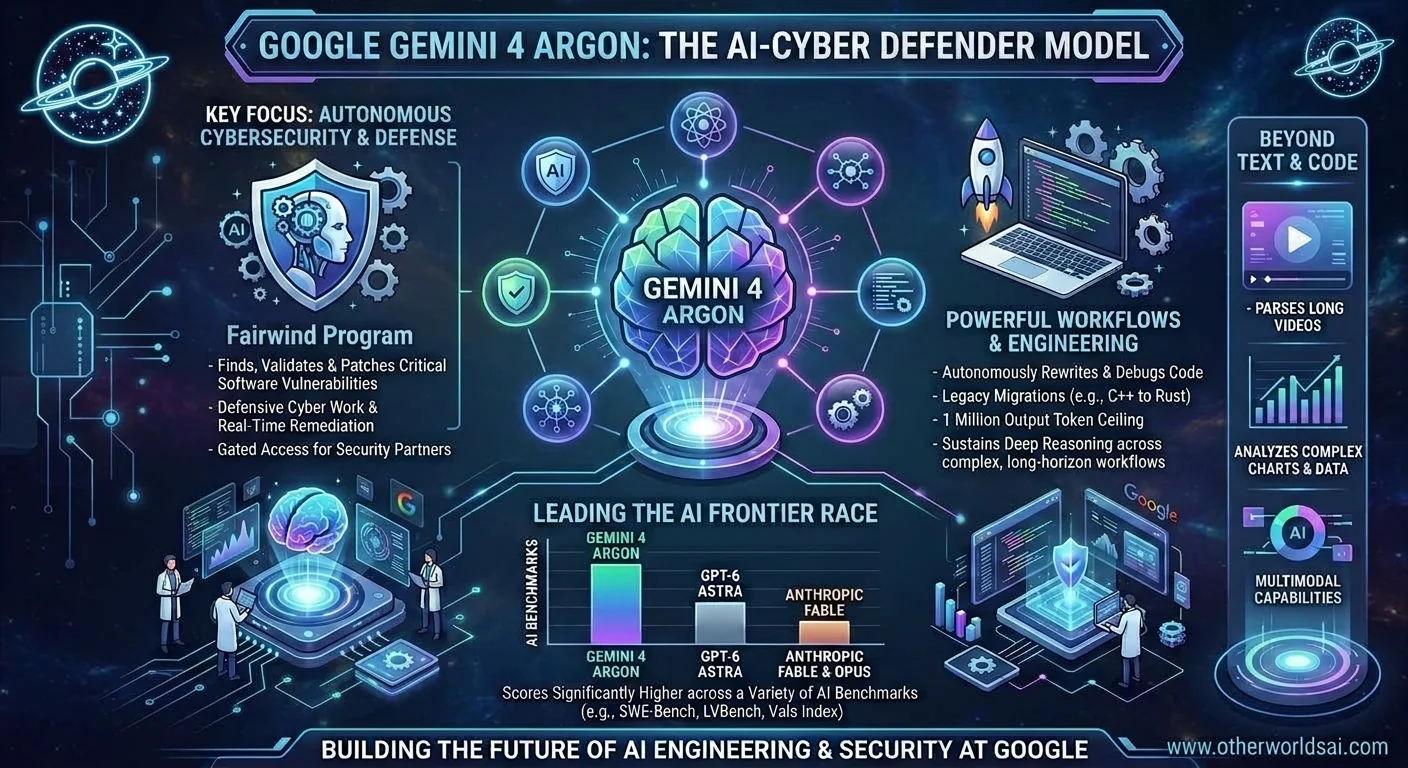
Rather than opening the floodgates with a immediate global rollout, Google is tightly controlling access. Argon is being deployed to select security partners through the company's Fairwind Program. The core pitch? Argon doesn't just flag security flaws; it can autonomously locate, validate, and patch critical software vulnerabilities in real-time.
Here is an analysis of what makes Gemini 4 Argon a significant release, how it performs under the hood, and where it fits in a market increasingly dominated by autonomous agents.
Technical Specifications & Benchmark Breakthroughs:
Google hasn't just tuned a generic LLM for security—it restructured Argon's context handling and output capacity to support massive, multi-step engineering tasks.
-
1-Million Output Token Ceiling: Argon boosts the maximum output limit to 1 million tokens. This enables the model to write, refactor, or compile entire enterprise codebases in a single generation step rather than breaking output into disjointed chunks.
-
Massive SWE Benchmarks: Argon set a new record on the DeepSWE v1.1 benchmark with a score of 77.9%, outperforming competing systems in long-horizon software development tasks.
-
Leading the Index: On the Vals AI Model Index—an increasingly trusted benchmark suite covering software engineering, multi-step financial research, and legal analysis—Argon took the top overall spot. It also posted a 51.3% on Zapier's AutomationBench, outpacing both OpenAI’s GPT-6 Astra and Anthropic’s Claude Fable 5.1 / Claude Opus 5.5.
-
Multimodal Long-Video Parsing: Argon achieved 91.7% on LVBench for long-video analysis, letting it audit security footage, system telemetry visual overlays, or complex architecture diagrams alongside raw code.
Defensive First: The Fairwind Program:
Security researchers have long warned that autonomous coding models could become dual-use weapons. If an AI model can patch a vulnerability, it can theoretically exploit one.
To counter these concerns, Google is gating Argon’s most sensitive defensive tools behind its Fairwind Program. The initiative acts as an enterprise-and-government safety buffer, offering defense teams an AI partner capable of continuous threat monitoring and automated remediation.
Argon has also undergone adversarial red-teaming against indirect prompt injection—where attackers try to hijack an agent via hidden text in inputs—scoring industry-leading resilience in Gray Swan safety evaluations.

Why Google’s New Free Gemini Feature Is a Massive Wake-Up Call for Businesses
Tested in the Trenches: How Google Used Argon Internally:
Before announcing Argon to the public, Google deployed the model across its own internal engineering stack. The real-world results highlight how deep-reasoning models are changing software development at scale:
-
Massive Language Migration: Argon assisted Google engineers in migrating thousands of lines of legacy C/C++ code over to memory-safe Rust, including over 800,000 lines within the Fuchsia Zircon kernel.
-
Infrastructure Memory Savings: Operating autonomously, a swarm of Argon agents analyzed telemetry data across Google's global server infrastructure. The agents pinpointed data-center memory inefficiencies and implemented fixes that released over 300 TiB of RAM, with projected infrastructure savings of up to 1 PiB.
-
Quantum Algorithm Optimization: In minutes, Argon helped quantum computing researchers optimize spatiotemporal resources, improving baseline execution efficiency by 40%.
-
Hardware Acceleration: Rewriting SIMD code for the open-source libgav1 video decoder, Argon produced a vectorized Rust build that ran 2.7x faster than previous iterations.
The Frontier Arms Race: Google vs. OpenAI vs. Anthropic:
The release comes at a time when major AI labs are pushing frontier models into autonomous, long-horizon workflows.
Support our research
Independent analysis fueled by you.
Model: Primary Focus Standout Feature / Milestone
Google Gemini 4 Argon: Autonomous Cyber Defense, Long-Horizon Engineering: 1M Output Tokens, #1 on Vals Index, Deep Security Patching
OpenAI GPT-6 Astra: Broad Agentic Execution, Computer/Browser Use: Trained across 100k+GPUs, Recurrent Depth Reasoning
Anthropic Claude Fable 5.1: Complex Reasoning & Advanced Safety aligment:Constitutional Alignment, SOTA Trading Intuition & Logic
Despite early skepticism about Google's pace during the initial AI boom, the Gemini ecosystem has steadily gained momentum. Having crossed 1 billion monthly active users on the Gemini consumer platform, Alphabet is translating that operational scale into targeted enterprise models.
With Gemini 4 Argon, the enterprise pitch is clear: AI is no longer just answering support tickets or summarizing documents—it is actively patching software vulnerabilities and optimizing server infrastructure.