
PHP2Shell and the Coming Vulnpocalypse: How AI Is Transforming Cybersecurity and Threatening the Internet’s Aging Code:
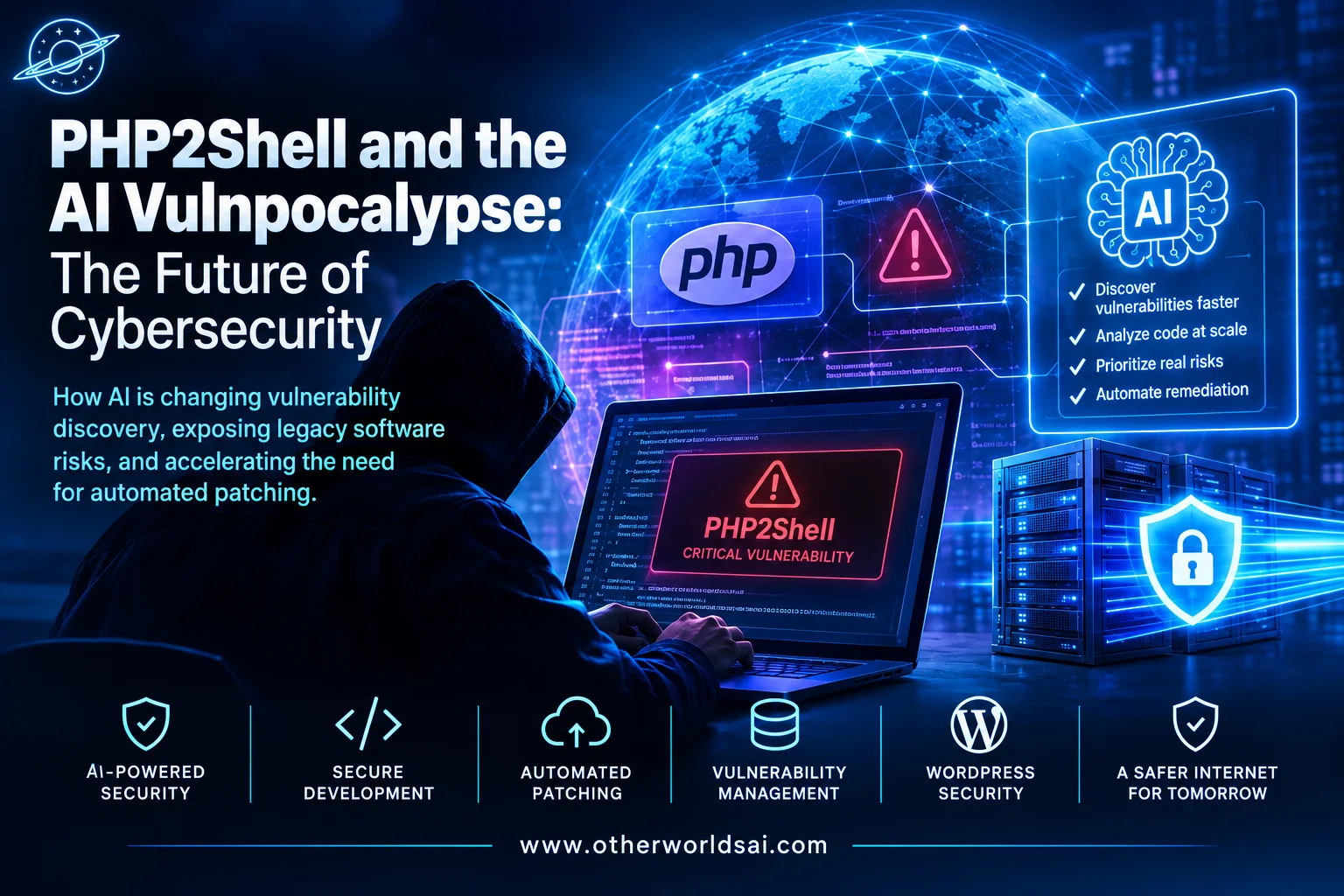
Artificial intelligence is changing the cybersecurity landscape faster than many organizations can adapt. The recent PHP2Shell vulnerability scare exposed the risks hidden in decades-old software, demonstrating how AI-powered security research uncovers critical bugs faster—and potentially helps attackers exploit them at unprecedented speed.
Two critical vulnerabilities in PHP, one of the world's most widely used web development languages, recently triggered an urgent response from security researchers, technology companies, and software maintainers. Some organizations reportedly took websites offline while working to secure affected systems.
This incident raises a larger question: What happens when artificial intelligence discovers software vulnerabilities faster than businesses can identify, patch, and remediate them?
Tomer Schwartz, CTO of Exposure Management and Application Security at Google-owned cybersecurity company Wiz, discussed the incident on TechCrunch's Equity podcast with Rebecca Bellan. The conversation explored the role of AI in discovering vulnerabilities, the challenges of coordinated disclosure, and why traditional manual approaches to cybersecurity are no longer sufficient.
What Is PHP2Shell? Understanding the PHP Security Scare:
PHP powers a massive share of dynamic websites, web applications, content management systems, and e-commerce platforms. Because of this extensive adoption, vulnerabilities in the language carry massive downstream consequences, affecting thousands or millions of installations across hosting providers, businesses, developers, and website owners.
While the name PHP2Shell suggests a pathway to gaining command-line or shell-level access, the precise technical impact, affected versions, and exploitation conditions must always be verified through official security advisories. Nevertheless, the incident highlights a recurring cybersecurity challenge: foundational software components operating smoothly for years can harbor overlooked defects that become major threats when new exploitation methods emerge.
Why PHP Vulnerabilities Matter:
-
Large Attack Surface: PHP powers a substantial portion of the web, including critical CMS and business systems.
-
Legacy Dependencies: Organizations often run older PHP versions or depend on outdated, unmaintained libraries.
-
Remote Exploitation Risks: Attackers can compromise exposed systems without physical access, depending on configurations.
-
Business Disruption: Emergency patching, website downtime, and forensic investigations hurt revenue and consumer trust.
-
Supply-Chain Exposure: A flaw in a shared component creates cascading security risks across downstream applications.
Widely used software requires continuous security assessment—not merely occasional updates when a critical flaw goes public.
How AI Helped Researchers Uncover Critical Vulnerabilities:
One of the most significant aspects of the PHP2Shell story is the role of artificial intelligence in security research. According to the TechCrunch discussion, Schwartz explained that AI was instrumental in accelerating the research effort, helping teams test numerous hypotheses over a single weekend.
Traditional vulnerability research involves reading massive codebases, tracing program execution, examining memory behavior, testing unusual inputs, and analyzing component interactions. This requires deep technical expertise and considerable time.
AI-assisted research changes that economic equation by helping researchers:
Analyze large codebases and spot suspicious patterns.
Generate hypotheses about potential software flaws.
Suggest unconventional inputs that expose unexpected application behavior.
Assist with code review, debugging, and vulnerability triage.
Develop and refine test cases for security analysis.
Explain complex code paths and uncover unsafe assumptions.
When combined with static application security testing (SAST), dynamic application security testing (DAST), and fuzz testing, AI creates a more iterative research process. Instead of checking every code path manually, researchers use AI to evaluate promising hypotheses and validate findings through controlled testing.
AI is not infallible; models can produce false positives, overlook subtle bugs, or suggest incorrect exploitation paths. Human expertise and rigorous validation remain essential. Still, the PHP incident proves that AI-assisted vulnerability discovery is now a core component of modern application security.
The Vulnpocalypse: When AI Accelerates Both Attackers and Defenders:
The term vulnpocalypse describes a potential future where artificial intelligence dramatically increases the rate at which software vulnerabilities are discovered, analyzed, and exploited.
This scenario does not require AI to invent entirely new types of cyberattacks. Instead, AI makes existing security techniques faster, cheaper, and more accessible.
-
For defenders: It means finding critical bugs earlier, testing more code, and prioritizing remediation.
-
For attackers: It means quickly identifying exposed systems, analyzing vulnerable software, adapting exploits, and scaling reconnaissance across massive attack surfaces.
The central crisis is a widening gap between the speed of discovery and the speed of remediation.
A vulnerability can be discovered by an AI-assisted researcher, patched by a vendor within hours, and published. Yet, thousands of websites remain vulnerable because their owners lack software asset inventories, run unsupported versions, rely on incompatible plugins, or lack patch management processes. AI compresses the discovery timeline, but organizations still operate on a manual remediation timeline.
Why Decade-Old Bugs Can Suddenly Become Critical:
The PHP incident revealed a flaw that remained in plain sight for over a decade. Long-lived software is not inherently insecure, but aging codebases accumulate unique risks:
-
Legacy Code and Technical Debt: Years of feature additions, bug fixes, and integrations leave behind poorly documented assumptions. Functions safe under old conditions become vulnerable when new components are introduced.
-
Complex Component Interactions: Flaws often emerge from unexpected interactions between subsystems. A single line of code may look harmless until untrusted input reaches it through a new execution path.
-
Advanced Research Techniques: AI analysis helps researchers explore complex code paths that routine development audits miss.
-
Changing Exploitation Environments: A bug can sit dormant for years until changes in surrounding software or tooling reveal a practical exploitation pathway.
Organizations cannot assume older software is safe simply because it has run without obvious incident. Security must rely on evidence, supported versions, and ongoing testing.

Meta's Next Big Bet: This New App Lets You Build Games Simply by Typing a Prompt
Why Manual Vulnerability Patching Will Not Scale:
Traditional vulnerability management often involves a slow, multi-tiered handoff process: a vendor publishes an advisory, security teams identify affected products, IT scans for installations, developers check compatibility, administrators deploy patches, and security teams verify fixes. Every handoff introduces fatal delays.
AI-driven vulnerability management can automate many of these stages:
-
Advisory Interpretation: Parsing security notices and mapping them against software inventories.
-
Risk Prioritization: Evaluating exploitability, business impact, and exposure levels.
-
Remediation Assistance: Generating proposed patches, configuration adjustments, and verification tests.
However, organizations must avoid giving AI agents unrestricted access to production infrastructure. Human-supervised security automation is essential—using AI to accelerate investigation while requiring human approval for high-impact changes.
Do WordPress Websites and Small Businesses Need to Worry?
Small businesses and WordPress site owners often lack dedicated security teams or automated asset management. Because WordPress is built on PHP, its security depends heavily on PHP versions, core updates, themes, plugins, and hosting configurations.
Support our research
Independent analysis fueled by you.
Immediate Security Checklist for Site Owners:
-
Check Your PHP Version: Confirm through your hosting control panel that your PHP version is actively supported and updated.
-
Update Core, Themes, and Plugins: Install trusted updates promptly and remove unused, vulnerable extensions.
-
Confirm Infrastructure Patching: Ask your managed hosting provider whether necessary runtime mitigations have been deployed.
-
Enable Multi-Factor Authentication (MFA): Secure all administrator dashboards and sensitive access points.
-
Review Logs Regularly: Watch for unauthorized administrator accounts, unusual file modifications, or suspicious outbound connections.
-
Maintain Tested Backups: Keep isolated, recent backups and verify your recovery process works.
-
Deploy a Web Application Firewall (WAF): Use a WAF as an added defensive layer (not as a replacement for patching).
-
Verify Remediation: Confirm installed versions and apply all advisory recommendations.
Coordinated Vulnerability Disclosure: Why Leaks Are Difficult:
The PHP2Shell response underscored the friction of coordinated vulnerability disclosure (CVD). When researchers find a serious flaw, they must notify maintainers, allow time for a fix, and coordinate with stakeholders before publishing details.
When cloud providers, vendors, and hosting companies are all involved, operational constraints and communication gaps can lead to premature leaks. Organizations must prepare for scenarios where vulnerabilities become public before every system is patched, emphasizing the need for robust incident-response and temporary mitigation plans.
How Startups Can Build Secure AI Products From Day One:
For early-stage companies building AI applications and SaaS platforms, postponing security creates expensive technical debt. Startups should bake security into the software development lifecycle early:
-
Adopt Secure Coding Standards: Utilize peer reviews, dependency scanning, and static analysis.
-
Use AI Coding Tools Wisely: Validate AI-generated code suggestions through rigorous testing and expert review.
-
Maintain an SBOM (Software Bill of Materials): Keep an accurate record of application components and dependencies.
-
Automate Dependency Monitoring: Get alerts when underlying libraries require security updates.
-
Govern AI Agents Strictly: Apply least-privilege permissions, isolated execution environments, and explicit approvals for sensitive actions taken by autonomous agents.
How Otherworlds AI Views the Next Phase of AI Cybersecurity:
At Otherworlds AI, the rise of intelligent automation highlights a broader opportunity for businesses to build AI systems that drive efficiency while upholding strict security controls. AI agents can streamline software development, code analysis, and technical workflows when designed responsibly.
However, enterprise AI adoption must account for data privacy, access control, auditability, and autonomous execution risks. Organizations building custom AI models must carefully consider where models run, what data they access, and who controls their execution.
For businesses handling sensitive intellectual property or customer data, private AI infrastructure and governed agent architectures provide crucial advantages.

Move Over Nvidia: Anthropic and Samsung Team Up to Break the AI Chip Monopoly
The goal is not simply adding AI to old software, but building intelligent systems that are secure, maintainable, and engineered for real-world business environments.
Final Thoughts: The Vulnpocalypse Is a Warning, Not an Inevitability:
The PHP2Shell scare reminds us that foundational software can harbor critical vulnerabilities for years. While AI-assisted research accelerates complex code analysis, it also pressures organizations that cannot match that speed.
The potential vulnpocalypse is not an unavoidable collapse of internet security—it is a warning that traditional security practices must evolve. Businesses must prioritize supported software, automated vulnerability monitoring, rapid patching, secure development pipelines, and tested incident response.
In an AI-driven threat landscape, security cannot remain an occasional, manual chore. It must become a continuous process of discovery, verification, and remediation.
Follow Otherworlds AI for more insights into artificial intelligence, AI agents, enterprise technology, software development, and the future of cybersecurity.