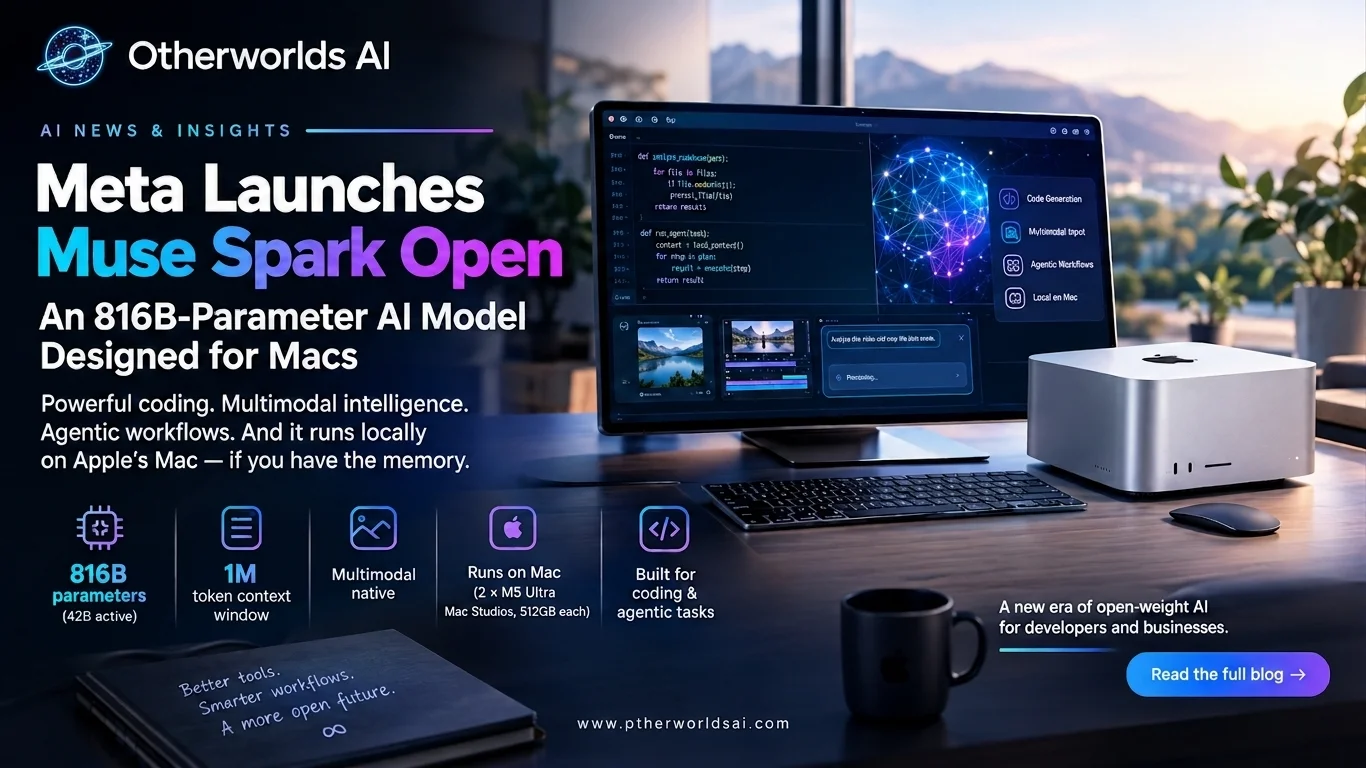

Meta’s Muse Spark Open: A Powerful Open-Weight AI Model for Coding and Local Computing:
Meta’s Muse Spark Open brings advanced coding, multimodal intelligence, and autonomous AI workflows closer to local computing. However, its enormous memory requirements raise important questions about accessibility, cost, and the future of desktop AI.
Artificial intelligence is moving beyond cloud-based chatbots and into the computers developers, designers, and businesses use every day. Meta’s reported introduction of Muse Spark Open, an open-weight AI model designed for complex coding, multimodal workloads, and agentic workflows, highlights this transition.
According to the announcement and reporting surrounding the release, the model features 816 billion parameters and a one-million-token context window. It has also been associated with local deployment on Apple Mac computers, offering the possibility of running advanced AI without relying entirely on cloud services.
However, the model’s reported scale presents a significant challenge. Running it locally could require approximately 1TB of RAM, depending on the configuration and inference method, placing it beyond the capabilities of most ordinary desktop computers.
For developers and businesses, this raises an important question: can powerful open-weight models make private AI, software development, and business automation more accessible?
At Otherworlds AI, we explore what this development could mean for AI-powered software, private infrastructure, and intelligent business workflows.
What Is Meta Muse Spark Open?
Muse Spark Open is presented as an open-weight AI model intended for demanding technical and professional applications. Its reported capabilities extend beyond text generation to coding, multimodal understanding, and AI agents that can perform sequences of tasks.
Open-weight models provide access to trained model weights under specific licensing terms, allowing developers to evaluate, deploy, and integrate them into their own applications.
However, open-weight does not necessarily mean fully open-source. Model weights may be available without providing all training data, training code, or development details.
Businesses should review the applicable licence and commercial-use restrictions before deployment.
Muse Spark Open stands out for three reported characteristics: its enormous parameter count, extended context window, and potential use in local computing environments.
816 Billion Parameters: Why Model Size Matters:
One of the model’s most notable reported specifications is its 816 billion parameters.
Parameters are numerical values learned during training that help an AI model recognise patterns, process information, and generate responses. Although larger models can offer greater capacity for complex tasks, parameter count alone does not determine intelligence or practical performance. Architecture, training quality, inference methods, and benchmark results also matter.
Model size has direct consequences for hardware requirements.
For example:
-
8-bit precision: Approximately 816GB of memory for model weights alone.
-
16-bit precision: Approximately 1.63TB of memory for model weights alone.
These are illustrative calculations based on the reported parameter count, not confirmed minimum requirements for every configuration. Quantisation, specialised architectures, and memory-management techniques can reduce requirements. Additional memory is needed for the runtime, context cache, and other processes.
The practical lesson is that businesses must evaluate whether a model’s capabilities justify its infrastructure costs rather than judging it by parameter count alone.
A One-Million-Token Context Window for Complex Work:
Muse Spark Open reportedly supports a one-million-token context window, allowing it to process a large amount of information within a single interaction or workflow.
This capability could be useful for analysing extensive software repositories, technical documentation, business reports, and interconnected project files.
For example, developers investigating a difficult bug may need to examine requirements, source code, test results, and previous implementation decisions. A large context window could help the model consider more of this information together instead of repeatedly dividing the task into smaller sections.
Businesses could also explore long-context AI for reviewing internal policies, comparing technical documents, and analysing product manuals.
However, a large context window does not guarantee perfect recall or accurate reasoning. Processing extensive information can increase memory consumption, latency, and operating costs. Effective retrieval and the model’s ability to use relevant information remain essential.
Multimodal AI: Beyond Text-Based Conversations:
Muse Spark Open is described as natively multimodal, meaning it is intended to work with different types of information rather than relying exclusively on text.
This matters because professional workflows frequently combine text, code, images, screenshots, and video.
Potential applications include:
-
Analysing screenshots to identify interface problems.
-
Connecting visual references with software development tasks.
-
Understanding supported image and text inputs together.
-
Assisting with media review and creative production.
-
Combining information from different sources to complete complex tasks.
The exact supported formats and capabilities should be confirmed through Meta’s official technical documentation.
For businesses, multimodal AI could reduce the need to translate every task into a text-only prompt, making AI tools more useful within existing professional workflows.
Muse Code: Bringing AI Coding Closer to Developers:
One reported application is Muse Code, an AI coding terminal associated with Meta’s model. Modern coding agents can do more than suggest code. When connected to appropriate tools and permissions, they can inspect repositories, edit files, execute commands, run tests, and investigate errors.
Meta has reportedly demonstrated the model in coding workflows involving fixes and new features for a Mastodon client, including completing a full build.
If independently validated, these capabilities could make AI useful across broader software engineering processes.
Potential applications include:
-
Bug investigation: Examining error messages, code, and test failures to identify likely causes.
-
Feature development: Helping implement requirements across interconnected files.
-
Codebase analysis: Using extended context to understand dependencies and unfamiliar projects.
-
Testing and debugging: Running tests, interpreting failures, and refining proposed changes.
-
Build assistance: Coordinating development steps and checking whether an application builds successfully.
These capabilities should not be interpreted as a guarantee of fully autonomous software development. Human review remains important, especially for security-sensitive code, production systems, and applications handling customer data.
The broader shift is from AI that generates isolated code snippets to AI agents that can participate in an entire development workflow.
Can Muse Spark Open Operate DaVinci Resolve?
Another reported demonstration involves DaVinci Resolve, professional video-editing software, where the model was used in workflows involving footage review and cropping.
This illustrates a growing direction in AI-assisted creative production: using agents to interact with desktop applications through instructions and tool-driven actions.
Potential tasks include identifying relevant footage, locating scenes, reviewing clips, and preparing preliminary editing sequences.
For video editors, the goal is to reduce repetitive work and leave more time for storytelling, pacing, visual consistency, and creative decisions.
However, reliable desktop automation requires an agent to understand instructions, select appropriate tools, execute actions in the correct order, and verify results. Creative judgement also remains difficult to automate completely.
The reported demonstration is therefore an indication of the potential for AI-assisted editing, not proof that the model can independently perform every professional production task.
Meta's Next Big Bet: This New App Lets You Build Games Simply by Typing a Prompt
Why Running AI Locally on a Mac Matters:
Most powerful AI models are accessed through cloud services. Local AI offers another option: running inference on a user's own hardware.
Potential benefits include:
-
Greater data control: Sensitive documents and source code may remain within an organisation’s environment.
-
Reduced API dependence: Local inference can operate without a remote model API, provided the necessary software and hardware are available.
-
More predictable access: Users may avoid some cloud-service interruptions, usage limits, and per-request charges.
-
Customised deployment: Developers can integrate AI into internal applications, subject to licensing and technical constraints.
-
Privacy-oriented workflows: Organisations can reduce the need to transmit sensitive information to external providers.
These benefits are not automatic. Local systems still require security controls, access management, updates, monitoring, and protection against unauthorised access. Applications may also continue using cloud services for certain functions.
Local AI is best understood as a deployment option that can improve control, rather than a universal guarantee of privacy or lower costs.
The 1TB RAM Challenge: Why Most Macs Cannot Run It Easily:
The model’s reported memory requirements are among its most important limitations.
Support our research
Independent analysis fueled by you.
A system with approximately 1TB of RAM is far beyond the specifications of a typical consumer laptop. Even powerful workstations may struggle to accommodate a model of this scale without specialised configurations.
Apple’s Mac Studio family is designed for demanding professional workloads, making it relevant to discussions about desktop AI. However, actual feasibility depends on the specific model, available unified memory, memory bandwidth, inference software, and deployment configuration.
Several approaches could make large models more accessible:
-
Quantisation: Reducing numerical precision to lower memory requirements, potentially affecting accuracy or capability.
-
Model sharding: Distributing model components across multiple devices, with additional coordination and networking overhead.
-
Memory offloading: Moving some components to other memory resources, potentially reducing inference speed.
-
Cloud inference: Running the model on remote infrastructure rather than purchasing specialised hardware.
-
Smaller or distilled models: Using compact alternatives that offer a better balance of performance, affordability, and responsiveness.
For most individuals and small businesses, running a smaller model locally may be more practical than operating the largest available model.
Open-Weight AI vs Proprietary AI: What Is the Difference?
Muse Spark Open also highlights the continuing competition between open-weight and proprietary AI systems.
**Feature:** **:Open-weight AI:** **:Proprietary hosted AI**
Model access: Weights available under applicable licence: Weights generally controlled by provider.
Deployment: May support local or private infrastructure: Commonly accessed through hosted services.
Customisation: Greater deployment flexibility may be available:Depends on provider features
Infrastructure: User may manage hardware and operations:Provider primarily manages infrastructure.
Cost: Hardware, maintenance, and support: Subscriptions, usage fees, or contracts
Data governance: More control possible with suitable deployment: Depends on provider policies and configuration.
Neither approach is automatically superior.
Hosted AI can be convenient and economical when providers offer efficient infrastructure. Open-weight AI can appeal to organisations requiring custom integrations, flexible deployment, or greater control over their computing environment.
The best choice depends on performance, licensing, security, technical expertise, and total cost of ownership.
What Muse Spark Open Could Mean for Businesses:
If the model proves capable and commercially usable under its licence, businesses could explore several applications.
-
- Private software development assistants: Organisations could evaluate private coding assistants for maintaining internal repositories and supporting engineering teams without relying exclusively on external AI APIs.
-
- Internal knowledge assistants: Long-context processing could help analyse technical documentation, product manuals, internal procedures, and project materials. Effective information retrieval and access controls would remain essential.
-
- Creative production support: AI agents could assist with selected video-editing and other professional tasks, reducing repetitive work.
-
- Custom AI agents: Developers could connect models to approved tools, databases, and business software to automate multi-step workflows.
-
- Privacy-sensitive AI infrastructure: Businesses with strict data-governance requirements could assess open-weight deployment as part of a broader private AI strategy. Compliance would need to be evaluated for each use case.
Before adopting a model, businesses should compare accuracy, latency, operating costs, hardware requirements, security, and the amount of human intervention needed.
Challenges Meta Must Still Overcome:
Despite the potential, several questions will influence the model’s practical adoption. Hardware accessibility: Expensive infrastructure could restrict adoption among smaller organisations.
-
Independent performance testing: Real-world evaluations are needed to compare the model with competing systems.
-
Agent reliability: Autonomous systems must handle unexpected outcomes, recognise mistakes, and avoid unsafe actions.
-
Security and privacy: Local execution does not eliminate vulnerabilities in operating systems, tools, plugins, or connected applications.
-
Licensing: Businesses must understand commercial-use, redistribution, and other restrictions.
-
Total cost of ownership: Hardware, electricity, maintenance, engineering time, and administration all contribute to operating costs.
These factors will help determine whether Muse Spark Open becomes a practical business tool or remains primarily useful for research and specialised workloads.
The Future of Desktop AI: From Chatbots to AI Workers:
The broader trend behind Muse Spark Open is the transition from conversational AI to systems capable of participating in real workflows.

Move Over Nvidia: Anthropic and Samsung Team Up to Break the AI Chip Monopoly
Traditional chatbots primarily respond to prompts. AI agents can use connected tools to execute sequences of actions, evaluate intermediate results, and adjust their approach when problems occur.
Imagine an agent investigating a software bug, proposing a fix, running tests, and preparing changes for human review. A creative professional might use an assistant to identify footage and prepare an initial editing sequence.
These systems could help smaller teams accomplish more with fewer repetitive tasks. Their success, however, depends on reliable execution, appropriate permissions, transparent reporting, and human oversight.
The most valuable AI agent will not necessarily be the largest. It will be the one that completes the right tasks accurately, securely, and at a sustainable cost.
Otherworlds AI Perspective: Choosing the Right Model:
At Otherworlds AI, we view developments like Muse Spark Open as part of a wider movement towards flexible, task-oriented AI infrastructure.
Large open-weight models could expand opportunities for customised applications, private assistants, and automated business workflows. However, model size alone should not determine technology choices.
A company building a private coding assistant may prioritise source-code confidentiality and developer-tool integration. A customer-service business may value response speed, affordability, and reliable connections to booking systems or customer relationship management (CRM) platforms. A media company may prioritise visual understanding and compatibility with production software.
For many organisations, a hybrid AI strategy may be the most practical approach: smaller local models for routine tasks, larger models for complex workloads, and carefully controlled cloud services where they offer clear advantages.
The future of business AI will depend on turning model capabilities into dependable, secure, and measurable results.
Final Thoughts:
Meta’s reported Muse Spark Open release highlights the ambition to bring powerful AI capabilities into coding tools, creative applications, and local computing environments.
Its reported 816-billion-parameter scale, one-million-token context window, multimodal capabilities, and agentic workflows make it an interesting development to watch. However, the reported memory demands demonstrate that open-weight availability does not automatically make advanced AI affordable or accessible.
For developers, the model represents another opportunity to explore AI-assisted software engineering. For businesses, it reinforces the importance of evaluating open-weight models as part of a broader strategy for automation, privacy, and customised AI infrastructure.
Ultimately, the next stage of AI adoption will depend on practical performance, affordable deployment, and reliable integration into everyday work.
Follow Otherworlds AI for more insights into artificial intelligence, AI agents, private AI infrastructure, software development, and emerging technologies.