
Meta is making a major move in the global artificial intelligence race.
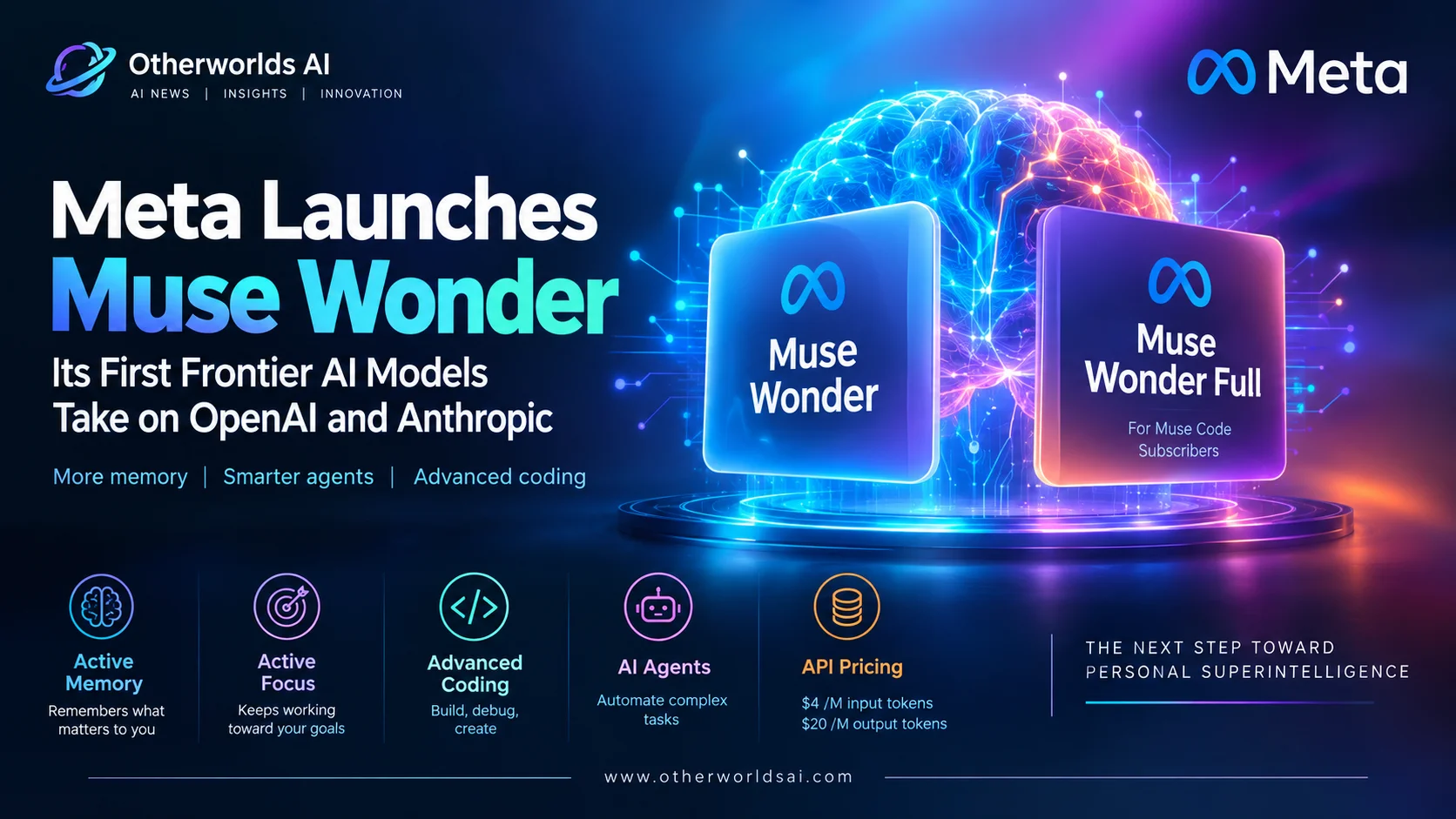
On October 12, 2026, the company introduced Muse Wonder and Muse Wonder Full, two advanced AI models designed to compete with leading systems from OpenAI and Anthropic. The launch marks an important milestone for Meta Superintelligence Labs as the company shifts toward more powerful AI systems capable of handling complex, real-world tasks.
Unlike lightweight AI models designed primarily for speed, Meta's new Muse Wonder models focus on deeper reasoning, advanced coding, long-running tasks, and the ability to remember important information across conversations. The goal is to move beyond simple question-and-answer interactions toward AI assistants that can understand a user's objectives and work toward them over time.
According to Meta's official announcement, the models are designed for personal and professional applications ranging from understanding legal documents and navigating insurance claims to analyzing financial information and developing software applications. For Meta, this is more than another AI model release. It represents a significant step in the company's ambition to establish itself among the leading developers of frontier AI technology.
Meta Muse Wonder: What Makes These New AI Models Different?
Meta has introduced two versions of its new model family: Muse Wonder and Muse Wonder Full. Both are designed to handle demanding tasks, but their availability and intended use differ.
Muse Wonder is the standard model, available through the Meta Model API and Muse Code. It is intended for developers and businesses that want to integrate advanced AI capabilities into applications and workflows.
Muse Wonder Full is Meta's more advanced offering for complex coding and agentic workflows. At launch, it is available exclusively to Muse Code subscribers rather than through the public API.
The distinction matters because businesses increasingly need AI systems that can do more than generate text. They need models that can plan a sequence of actions, use tools, inspect information, adapt to unexpected problems, and complete multi-step assignments. Meta is positioning the Muse Wonder family around precisely these requirements.
Muse Wonder vs. Muse Wonder Full: Key Differences
Feature: Muse Wonder: Muse Wonder Full
Primary purpose: Advanced AI tasks and agent development:More demanding coding and agent workflows
API access: Available: Not available at launch
Muse Code: Available: Available to subscribers
AI memory: Active Memory: Active Memory
Complex task handling: Advanced: Designed for the most demanding workflows
API pricing: $4 per million input tokens; $20 per million output token:Subscription-based access through Muse Code
The pricing and access information is based on Meta's launch materials. The company has not positioned Wonder Full as a separately priced, token-based API product.
Active Memory: Teaching AI to Remember What Matters:
One of the most important features of Muse Wonder is Active Memory, a capability designed to help AI retain relevant information across conversations and bring it back when needed.
Traditional AI interactions often require users to repeat background information, preferences, project requirements, and previous decisions. This can make AI less useful for ongoing work, especially when a task takes several days or involves many separate steps.
Active Memory aims to reduce that friction.
For example, imagine a business owner using an AI assistant to develop a marketing strategy. Over several weeks, the assistant might need to keep track of the company's target audience, advertising budget, preferred writing style, previous campaign results, and future objectives.
Instead of treating every conversation as an isolated request, an AI system with effective memory could use relevant information from earlier interactions to provide more consistent assistance.
Potential applications include:
-
Personal AI assistants: Retaining relevant preferences and ongoing goals.
-
Business operations: Maintaining context across recurring tasks and projects.
-
Software development: Keeping track of requirements, code changes, and previous debugging attempts.
-
Financial analysis: Working with information across multiple documents and related tasks.
-
Legal and administrative work: Using relevant details from contracts, records, and earlier discussions.
Meta also highlights MemoryBench in its discussion of model memory. This benchmark evaluates aspects of memory construction and continual learning. Meta reports strong results for its new models, although the company's benchmark claims should be interpreted in the context of the evaluation methods and results it publishes.
The broader significance is clear: persistent context could make AI assistants more useful for work that cannot be completed in a single prompt.
Active Focus: AI Agents That Keep Working Toward a Goal:
Memory is only one part of Meta's strategy. The company has also introduced Active Focus, a capability intended to help Muse Wonder remain oriented toward a user's objective when a task becomes difficult.
An ordinary chatbot might explain how to build an application or troubleshoot a software problem. An advanced AI agent could potentially take additional steps: inspect the relevant files, attempt a solution, run tests, identify errors, and try another approach.
Meta describes its new models as capable of working through obstacles, recovering from errors, and asking for clarification when necessary. The models are also designed to check with users before carrying out important actions.
Consider a practical business example. A company wants to automate a customer onboarding process. The task might require reviewing submitted documents, checking required fields, updating a business system, preparing a confirmation message, and identifying missing information.
An AI agent built around a capable model could coordinate these steps instead of simply describing the process.
However, the quality of the final result still depends on the tools available to the agent, the permissions it receives, the accuracy of its information, and the safeguards implemented by its developers. Agentic capabilities do not guarantee that every task will be completed correctly.
This distinction is particularly important as companies move from experimenting with AI chatbots to deploying AI agents in operational environments.
Meta Muse Wonder vs. OpenAI and Anthropic: The Frontier AI Competition:
The launch places Meta more directly in competition with OpenAI and Anthropic.
Meta says its internal evaluations show Muse Wonder and Muse Wonder Full achieving competitive results against models including GPT-6 Astra and Claude Fable 5.1. Its research materials also highlight coding and agent-oriented benchmarks.
These claims are significant, but they require context. Benchmark performance can vary depending on the model configuration, testing methodology, tool access, evaluation dataset, and scoring procedure. Results reported by a model developer should not automatically be treated as independent proof that one model is better across every task.
The more meaningful comparison is how these systems perform in actual workflows.
For businesses and developers, the important questions include:
- Can the model solve complex problems reliably?
- Does it produce working code and recover from errors?
- Can it maintain useful context during long-running tasks?
- How well does it use external tools and business software?
- What does it cost to complete a real task?
- Can its outputs be reviewed, secured, and audited?
The frontier AI market is increasingly defined by these practical considerations rather than by a single benchmark score.

Anthropic’s Surprise Double Launch Directly Targets OpenAI and Google’s AI Dominance
Meta's launch signals that it wants to compete at this level, offering models designed for coding, professional assistance, and AI agents rather than focusing exclusively on lightweight conversational AI.
Muse Wonder API Pricing: What Developers Need to Know:
Pricing is an important consideration for businesses deciding which AI model to integrate into their products.
Meta has announced the following pricing for Muse Wonder through the Meta Model API:
- API usage Price
-
Input tokens - $4 per million
-
Output tokens - $20 per million
Input tokens generally represent the text and other supported content supplied to the model, while output tokens represent the content it generates.
The difference matters because AI applications can generate substantial costs when they process long documents, handle repeated conversations, or produce lengthy responses. For illustration, an application processing one million input tokens and generating 100,000 output tokens would incur approximately $6 in token charges at these listed rates, assuming no other fees or pricing adjustments apply.
The calculation is:
-
Input: 1 million tokens × $4 = $4.
-
Output: 100,000 tokens × $20 per million = $2.
-
Estimated total: $6.
This is an illustrative calculation, not a prediction of the cost of any particular application. Actual spending depends on usage patterns, model calls, and any additional charges.
Support our research
Independent analysis fueled by you.
Muse Wonder Full follows a different access model because it is available through Muse Code subscriptions rather than the Meta Model API at launch.
For developers, this creates two distinct routes: API integration for applications built around Muse Wonder, and subscription-based access to the more advanced Wonder Full model through Muse Code.
What Does Muse Wonder Mean for Businesses?
The launch reflects a broader shift in enterprise AI: companies are looking for systems that can contribute to workflows, not merely answer questions.
- Software Development and Coding:
Advanced coding models can help developers generate code, investigate errors, understand unfamiliar projects, and automate parts of software development. If these capabilities prove reliable in real-world use, businesses may be able to reduce time spent on repetitive programming work while allowing engineers to focus on architecture, testing, and more complex decisions.
- Customer Service and Business Automation:
AI agents could help businesses manage customer questions, organize information, prepare responses, and coordinate routine tasks across connected software systems. For service businesses, the value comes from reducing repetitive manual work and improving responsiveness. Successful deployment, however, requires reliable integrations, suitable permissions, and human oversight for sensitive or consequential decisions.
- Finance and Document Analysis:
Businesses routinely work with invoices, contracts, financial reports, and other documents containing information that must be compared and interpreted. More capable AI models could help extract relevant details, summarize records, identify inconsistencies, and prepare preliminary analyses. Financial decisions should still involve appropriate professional review.
- Legal and Administrative Work:
AI models can assist with document review, contract summarization, information retrieval, and the organization of case-related materials. These uses can save time, but AI-generated legal interpretations must be checked by qualified professionals. Confidentiality and data-handling requirements also need to be considered before uploading sensitive documents.
- Long-Term AI Assistance:
Active Memory and Active Focus point toward assistants that can support continuing projects rather than handling isolated questions.
This could prove valuable for entrepreneurs, marketing teams, researchers, software developers, and professionals managing several related tasks over time.
The commercial opportunity will depend on whether these systems deliver measurable improvements in accuracy, productivity, and operating costs.
Meta's AI Strategy: From Muse Spark to Frontier Models:
Muse Wonder builds on Meta's earlier work with Muse Spark, a lightweight model intended to deliver responsive AI experiences.
The new models are larger and designed to support more demanding workloads. Their launch also follows the restructuring of Meta's AI organization and the company's renewed push to develop more capable systems under Meta Superintelligence Labs.
The strategic objective is to connect advances in AI research with products that people and businesses can use directly.
Meta already operates a large ecosystem of consumer and business products. More capable AI models could potentially strengthen its assistant offerings, developer tools, and software-based services.
At the same time, building frontier AI models requires substantial computing infrastructure, research investment, specialized talent, and ongoing safety work.
Meta's ability to translate model performance into dependable products will therefore be just as important as its initial benchmark results.
AI Safety, Privacy, and Responsible Deployment:
As AI agents become more capable, privacy and security become increasingly important. An assistant that can work across documents, calendars, messages, and business applications may need access to sensitive information. If it can also perform actions, mistakes can have consequences beyond an inaccurate text response.
Meta says it has trained the Muse Wonder family to avoid sharing private information without permission, refuse harmful requests, and improve security against cyberattacks. The company also says its most capable models are developed and evaluated under its Superintelligence Scaling Framework. Additional safety evaluation details are expected in its launch materials.
For organizations considering advanced AI agents, several safeguards remain essential: Apply the principle of least privilege when granting access to systems and data.
-
Require human approval for consequential or irreversible actions.
-
Keep audit logs of important agent activities.
-
Test model outputs and tool use before production deployment.
-
Establish clear policies for confidential data and retention.
-
Monitor for prompt injection, unauthorized actions, and other security failures.
These practices are necessary regardless of which AI model a business chooses.

Meta's Next Big Bet: This New App Lets You Build Games Simply by Typing a Prompt
The Future of AI Agents: What Comes Next?
The introduction of Muse Wonder and Muse Wonder Full highlights a change in the direction of AI development. The industry is moving beyond models evaluated primarily as conversational systems toward models designed to operate as components of larger, tool-using workflows.
For developers, this creates opportunities to build more sophisticated AI applications. For businesses, it raises the possibility of automating selected processes that previously required substantial manual coordination.
For Meta, the challenge is to demonstrate that its new models can deliver consistent results at scale and turn advanced capabilities into useful, trusted products.
The launch is an important milestone, but it is not the end of the competition. Independent evaluations, real-world reliability, pricing, integration options, and safety will help determine how these models compare with other frontier AI systems over time.
Final Takeaway:
Meta Muse Wonder and Muse Wonder Full represent a major step in Meta's effort to compete in frontier AI. Their emphasis on active memory, persistent focus, coding, and agentic workflows reflects the industry's growing interest in AI systems that can help complete complex tasks—not simply generate answers.
Whether Meta can turn these capabilities into a lasting competitive advantage will depend on performance in real-world applications.
Follow Otherworlds AI for the latest AI news, frontier model launches, enterprise AI developments, and practical insights into the future of intelligent automation.
Visit: www.otherworldsai.com