
Google Unveils Gemini 3.8 Flash TTS Voice Models: Direct Performance Scripting & Next-Gen Audio Production:
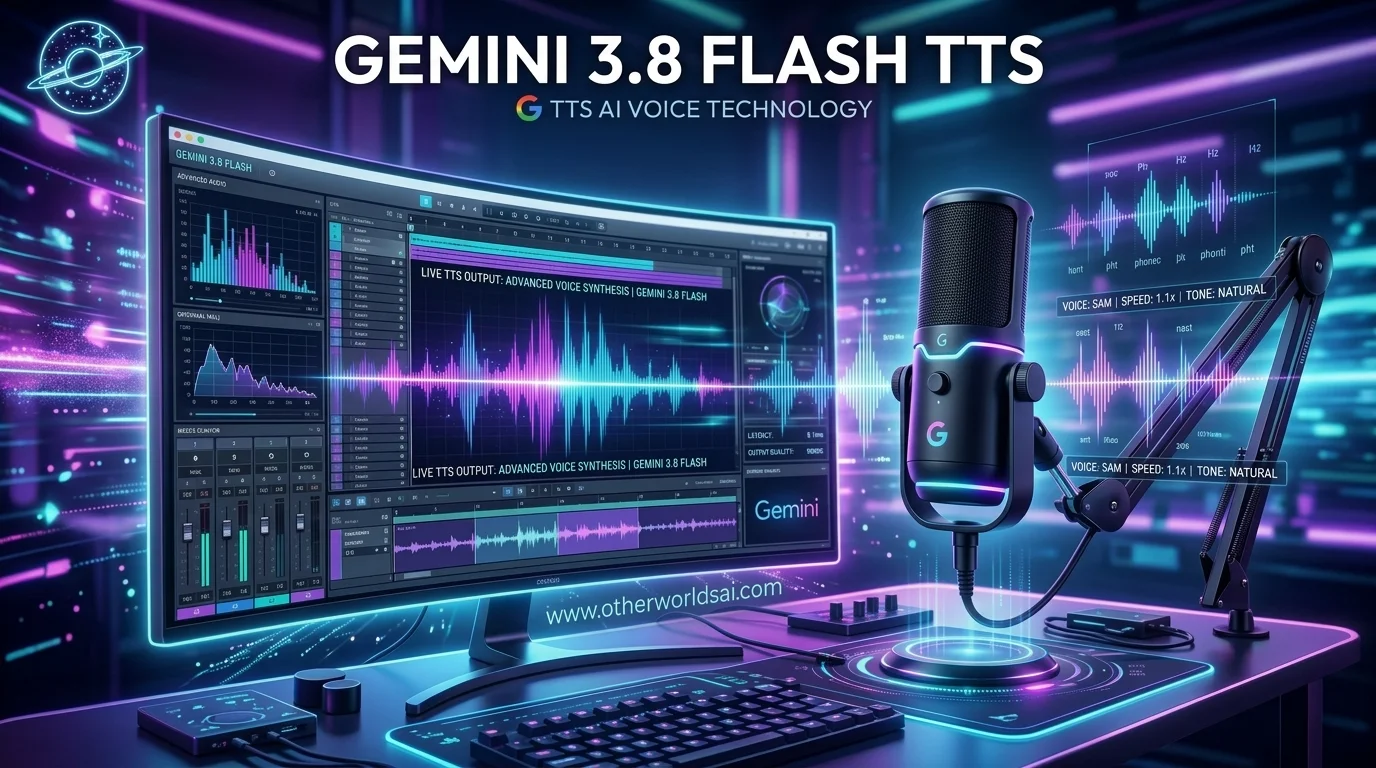
Google has officially expanded its generative audio portfolio with the release of two dedicated speech generation models: Gemini 3.8 Flash TTS and Gemini 3.8 Flash-Lite TTS.
Designed to meet the demands of direct performance scripting and high-volume audio production, these models split vocal synthesis tasks between high-level creative direction and cost-optimized infrastructure.
As generative audio and AI-driven spatial environments continue to evolve, Otherworlds AI explores how these developments impact creative workflows, interactive storytelling, and real-time voice integration.
Dual Model Architecture: Creative Direction vs. Scalable Automation:
Google’s dual-release strategy addresses two distinct operational needs within modern speech generation workflows:
-
Gemini 3.8 Flash TTS: Engineered for prompt-based vocal design, interactive entertainment, game development, and long-form narrative production where precise artistic control and emotional resonance are required.
-
Gemini 3.8 Flash-Lite TTS: Tailored for high-throughput pipelines, automated media dubbing, real-time customer conversational agents, and continuous translation tasks.
These releases build upon Google’s existing audio infrastructure—which includes Gemini 3.5 Live Translate, Gemini 3.5 Transcribe, Gemini 3.8 Live, and Gemini 3.8 Live Extended Thinking—effectively replacing a legacy catalogue of 30 fixed static voices.
Key Capabilities & Architectural Features:
- Extensive Linguistic Directory & Voice Remixing:
Developers gain access to an expanded directory of over 2,000 pre-built vocal profiles across more than 100 languages, featuring regional variations such as Quebec French, Scots English, and Mexican Spanish. Additionally, a planned voice remixing module will allow engineers to fine-tune pitch, timbre, pace, and accent contours using natural language text prompts.
- Multi-Speaker Staging & Long-Form Stability:
The models support multi-speaker staging directly within single scripts. Key features include:
-
Natural Conversational Dynamics: Seamless turn-taking and distinct vocal separation across multi-speaker exchanges.
-
Extended Synthesis Stability: Maintained character timbre and acoustic stability over multi-hour runs, minimizing degradation in audiobooks and episodic podcasts.
- Non-Verbal Acoustic Markers & Expressive Tags:
Production scripts can now incorporate inline acoustic markup for natural expressiveness:
Why Google’s New Free Gemini Feature Is a Massive Wake-Up Call for Businesses
-
Acoustic Tags: Drop non-verbal markers directly into scripts, such as
, , or . -
Verbal Interjections: Insert reactive timing markers like |mhm| and |yeah| to balance conversational cadence.
Benchmark Performance & Quality Rankings:
In independent third-party evaluations, the new models achieved leading positions across multiple speech metrics:
Support our research
Independent analysis fueled by you.
-
Hume AI Voice Design Benchmark: Gemini 3.8 Flash TTS secured an overall score of 71.4, alongside a category-leading 60.8 in accent modelling.
-
Hume AI Overall Quality Index: Gemini 3.8 Flash TTS captured first place, while Gemini 3.8 Flash-Lite TTS took second place, outperforming previous baselines set by Gemini 3.1 Flash TTS.
-
Voice Arena Human Trials: Double-blind preference evaluations demonstrated strong performance across regional variations including Japanese, Brazilian Portuguese, Vietnamese, Modern Standard Arabic, Mexican Spanish, and Hindi.
Safety Controls, Authenticity & Provenance:
To mitigate impersonation risks and manage voice cloning responsibly, Google has implemented multi-layered identity and verification controls:
-
Consent Verification: Custom vocal replication requires a 30-second reference recording along with an explicit verbal consent track spoken by the voice owner. Acoustic alignment between both inputs is validated before profile creation.
-
Watermarking & Provenance: Audio exports embed imperceptible SynthID watermarks alongside cryptographic C2PA metadata directly into the waveform to ensure asset origin traceability.
Developer Access & Enterprise Ecosystem Deployment:
Integration across developer environments and enterprise platforms is currently rolling out:
Meta's Next Big Bet: This New App Lets You Build Games Simply by Typing a Prompt
-
Developer API & Frameworks: Available via Google AI Studio and the standard Gemini API, with support for frameworks including Agora, LiveKit, Pipecat, and Vercel.
-
Commercial Integrations: Early adopters across localization, media, and support include Figma, HeyGen, Linguana, Wondercraft, 99.co, and Ollang.
-
End-User Applications: Flash TTS is integrated into Gemini Notebook, while Flash-Lite TTS powers vocal generation in Google Vids. Administrative API access for Gemini Enterprise accounts will follow in upcoming deployment phases.