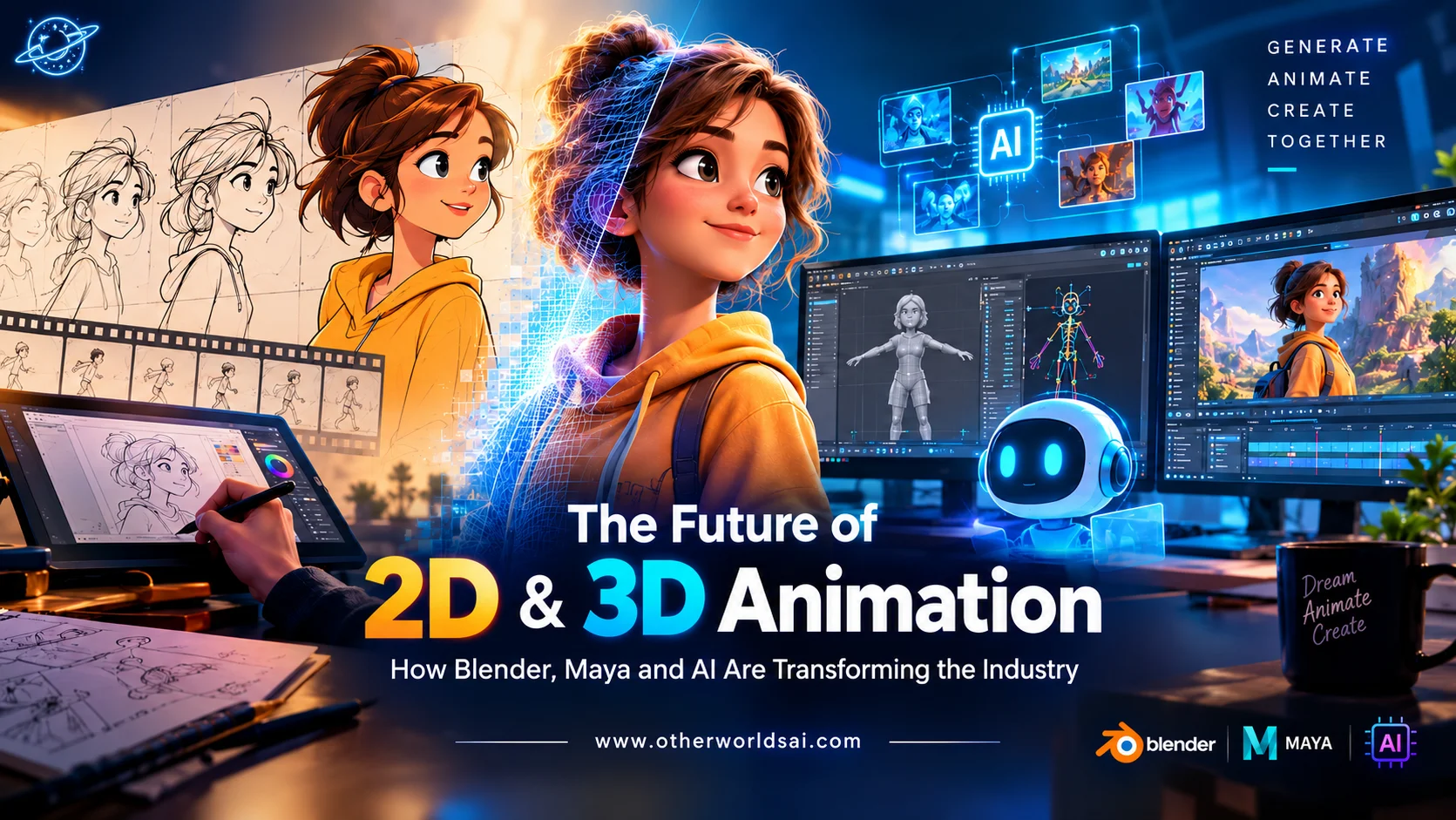

The Future of 2D & 3D Animation: Blender, Maya and AI Animation Tools in 2026:
Introduction:Animation Is Entering a New Creative Era:
Animation has always been about bringing imagination to life. From hand-drawn cartoon characters and traditional 2D storytelling to realistic 3D environments, cinematic visual effects and interactive digital worlds, the industry has continuously evolved with technology.
Today, animation is experiencing another major transformation.
Artificial intelligence is entering almost every stage of the production process. Tasks that once required hours of manual work can now be accelerated with AI-powered tools. Character creation, background design, motion generation, lip synchronization, texturing and even video production are becoming faster and more accessible.
However, this doesn't mean traditional animation software is becoming irrelevant. Quite the opposite. Professional tools such as Blender and Autodesk Maya remain essential to serious animation production, while AI is opening new possibilities for artists working with these platforms.
For animation studios, game developers, filmmakers, advertising agencies and digital content creators, the real opportunity lies in combining artistic experience with intelligent technology.
Let's explore how 2D and 3D animation work, which tools professionals use, and how the latest AI developments are changing the future of this creative industry.
1. Understanding 2D Animation: Where Every Frame Tells a Story:
2D animation is one of the oldest and most recognizable forms of animation. It creates the illusion of movement through a sequence of two-dimensional images, illustrations or digitally created characters.
Traditional 2D animation involved drawing individual frames by hand. Animators carefully created character poses, expressions and movements, ensuring that each frame connected naturally with the next.
Today, digital technology has made this process more efficient without taking away its artistic character.
Where is 2D animation used?
-
Animated cartoons and television series.
-
Explainer videos and educational content.
-
Advertising campaigns and promotional videos.
-
Mobile games and independent video games.
-
Motion graphics and social media content.
-
Children's entertainment and storytelling.
-
Character-based brand communication.
Popular 2D animation tools:
-
Toon Boom Harmony: One of the leading professional solutions for television and studio-based 2D animation. It supports traditional frame-by-frame animation, digital rigging, compositing and advanced character animation workflows.
-
Adobe Animate: A widely used tool for creating interactive animations, web content, animated characters, banners and educational videos.
-
TVPaint Animation: Particularly useful for artists who prefer a traditional hand-drawn animation approach. Its frame-by-frame workflow provides extensive artistic freedom.
-
Adobe After Effects: Commonly used for motion graphics, visual effects, animated typography and compositing. It is especially valuable when combining illustrations, graphics and video.
Although AI tools can now generate images and animated sequences, the creative decisions behind character design, storytelling, timing and visual expression remain important parts of professional 2D animation.
2. 3D Animation: Creating Digital Worlds That Feel Real:
While 2D animation works with flat images, 3D animation creates characters, objects and environments inside a three-dimensional digital space.
Artists build models, apply textures, create skeletons, define movement, arrange lighting and render the final scenes.
This process gives animators the ability to move cameras around characters, create realistic environments and produce complex visual sequences.
3D animation has become an essential part of modern entertainment and digital production.
Major applications of 3D animation include:
-
Feature films and animated television.
-
Video games and interactive entertainment.
-
Product advertisements and commercial videos.
-
Architectural visualization.
-
Automotive animation and product demonstrations.
-
Industrial simulations and training.
-
Medical and scientific visualization.
-
Virtual production and visual effects.
Two of the most important software platforms in this industry are Blender and Autodesk Maya.
3. Blender: Powerful 3D Animation Without Expensive Software Barriers:
<PRIVATE_PERSON> is an open-source 3D creation platform that has developed into one of the most capable tools in the animation industry.
Blender allows artists to manage almost the entire 3D production pipeline within a single application.
Its capabilities include:
-
3D modeling and sculpting.
-
Character design and rigging.
-
Character and object animation.
-
Physics and particle simulations.
-
Lighting and rendering.
-
Visual effects and compositing.
-
Motion tracking.
-
Procedural modeling through Geometry Nodes.
One of Blender's biggest advantages is accessibility. Because it is open source, independent artists, small studios, freelancers and large production teams can use it without purchasing a traditional commercial software license.
Blender 5.2 LTS: What's New in 2026?
Blender continues to evolve, and its July 2026 release of Blender 5.2 LTS introduced several useful improvements.
Some important developments include:
-
Improved Geometry Nodes functionality.
-
Experimental procedural physics approaches for hair and cloth simulations.
-
Improvements to Cycles rendering and materials.
-
Expanded Grease Pencil capabilities.
-
Remote hosting support for Asset Libraries.
-
Improvements to animation and video editing workflows.
The LTS release also provides a longer support cycle, making it attractive for studios that need stability in ongoing productions.
For animation studios, Blender offers a flexible foundation for building characters, environments, visual effects and complete animated productions.
4. Autodesk Maya: A Professional Standard for Character Animation:
<PRIVATE_PERSON> Maya is another major name in professional 3D animation, particularly in film production, television, visual effects and game development.
Unlike tools that focus primarily on general 3D creation, Maya has a particularly strong reputation for character animation, rigging and complex production pipelines.
Professional artists use Maya to create detailed character performances, realistic movement and sophisticated digital environments.
Key Maya capabilities include:
-
Advanced character modeling.
-
Character rigging and skinning.
-
Keyframe and motion capture animation.
-
Facial animation.
-
Dynamic simulations.
-
Visual effects and procedural workflows.
-
Scene management and production integration.
Maya is especially useful when projects require detailed control over character movement and performance.
The important development: Maya's AI-powered MotionMaker:
One of the most interesting developments in 2026 is Autodesk's expansion of MotionMaker, its AI-powered character animation system.
MotionMaker can generate foundational character movement from high-level direction. It supports human characters, dogs and horses, helping artists create movement without manually animating every motion cycle.
An especially interesting development is MotionMaker's Bring Your Own Data capability. Professional studios can train custom motion models using their own motion-capture and keyframe animation libraries.
The generated animation remains editable, allowing artists to refine movement using familiar Maya tools.
This is a significant change: AI is no longer just generating visual content; it is becoming part of the actual character animation pipeline.
5. The AI Animation Revolution: A New Generation of Creative Tools:
Perhaps the biggest development in animation today is the speed at which AI-powered creative platforms are emerging.
Previously, creating a high-quality animated sequence could require multiple artists working across modeling, rigging, animation, lighting, rendering and compositing.
AI is beginning to automate or accelerate selected stages of this process.
A designer can now start with a written description, a reference image or a short video and use AI to generate visual concepts, characters, backgrounds and animated sequences.
Here are some important AI technologies and platforms changing the industry.
A. Autodesk Flow Studio: Bringing AI and 3D Production Together:
Autodesk Flow Studio is an interesting example of how traditional 3D production is merging with generative AI.
Its development has moved beyond simple AI video generation.
In April 2026, Autodesk introduced AI Rigging and Neural Layer capabilities, allowing creators to automatically rig generated characters, animate them and refine their shots. In August 2026, Autodesk introduced its 3D Editor and Canvas expansion.
This is particularly interesting because creators can work directly with 3D scenes, characters, cameras and environments while using AI for rendering and creative refinement.
Meta's Next Big Bet: This New App Lets You Build Games Simply by Typing a Prompt
The goal is to combine the speed of AI generation with the control of a traditional 3D production environment.
B. Runway: AI-Powered Video and Creative Production:
Runway has become an important name in generative video technology.
Its AI-powered video creation capabilities help creators transform written prompts and reference images into moving visual sequences.
Potential applications include:
-
Advertising and promotional videos.
-
Cinematic concept development.
-
Visual storytelling.
-
Background and environment creation.
-
Creative video experiments.
-
Previsualization for film production.
**Rather than replacing a complete animation pipeline, **these tools can help studios explore ideas and produce initial visual concepts much faster.
C. AI-Assisted 3D Modeling and Asset Generation:
Creating 3D models has traditionally required considerable time and technical expertise. AI-powered 3D generation is changing this process.
Tools and technologies such as Autodesk Flow Studio's Wonder 3D and Trellis 2 are helping creators explore 3D asset generation from text and image references.
Other emerging AI-assisted workflows are focusing on:
- Generating 3D objects from images.
- Creating textures and materials.
- Building digital environments.
- Producing preliminary character models.
- Accelerating asset development.
- Supporting procedural 3D workflows.
The biggest opportunity is not simply generating an object. It is making that object suitable for use in a professional production pipeline, with clean geometry, appropriate topology, materials and rigging.
D. AI-Powered Character Animation and Motion Capture:
Character animation is one of the most demanding parts of 3D production.
A convincing character needs natural body movement, facial expressions, balance, timing and believable interaction with its surroundings.
AI-powered motion generation and video-based motion capture can help artists accelerate these tasks.
Support our research
Independent analysis fueled by you.
Instead of manually creating every movement, animators can use AI to generate a starting point and then refine the performance.
This is particularly valuable for:
-
Game character animation.
-
Background characters.
-
Crowd animation.
-
Animal movement.
-
Digital avatars.
-
Previsualization and cinematic sequences.
E. AI-Assisted Facial Animation and Lip Synchronization:
Facial animation is another area experiencing rapid development.
AI-powered tools can analyze speech, audio or reference footage to help synchronize character mouth movements and facial expressions.
These technologies are useful for animated films, virtual presenters, digital characters, educational videos and multilingual content.
They can reduce repetitive manual work, although professional facial animation still requires artistic refinement when emotional accuracy and realistic performance matter.
6. Traditional Animation vs AI Animation: Why the Best Approach Combines Both:
It is tempting to think that AI will eventually replace traditional animation software. However, professional production is more complicated than simply generating an image or video from a prompt.
AI can generate impressive results, but maintaining consistency across multiple shots, controlling character movements, adjusting camera angles and making precise revisions can still be challenging.
Traditional 3D software offers something that generative video tools do not always provide: detailed control over the production environment.
**Consider the following comparison:**
Production area: Traditional approach: AI-assisted approach
Character design: Manual digital design: AI-generated concepts
3D modeling: Manual modeling and sculpting: Image-to-3D generation
Rigging: Artist-created skeletons: Automated AI rigging
Animation: Keyframes and motion capture: AI motion generation
Texturing: Manual material creation: AI-assisted textures
Backgrounds: Manual environment design: AI-generated environments
Lip sync: Manual facial animation: AI-assisted synchronization
Rendering: Traditional render engines: AI-assisted rendering and refinement
The strongest workflow is often a hybrid one.
For example, an artist might generate a character concept with AI, develop the final model in Blender or Maya, create a professional rig, use AI-assisted animation for initial movement, and then refine the performance manually.
This approach combines speed with artistic control.
7. How AI Is Changing the Animation Production Pipeline:
The impact of AI becomes clearer when we look at the complete production process.
Stage 1: Concept Development:
AI image-generation tools can help artists explore character designs, environments, colour palettes and visual styles.
Stage 2: Storyboarding and Previsualization:
AI can help develop visual references, scene concepts and preliminary animated sequences before full production begins.
Stage 3: Modeling and Asset Creation:
AI-assisted 3D tools can accelerate the creation of objects, environments and preliminary character models.
Stage 4: Rigging and Animation:
Automated rigging, AI-generated movement and motion capture can reduce repetitive technical work.
Stage 5: Lighting and Rendering:
Traditional rendering software remains essential, while AI-assisted workflows can help with visual refinement and production efficiency.
Stage 6: Compositing and Final Editing:
AI video tools can support background replacement, visual cleanup and other post-production tasks.
However, the final result still needs human review to ensure visual consistency, technical quality and storytelling continuity.
8. What Does This Mean for Animation Studios and Game Developers?
The combination of traditional animation and AI is creating new opportunities for production studios.
Companies no longer need to approach every project using exactly the same production structure.
A studio can use traditional 3D pipelines for important hero characters and complex cinematic sequences while using AI-assisted tools to accelerate background assets, early concepts and repetitive animation tasks.
This can help production teams:
-
Reduce development time.
-
Explore more creative directions.
-
Improve production flexibility.
-
Accelerate asset creation.
-
Support larger projects with existing teams.
-
Deliver more visual variations.
-
Focus more time on artistic quality.
For game developers, AI-assisted character animation and asset creation can help accelerate prototyping and world-building.
For advertising agencies, hybrid animation workflows can make it easier to explore different concepts and visual approaches.
For filmmakers, AI can support previsualization, virtual production and selected visual effects tasks.
The key is knowing where automation adds value and where experienced artists must remain directly involved.
9. The Challenges: AI Still Needs Artists:
Despite the impressive progress, AI animation is not without limitations.
Move Over Nvidia: Anthropic and Samsung Team Up to Break the AI Chip Monopoly
Professional studios must consider several important challenges.
-
Character consistency: A character should look and behave consistently across multiple scenes and camera angles.
-
Animation quality: Generated movements may require corrections to achieve natural timing, weight, balance and emotional expression.
-
Production control: Clients frequently request specific revisions. Professional software must allow artists to make precise changes rather than regenerate entire scenes.
-
Copyright and licensing: Studios need to understand the rights associated with training data, generated content, commercial usage and third-party assets.
-
echnical compatibility: AI-generated assets may require additional work before they can be used in Blender, Maya, Unreal Engine or other production environments.
-
Human creativity: Technology can accelerate production, but storytelling, artistic direction and emotional connection remain fundamental to successful animation.
The future belongs to studios that understand both the creative and technical sides of this transformation.
10. The Future of Animation: What Should We Expect Next?
Looking ahead, the animation industry is likely to move towards increasingly integrated production environments.
Instead of switching between dozens of disconnected applications, artists will increasingly work with interconnected tools that combine AI generation, 3D modeling, animation, rendering and post-production.
We can expect continued progress in several areas:
- More realistic AI-generated character movement.
- Improved text-to-3D and image-to-3D workflows.
- AI-assisted character rigging.
- More controllable generative video.
- Real-time animation and rendering.
- Intelligent virtual production environments.
- Better integration between AI tools and professional 3D software.
- More advanced digital humans and interactive characters.
The development of custom AI models trained on studio-owned animation data is particularly interesting. It could allow production companies to develop workflows that reflect their own artistic styles and established animation standards.
This could become an important competitive advantage for studios working on long-term film, television and game projects.
Conclusion: The Future Is Not AI vs Artists — It Is AI Working With Artists
The animation industry is not abandoning its traditional foundations. Instead, it is expanding them.
Blender and Autodesk Maya continue to provide powerful creative environments for professional 3D production. Traditional 2D animation software remains essential for hand-drawn storytelling, illustration and expressive character design.
At the same time, AI tools are making it possible to explore new ideas, accelerate repetitive tasks and experiment with creative approaches that were previously expensive or time-consuming.
The real transformation is happening when these technologies work together.
For animation studios, the opportunity is to combine experienced artists, established production pipelines and emerging AI capabilities to deliver better visual experiences.
At Otherworlds Studio, we believe the next generation of animation will be built around this combination of creativity, technical expertise and intelligent production workflows.
Whether it is 2D character animation, complex 3D modeling, cinematic visual effects, character rigging or AI-assisted production, the objective remains the same: bringing ideas to life through compelling visual storytelling.
Technology may change how animation is produced, but creativity will always determine what makes it memorable.
Explore the possibilities with Otherworlds Studio.
From 2D and 3D animation to character design, rigging, lighting, rendering and AI-assisted production workflows, the future of visual storytelling offers exciting opportunities for businesses, game developers and creative studios.
Website: www.otherworldsai.com
1.https://blogs.autodesk.com/media-and-entertainment/2026/09/16/au-2026/?utm_source=chatgpt.com
2.https://adsknews.autodesk.com/en/news/direct-ai-3d-editor-canvas-flow-studio/?utm_source=chatgpt.com
3.https://www.blender.org/press/blender-5-2-lts-release/?utm_source=chatgpt.com