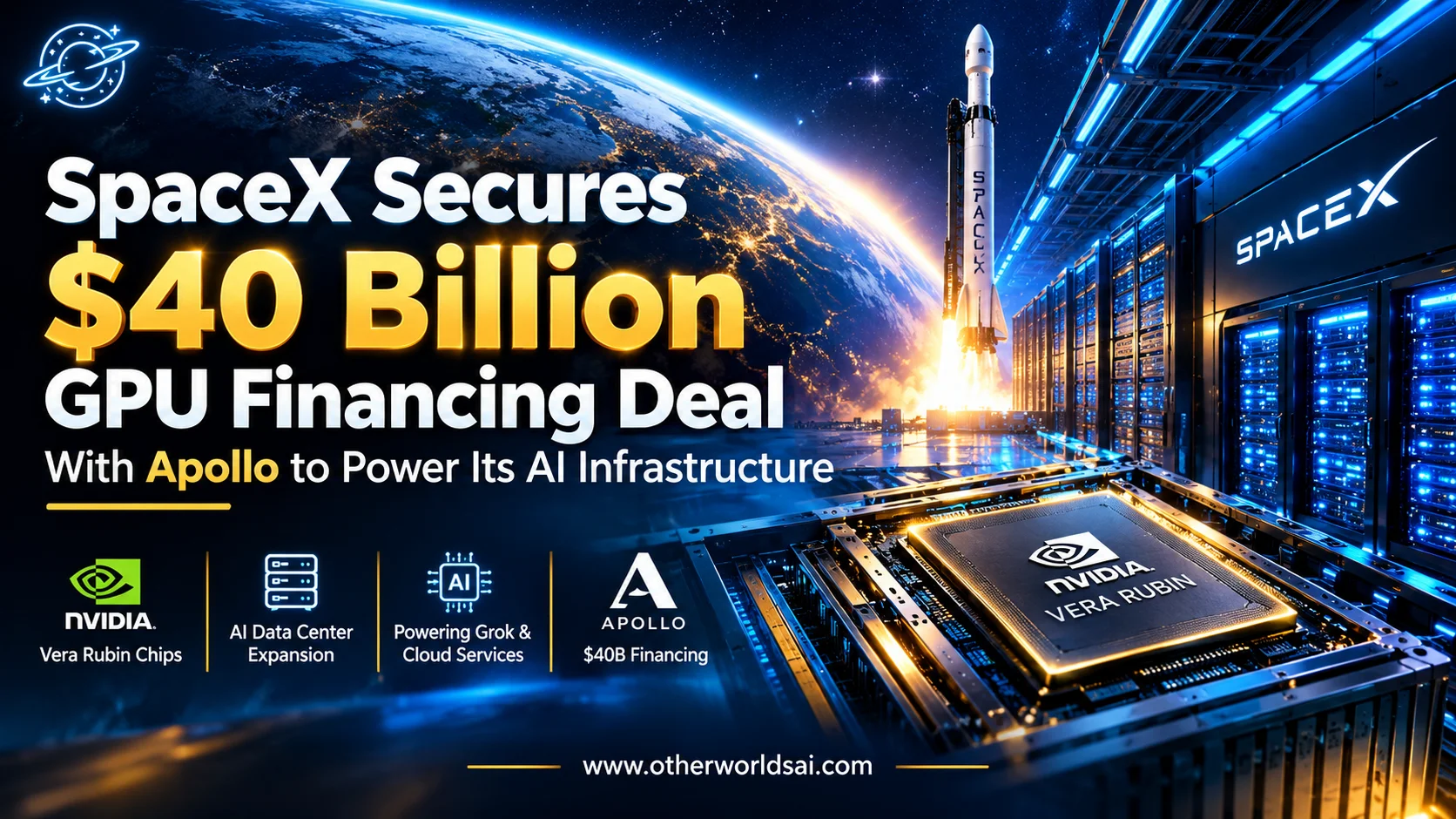

SpaceX has secured a binding commitment for approximately $40 billion in GPU financing from Apollo Global Management,
marking a major milestone in the race to build next-generation AI infrastructure. The deal will help Elon Musk’s company acquire advanced NVIDIA chips, expand its data center capacity, and support the growing computing demands of Grok and its cloud services.
The agreement, described by SpaceX as the largest committed GPU financing deal ever, highlights how expensive the artificial intelligence industry has become — and how companies are finding new ways to fund the infrastructure required to compete in the AI era.
Rather than purchasing all the hardware outright, SpaceX will use a leasing arrangement that allows it to deploy advanced AI computing equipment while diversifying its funding sources. For the broader technology industry, this deal raises an important question: as AI models become more powerful, which companies will have the financial resources and infrastructure to stay ahead?
SpaceX and Apollo Announce a $40 Billion AI Chip Financing Agreement:
The financing agreement involves an entity managed by Apollo Global Management, a major New York-based alternative investment manager. Under the arrangement, Apollo’s managed entity will purchase graphics processing units (GPUs) and associated server hardware, then lease the equipment to SpaceX.
According to the company’s regulatory filing, the equipment leases will run for approximately five to five-and-a-quarter years, with each lease beginning when its corresponding hardware tranche is delivered.
SpaceX expects the transaction to close by the end of 2026, subject to customary closing conditions. The leases are expected to begin during the first half of 2027 as the equipment arrives.
The structure gives SpaceX access to substantial computing resources without requiring it to fund the entire hardware purchase through an immediate cash outlay.
For a business investing heavily in AI, satellite internet, and space launch operations, that flexibility could be strategically important.
Why SpaceX Needs $40 Billion in GPU Financing:
Artificial intelligence development is increasingly dependent on access to enormous amounts of computing power. Training advanced AI models, running inference workloads, and delivering AI services to millions of users all require powerful processors, data centers, networking equipment, and reliable electricity.
GPUs have become essential to this infrastructure because they can perform the parallel computations required by modern AI systems.
SpaceX is expanding its AI ambitions across several areas, including the Grok chatbot, AI coding tools, and cloud computing services. These products require computing capacity that can scale as demand increases.
The $40 billion GPU financing agreement is designed to help meet that demand.
Instead of relying exclusively on conventional borrowing or using cash to purchase every component, SpaceX can access hardware through equipment leasing. This approach allows the company to spread payments over time while deploying the equipment as it becomes available.
The bigger story is not simply the size of the financing deal. It is the growing importance of capital-efficient AI infrastructure financing as companies compete to secure increasingly expensive computing resources.
NVIDIA Vera Rubin Chips at the Center of SpaceX's AI Expansion:
One of the most significant details in the agreement is the planned delivery of NVIDIA’s next-generation Vera Rubin chips.
NVIDIA has become a central supplier to the AI industry because its GPUs and supporting software ecosystem power many of the data centers used for AI training and inference.
The Vera Rubin platform represents NVIDIA’s next generation of AI computing technology, designed to support demanding workloads as AI models and services continue to grow. Apollo said the financing will help deliver these chips for SpaceX’s terrestrial computing infrastructure expansion.
The planned hardware investment could support several important activities:
-
AI model training: Providing computing capacity for the development and improvement of advanced AI models.
-
AI inference: Running trained models efficiently as users interact with chatbots, coding assistants, and other AI applications.
-
AI cloud computing: Offering computing resources for commercial customers and demanding AI workloads.
-
AI agent development: Supporting systems that can reason, use tools, and carry out multistep tasks.
-
Large-scale data center operations: Expanding the physical infrastructure needed to support growing AI demand.
The precise number of chips covered by the agreement and the complete hardware delivery schedule have not been publicly specified in the details described here.
Nevertheless, the planned use of next-generation NVIDIA hardware underscores how access to advanced chips has become a major competitive factor in the global AI market.
SpaceX's AI Business Is Becoming a Major Revenue Driver:
The financing announcement follows a strong third quarter for SpaceX’s AI business, according to reports published on October 20, 2026.
The company’s AI segment reportedly generated approximately $7.6 billion in revenue out of SpaceX’s total $14.6 billion for the quarter. This made AI a larger revenue contributor than Starlink and rocket launches combined, based on the reported figures.
The AI business includes Grok, the Cursor coding tool, and cloud computing operations, according to the reporting cited in the original coverage.
These results suggest that SpaceX is developing beyond its established identity as a space transportation and satellite internet company.
Its business model increasingly combines several interconnected areas:
-
Space launch services: Revenue from launching payloads and operating space transportation services.
-
Starlink satellite internet: Recurring revenue from broadband connectivity for residential, enterprise, and other customers.
-
AI software and services: Revenue associated with AI assistants, coding tools, and related applications.
-
Cloud computing infrastructure: Computing capacity that can support internal AI development and potentially external customers.
This combination may provide SpaceX with a financing advantage over companies whose businesses depend almost entirely on renting AI computing capacity.
However, revenue alone does not establish profitability. The long-term returns from these investments will depend on operating costs, hardware utilization, pricing, and the continued growth of customer demand.
Capital Expenditure Is Surging as SpaceX Builds More Computing Capacity:
The expansion comes with a substantial price tag.
SpaceX’s reported capital expenditure rose to nearly $20 billion in the third quarter of 2026, compared with approximately $6.9 billion a year earlier.
During an October 20 earnings call, CFO Bret Johnsen reportedly said the company expected to spend between $35 billion and $40 billion in the fourth quarter alone.
These figures illustrate the scale of the infrastructure investment required to compete in the AI industry.
Building an AI data center involves far more than purchasing GPUs. Companies must also invest in servers, networking equipment, power distribution, cooling systems, buildings, and the infrastructure required to keep large computing clusters running reliably.
The financial challenge becomes more complicated as chip generations change rapidly. Hardware purchased today must generate sufficient value before newer systems reduce its competitive advantage.
SpaceX’s leasing agreement offers one way to manage that challenge by spreading equipment costs across multiple years. It does not eliminate the underlying expense, however, and the company will still need to generate adequate returns from the computing capacity it deploys.
SpaceX CFO Says AI Infrastructure Investments Can Pay Back in Under a Year:
SpaceX CFO Bret Johnsen described the leasing arrangement as a way to diversify the company’s funding sources and address a significant portion of the capital required for its growth plans.
He also pointed to payback periods of less than one year for the company’s AI infrastructure investments as it scales computing resources for Grok and its cloud services.
That statement is important because the economics of AI infrastructure are becoming a major focus for investors.
A short payback period can make expensive hardware investments more attractive when computing capacity is rapidly monetized. However, such claims should not automatically be interpreted as a guarantee that every GPU investment will recover its cost within a year.

Meta's Next Big Bet: This New App Lets You Build Games Simply by Typing a Prompt
Actual returns can vary according to utilization rates, electricity costs, customer contracts, operating expenses, depreciation, and the commercial performance of the AI services using the hardware.
For SpaceX, the key challenge will be turning its growing computing capacity into sustainable cash flow while continuing to invest in its other businesses.
Why AI Data Center Financing Is Becoming More Difficult:
SpaceX’s deal comes at a time when investors are scrutinizing the cost and financial sustainability of AI infrastructure.
Over the past several years, numerous companies have emerged to provide GPU-based cloud computing services. Often called neocloud providers, these businesses specialize in supplying computing capacity for AI training, inference, and other intensive workloads.
Their appeal is straightforward: AI developers need access to powerful GPUs, but building and operating a data center requires enormous capital.
Neocloud companies attempt to bridge that gap by purchasing or financing hardware and renting computing capacity to customers.
However, this business model also creates financial risks.
The challenge of expensive hardware:
Advanced GPUs and associated server systems require significant upfront investment. Companies must secure financing, deploy the equipment, attract customers, and generate enough revenue to cover operating and financing costs.
If customer demand weakens or prices fall, expensive computing infrastructure can become less profitable.
Support our research
Independent analysis fueled by you.
The risk of rapid technological change:
AI hardware evolves quickly. A data center built around one generation of GPUs may face competitive pressure when newer processors offer better performance or efficiency.
Companies must therefore balance the need to invest early against the risk of owning equipment that becomes less attractive over time.
Dependence on external financing:
Some AI cloud providers rely heavily on borrowing or external investment to purchase their hardware. If lenders become more cautious, these companies may find it harder to expand or refinance existing obligations.
The importance of reliable customers:
Long-term customer commitments can make infrastructure investments easier to finance.
Without sufficient demand, a provider may struggle to keep its GPUs fully utilized. These pressures help explain why SpaceX’s financing arrangement has attracted attention. The company has substantial operating businesses beyond AI computing, potentially giving it more ways to support its investment plans.
Elon Musk Says Smaller AI Compute Companies Face Consolidation:
Elon Musk used the financing announcement to criticize the financial position of AI computing companies that lack substantial revenue outside their data center businesses. Musk argued that SpaceX benefits from investment-grade status and cash flow generated by Starlink and its launch operations.
In comments posted on X, he suggested that companies focused exclusively on renting GPUs could face severe difficulties as debt financing becomes harder to obtain.
He predicted that many of the more than 200 neocloud companies operating in the market would fail or be consolidated.
The comments reflect a wider debate over the future structure of the AI infrastructure industry.
Companies with diversified revenue streams may have more flexibility to finance large investments, particularly when credit conditions tighten. By contrast, infrastructure providers that depend on a narrow customer base or repeated rounds of external financing can be more vulnerable to market changes.
Still, the outlook is not necessarily the same for every neocloud provider. Companies with strong customer contracts, efficient operations, differentiated technology, or disciplined capital allocation may remain competitive.
The likely lesson for AI infrastructure companies is that access to GPUs is not enough. Sustainable financing, reliable demand, and sound operating economics are equally important.
What the Apollo Financing Deal Means for the AI Industry:
SpaceX’s $40 billion GPU financing commitment could have implications beyond the company itself.
- AI infrastructure is becoming a financial asset class:
The agreement illustrates how advanced computing hardware can be financed through structured leasing arrangements rather than conventional outright purchases.
For investors and equipment owners, GPUs and servers can form part of an asset-backed financing strategy, provided the associated risks and residual values are properly assessed.
- Leasing can help companies preserve cash:
Equipment leasing allows businesses to spread payments over time instead of funding the entire acquisition upfront. This can preserve cash for other investments, although lease obligations remain an important financial commitment.
- Access to capital may shape the competitive landscape:
AI companies need money not only to develop models but also to secure the infrastructure on which those models operate.
Businesses with diversified revenues and strong financing options may be better positioned to expand during periods of tighter credit.
- NVIDIA's role in AI infrastructure remains significant:
The planned deployment of NVIDIA Vera Rubin chips highlights the continued importance of advanced GPU platforms in the development of large-scale AI computing systems.
The availability, performance, and cost of next-generation chips will influence how quickly AI providers can expand their services.
- AI infrastructure spending will face greater scrutiny:
As capital expenditure rises, investors are likely to pay closer attention to GPU utilization, data center operating costs, customer demand, and the time required to recover infrastructure investments.
The companies that succeed will need to demonstrate that their spending generates sustainable commercial returns rather than simply increasing computing capacity.
What This Means for Businesses Adopting AI:
The SpaceX–Apollo agreement may involve billions of dollars in infrastructure, but its broader implications are relevant to businesses of every size.
Companies adopting artificial intelligence do not necessarily need to build their own data centers or purchase expensive GPUs. They can often access AI capabilities through cloud platforms, managed services, specialized software, and purpose-built AI agents. The important decision is determining which infrastructure and deployment model best matches a business’s requirements.
For example, a company developing a proprietary AI model may need dedicated computing resources and greater control over its data. A business implementing an AI customer service assistant may instead benefit from a managed solution that handles routine inquiries, captures leads, and integrates with existing business systems.
The right approach depends on several factors:
-
Computing requirements: Whether the workload needs high-performance GPUs or can run on less expensive infrastructure.
-
Data privacy: Whether customer or business information must remain within a controlled environment.
-
Scalability: How computing demand is expected to change over time. Total cost of ownership: The combined cost of hardware, software, energy, maintenance, and ongoing operations.
-
Return on investment: Whether the AI system produces measurable improvements in productivity, revenue, or operating efficiency.
At Otherworlds AI, this is an important distinction for businesses exploring AI automation and private AI agent development. The objective should not simply be to adopt the largest or most expensive AI infrastructure available. It should be to deploy the right technology to solve a defined business problem securely and cost-effectively.
The Future of AI Infrastructure: Bigger Investments, Greater Financial Pressure:
The $40 billion SpaceX GPU financing deal demonstrates the extraordinary financial scale of the current AI race.
Advanced processors, data centers, and cloud computing capacity are becoming strategic resources. Companies are experimenting with new ways to finance these assets while attempting to keep pace with rapidly evolving AI technology.

Move Over Nvidia: Anthropic and Samsung Team Up to Break the AI Chip Monopoly
SpaceX has several advantages, including its established businesses, its reported AI revenue growth, and access to a major equipment financing arrangement with Apollo. Those advantages could help it pursue an ambitious computing expansion.
But the underlying risks remain. AI infrastructure is expensive, technology changes rapidly, and strong revenue growth does not automatically translate into durable profits.
For neocloud providers and other AI companies, the coming years may reward businesses that combine technological capability with disciplined financial management.
For the rest of the market, the implications are equally significant: AI is no longer just a software race. It is also a competition over computing resources, energy, capital, and the ability to turn infrastructure investments into lasting commercial value.
As AI adoption accelerates, the companies that balance innovation with sustainable economics may ultimately be better positioned to lead the next phase of the industry.
Follow Otherworlds AI for more insights into artificial intelligence, AI infrastructure, cloud computing, private AI agents, and the technologies reshaping modern businesses.