
Apple's New CEO, the SpaceX-Cursor $60B Deal, and What It All Means for the Future of Tech:
From Apple's historic leadership handover to Elon Musk's audacious $60 billion bet on AI coding tools — the tech industry is entering a bold, turbulent new era. Here is everything you need to know.
Apple's Leadership Transition: A New Era Begins:
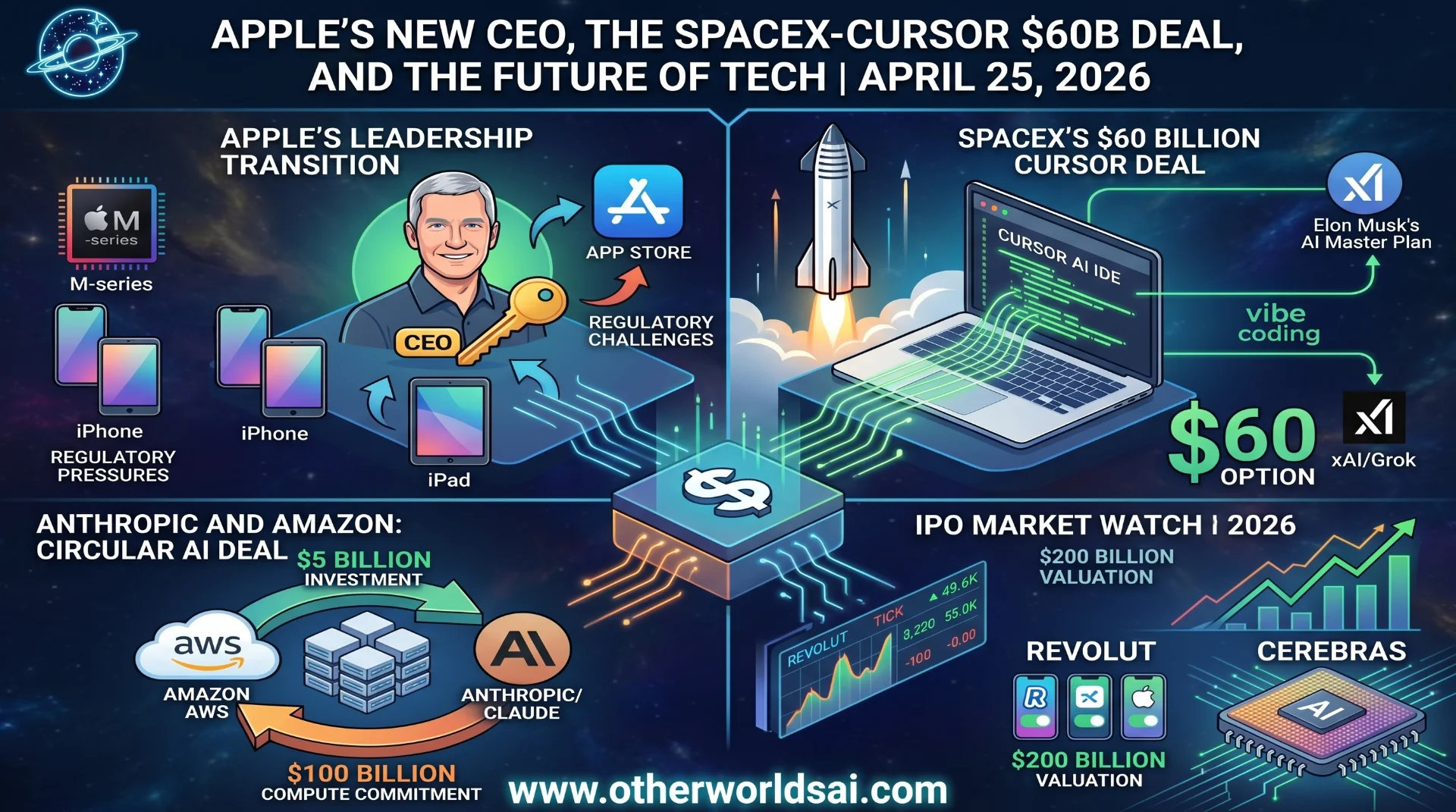
After more than a decade of unparalleled corporate leadership, Apple CEO Tim Cook has announced he will step down in September 2026, handing the reins to John Ternus — Apple's current Senior Vice President of Hardware Engineering. This is one of the most significant leadership transitions in Silicon Valley history, and its ripple effects will be felt across the entire global technology ecosystem.
John Ternus is not simply a successor — he is an architect of Apple's most transformative hardware. Having joined Apple in 2001, Ternus has spent over two decades engineering the products that define Apple's identity: the iPhone, iPad, MacBook, and the groundbreaking M-series Apple Silicon chips.
His fingerprints are on the most consequential engineering decisions of the past decade, making him a deeply product-focused, technically rigorous leader who understands both the precision of engineering and the poetry of consumer experience.
"Ternus may be inheriting one of the most durable businesses in tech — but he is also stepping into a very different ecosystem than the one Cook spent decades shaping." The challenge ahead is formidable. Apple's iconic App Store — long a 30% revenue machine — is under siege from regulators across the United States, Europe, and Asia.
Courts and lawmakers are challenging the gatekeeping power Apple has wielded over developers for years. The era of absolute platform control may be ending, and Ternus will need to redefine what it means to be Apple's steward in a world where its rules are being rewritten.
The App Store Boom: How AI and Vibe-Coding Are Rewriting the Rules:
Despite the regulatory storm clouds, the App Store is experiencing a surprising and powerful renaissance. AI-powered development tools — a phenomenon increasingly called "vibe coding" — have slashed the time and technical skill required to build polished, functional applications. What once took a team of engineers months to ship, a solo founder with an AI co-developer can now accomplish in days.
This explosion in AI-assisted development is flooding the App Store with a new generation of software, driving record-breaking submission volumes and reigniting revenue growth across the platform. For Apple, it is both a gift and a governance challenge: more developers, more apps, more revenue — but also more complexity in curation, quality control, and the preservation of what makes the App Store trustworthy.
The vibe-coding revolution is not just changing how apps are built — it is changing who can build them, and what it means to compete on Apple's platform.
For startup founders and independent developers, the message is clear: the barriers to entry on Apple's platform have never been lower. But the barriers to standing out have never been higher. As Ternus steps into the CEO role, his engineering DNA may be exactly what Apple needs to separate signal from noise in this AI-driven wave of creation.
SpaceX's $60 Billion Cursor Option: Inside Elon Musk's AI Master Plan:
The single most audacious deal of the week — arguably of the year — is SpaceX's agreement with Cursor, the AI-powered coding assistant built by Anysphere, which includes an option for SpaceX to acquire the startup for a staggering $60 billion. The agreement also carries a $10 billion breakup fee, signaling that this is not a casual partnership — it is a strategic declaration.
"A $10 billion breakup fee is not a number you attach to a deal unless you are deadly serious. This is Elon Musk staking a claim on the future of how software is written."
Cursor has become one of the fastest-growing developer tools in history. Built on top of large language models, it functions as an AI-native code editor — one that writes, debugs, refactors, and explains code in real time alongside the developer. Millions of engineers have made it their primary development environment, embedding it into daily workflows in a way that few tools achieve so quickly.
To understand why Musk wants Cursor, you have to understand his larger ambition: vertical integration across the entire AI stack. With xAI now merged and Grok positioned as a direct competitor to ChatGPT and Claude, with X providing social distribution, and with Starlink delivering global connectivity, adding Cursor would give Musk ownership of the layer where AI meets the act of building software. Every engineer who uses Cursor powered by Grok is an engineer in Elon Musk's ecosystem.
This is not just a product acquisition — it is an infrastructure play, a distribution strategy, and a statement of competitive intent. If SpaceX exercises its option, Cursor will become the IDE of the Musk empire — embedding Grok into the daily creative act of millions of developers worldwide.
Anthropic and Amazon: The $5 Billion Circular AI Deal Explained:
Anthropic, the AI safety company behind the Claude family of models, announced a landmark $5 billion investment from Amazon this week — paired with a pledge to spend $100 billion on Amazon Web Services cloud infrastructure in return. This is the latest — and largest — example of what analysts are calling the "circular AI infrastructure play," a financing model that has quietly become the dominant architecture of the AI boom.
Anthropic receives $5 billion. Amazon gets $100 billion in cloud spending commitments. The money flows in a circle — and both companies call it a partnership. Critics argue these deals are more financial engineering than genuine investment, inflating balance sheets without moving capital out of the tech ecosystem. Supporters counter that they reflect genuine operational alignment —
Anthropic needs enterprise-scale compute that only hyperscalers like AWS can provide, and Amazon needs credible AI partners to compete with Microsoft's OpenAI relationship. Either interpretation reveals something important about how the AI industry finances its ambitions.
What is undeniable is the scale of Anthropic's capitalization. Combined with prior rounds from Google and others, Anthropic is now among the most heavily funded AI labs in the world — a position that gives it the runway to pursue long-horizon AI safety research while simultaneously competing at the frontier of commercial AI deployment.
IPO Market Watch: Is 2026 Finally the Year Tech Goes Public Again?
Two names dominated IPO speculation this week, reigniting hopes that the long-dormant public market window is finally reopening. Revolut, the UK-based fintech super-app that has disrupted traditional banking across Europe and beyond, is reportedly eyeing a valuation of up to $200 billion in an eventual IPO — a figure that would make it one of the most valuable fintech companies ever to list publicly.
Meanwhile, Cerebras — the AI chip startup renowned for building some of the largest silicon wafers ever manufactured — is also signaling its readiness to enter the public markets. Cerebras represents a fundamentally different bet than Revolut: not on how people manage money, but on the physical infrastructure that makes large-scale AI possible. Its wafer-scale engine chips are designed from the ground up for neural network training, challenging the dominance of NVIDIA GPUs in AI data centers.
Revolut is a bet on the future of money. Cerebras is a bet on the future of intelligence. Both are asking investors: do you believe in where we are going?
Whether either company ultimately lists in 2026 — and at what valuation — will serve as a crucial signal for the health of the broader startup and venture capital ecosystem. After years of suppressed IPO activity driven by rising interest rates and investor caution, a successful Revolut or Cerebras debut could unlock a wave of long-delayed public offerings across the tech landscape.
Anthropic's Mythos Model: Safety Questions at the Frontier:
Not all of this week's news was celebratory. Reports emerged that an unauthorized group has gained access to Anthropic's exclusive Mythos model — a specialized AI tool that was not intended for public or third-party use. The incident has raised serious questions about both the security of frontier AI systems and the marketing practices surrounding exclusive, restricted AI tools.
For Anthropic — a company that has built its entire brand identity around responsible, safety-first AI development — the Mythos situation is a reputational stress test. How AI labs manage unauthorized access, model leakage, and downstream misuse is rapidly becoming one of the most consequential governance questions in the industry.
The stakes are not just reputational; they are existential for the public's trust in AI development.
The frontier of AI capability is advancing faster than the infrastructure to secure it — and incidents like Mythos are early warnings of a much larger challenge ahead.
The Bigger Picture: What Every Founder and Investor Needs to Know:
Taken together, the events of this week are not isolated headlines — they are chapters in a single, sweeping story about an industry rewriting its own rules in real time. Apple is changing hands for the first time in a generation. Elon Musk is assembling an AI empire with the ambition and capital to reshape how software is built. Anthropic is deepening its ties with the cloud giants that power the AI revolution. And the public markets are beginning, cautiously, to reopen their doors.
For founders, developers, and investors, the key takeaways are:
• - AI development tools are now worth tens of billions of dollars. The infrastructure layer of the coding revolution is being priced accordingly — and Cursor's $60B valuation is just the beginning.
Meta's Next Big Bet: This New App Lets You Build Games Simply by Typing a Prompt
• - Apple's platform power is being contested on every front. New leadership may bring new opportunities — and new risks — for those building in the Apple ecosystem.
Support our research
Independent analysis fueled by you.
• - The circular investment model is the dominant financial architecture of AI. Understanding how money flows between hyperscalers and AI labs is now essential for anyone deploying capital in this space.
• - The IPO window may finally be opening — but only for companies with genuine revenue, defensible moats, and credible paths to profitability.
Move Over Nvidia: Anthropic and Samsung Team Up to Break the AI Chip Monopoly
• - Frontier AI security is an unsolved problem. The Mythos incident is a preview of governance challenges that will define the next decade of AI development.
The tech industry has always been defined by moments of disruption and reinvention. But rarely do so many tectonic shifts happen in the same week.
The next era of tech is not coming — it is already here.