
OpenAI Releases GPT-5.5: The Smartest AI Model Yet and the Bold Vision Behind the OpenAI Super App-
Elon Musk’s X Has a Major New Threat: The OpenAI Super App:
OpenAI has officially launched GPT-5.5 — and it could be the most consequential AI model release of the year. Unveiled on Thursday, GPT-5.5 is what OpenAI describes as its "smartest and most intuitive AI model" to date. Packed with advanced reasoning, enhanced agentic capabilities, and scientific research tools, the new model doesn't just raise the bar for large language model (LLM) performance —
it also brings OpenAI meaningfully closer to its long-discussed ambition of building an AI super app that unifies ChatGPT, Codex, and an AI-powered browser into a single, all-in-one platform.
What Is GPT-5.5? OpenAI's Smartest and Most Capable AI Model Explained:
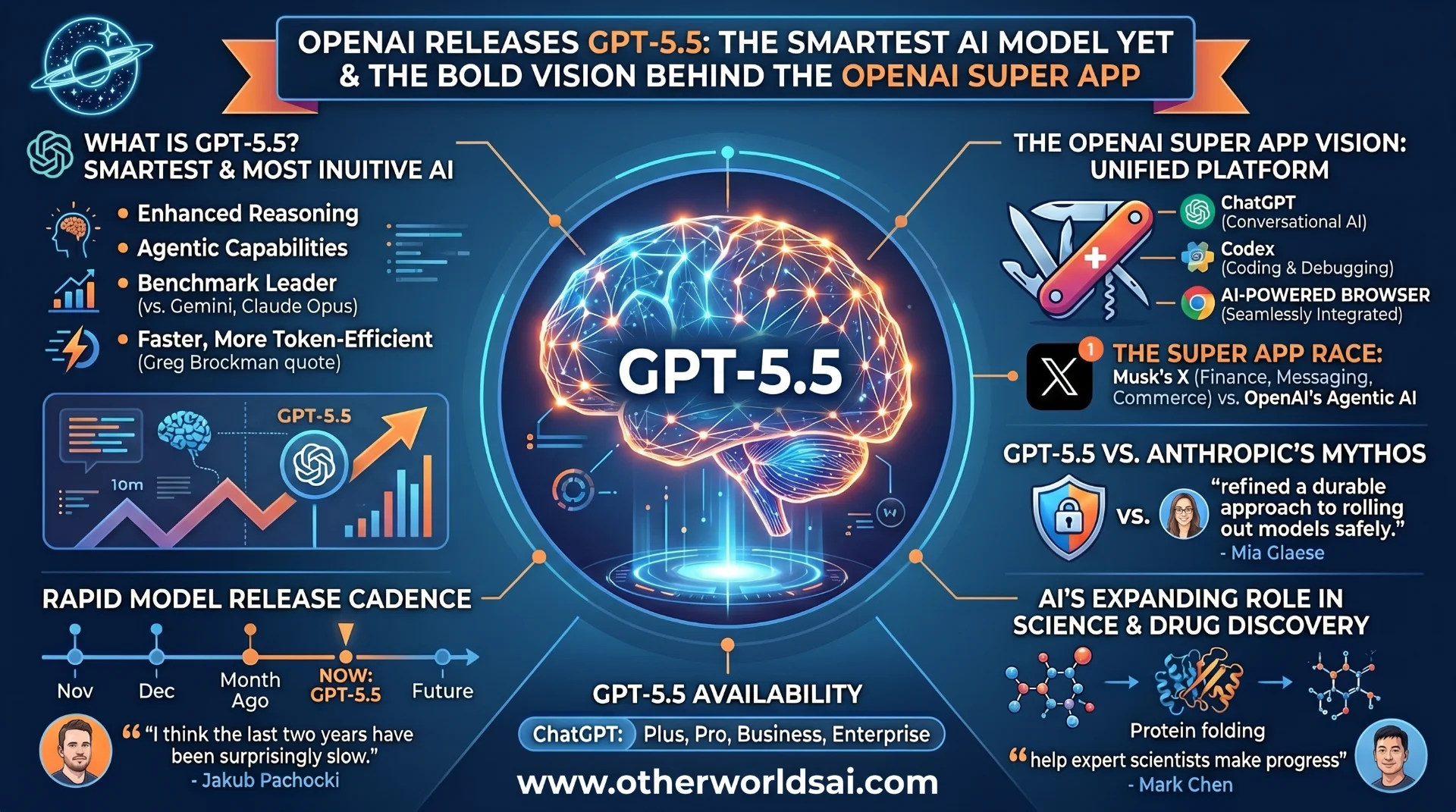
GPT-5.5 represents a significant leap in the evolution of OpenAI's flagship AI technology. OpenAI co-founder and president Greg Brockman described the release on a press call as a major advancement "towards more agentic and intuitive computing" — a phrase that signals a shift from AI as a conversational tool to AI as an active, task-executing intelligence.
In practical terms, GPT-5.5 is faster and more token-efficient than its predecessor, GPT-5.4. Brockman explained the implication directly: "It's a faster, sharper thinker for fewer tokens compared to something like 5.4. So this means that there's just more frontier AI available for businesses and for consumers, which is part of our goal." For enterprise customers in particular, this efficiency translates into real cost savings and dramatically improved performance across complex, multi-step workflows.
The model is designed for broad utility, spanning foundational enterprise AI applications like agentic coding, knowledge work, and digital defense, as well as more experimental domains including advanced mathematics and scientific research. OpenAI released benchmark data Thursday showing GPT-5.5 outperforming both its own previous models and key competitors — including Google's Gemini 3.1 Pro and Anthropic's Claude Opus 4.5 — across a range of industry-standard evaluations.
The OpenAI Super App Vision: Combining ChatGPT, Codex, and an AI Browser:
Perhaps the most strategically significant announcement alongside GPT-5.5 is the renewed clarity around OpenAI's super app ambitions. Brockman confirmed that GPT-5.5 is an explicit step toward the creation of a unified OpenAI super app — a multi-purpose, Swiss Army knife platform that would merge ChatGPT's conversational AI, Codex's coding capabilities, and a native AI-powered browser into a single, seamlessly integrated service for enterprise and consumer users alike.
The super app concept is not new, but its growing urgency within OpenAI reflects a broader shift in the competitive AI landscape. Sam Altman and Brockman have both discussed this vision publicly in the past, but with GPT-5.5 now deployable across agentic workflows, the underlying model capability to support such a platform is finally catching up with the ambition.
A single AI platform that can browse the web, write and debug code, answer complex questions, and execute multi-step tasks on behalf of a user represents the next frontier of AI product development.
The super app race is heating up across the tech industry. Notably, Elon Musk — an Altman rival and former OpenAI colleague — has publicly stated his intention to transform X (formerly Twitter) into its own super app, integrating financial services, messaging, commerce, and AI. The parallel ambitions of two of tech's most prominent figures make the super app narrative one of the defining competitive storylines of 2025 and beyond.
OpenAI's Rapid Model Release Cadence: What It Means for the AI Industry:
GPT-5.5 is the latest in a relentless string of model launches from OpenAI — and it won't be the last. The company released its previous model just one month ago, with earlier launches in December and November. OpenAI's pace of AI model development has become a defining characteristic of the company's strategy, one that puts sustained pressure on every competitor in the space.
OpenAI's chief scientist, Jakub Pachocki, was candid about the trajectory ahead. He said the company sees "pretty significant improvements in the short term, extremely significant improvements in the medium term" — and offered a striking assessment of the recent past: "I think the last two years have been surprisingly slow." That statement, coming from OpenAI's chief scientist, underscores just how aggressive the AI development roadmap is expected to become.
For businesses and developers integrating AI tools into their workflows, this rapid-release model has important implications. Organizations that build on OpenAI's infrastructure must remain agile, ready to leverage new model capabilities as they arrive — often with only weeks between major releases. The companies that adapt fastest to each new generation of frontier AI will have a compounding advantage over those that lag behind.
GPT-5.5 in Scientific Research and Drug Discovery: AI's Expanding Role:
One of the most compelling dimensions of GPT-5.5 is its enhanced capability in scientific and technical research workflows. Mark Chen, OpenAI's chief research officer, stated that the model "shows meaningful gains on scientific and technical research workflows" and expressed confidence that it could "help expert scientists make progress" in ways that were not previously possible with AI tools.
Drug discovery is one of the most high-stakes applications highlighted by Chen — and it's an area seeing explosive growth in AI adoption. From protein structure prediction to candidate molecule screening, AI is transforming the speed and economics of pharmaceutical R&D. GPT-5.5's improved reasoning and domain expertise in scientific literature could make it a meaningful tool for research teams working on some of the world's most pressing medical challenges — from cancer treatment to antibiotic resistance.
The model's improved performance on mathematics benchmarks further strengthens its utility in scientific contexts. Advanced mathematical reasoning is a foundational capability for fields including physics, materials science, financial modeling, and climate research — making GPT-5.5 a genuinely cross-disciplinary tool rather than a narrowly focused one.
GPT-5.5 vs. Anthropic's Mythos: The AI Cybersecurity Competition Heats Up:
The ongoing rivalry between OpenAI and Anthropic surfaced prominently during the GPT-5.5 press briefing. A reporter asked whether GPT-5.5 would offer capabilities comparable to Mythos, Anthropic's recently announced AI cybersecurity tool — which has itself been in the news following reports of unauthorized access to the program.
OpenAI's technical staff member Mia Glaese addressed the question directly, positioning GPT-5.5 as a significant evolution in the company's approach to digital defense. She stated:
"We have a strong and longstanding strategy for our approach to cyber, and we've refined a durable approach to rolling out models safely." This signals that OpenAI views AI-powered cybersecurity not as a niche vertical but as a core dimension of how frontier models are deployed responsibly — a position that directly challenges Anthropic's cybersecurity positioning with Mythos.
The AI cybersecurity space is rapidly becoming one of the most competitive and consequential arenas in the industry. As AI models grow more capable, they introduce both new defensive tools and new attack vectors. The companies that establish credibility and trust in safe, effective AI deployment for digital defense will hold an enormous advantage — not just commercially, but in shaping the regulatory environment around AI security.
GPT-5.5 Availability: Who Can Access It and How:
GPT-5.5 is rolling out broadly starting Thursday, with availability structured across OpenAI's subscription tiers. The standard GPT-5.5 model is deploying immediately to Plus, Pro, Business, and Enterprise users in ChatGPT. The more powerful GPT-5.5 Pro variant is being made available to Pro, Business, and Enterprise subscribers — positioning the premium tier as the destination for users who need the highest level of reasoning, coding, and research capability.
For enterprise organizations evaluating AI platforms, this tiered rollout has strategic implications. The distinction between the standard 5.5 and the 5.5 Pro offering will likely become a key consideration in enterprise AI procurement — particularly for organizations in regulated industries, advanced research, or those deploying AI at significant scale. OpenAI's ability to offer differentiated tiers with meaningful capability differences is a maturing sign of the company's enterprise product strategy.
The Bigger Picture: How GPT-5.5 Shapes the Future of Frontier AI:
GPT-5.5 is more than a model update — it is a marker in the ongoing race to define what AI can do for humanity. With every release, OpenAI is compressing the timeline between concept and capability. Agentic AI that can autonomously navigate computer workflows, scientific AI that can accelerate drug discovery, and a unified super app that could reshape how billions of people interact with technology — these are not distant aspirations. With GPT-5.5, they are measurably closer.
The competitive dynamics are sharpening with every release cycle. Google, Anthropic, Meta, Mistral, and a growing field of open-source challengers are all moving fast — but OpenAI's combination of model performance, brand recognition, enterprise distribution, and product velocity gives it a formidable position. GPT-5.5 is the latest evidence that OpenAI intends to keep that position.
One thing is clear from Thursday's release: the pace of AI progress is not slowing down — it is accelerating.
And if Jakub Pachocki is right that the last two years were "surprisingly slow," the next two years could be among the most transformative in the history of technology.