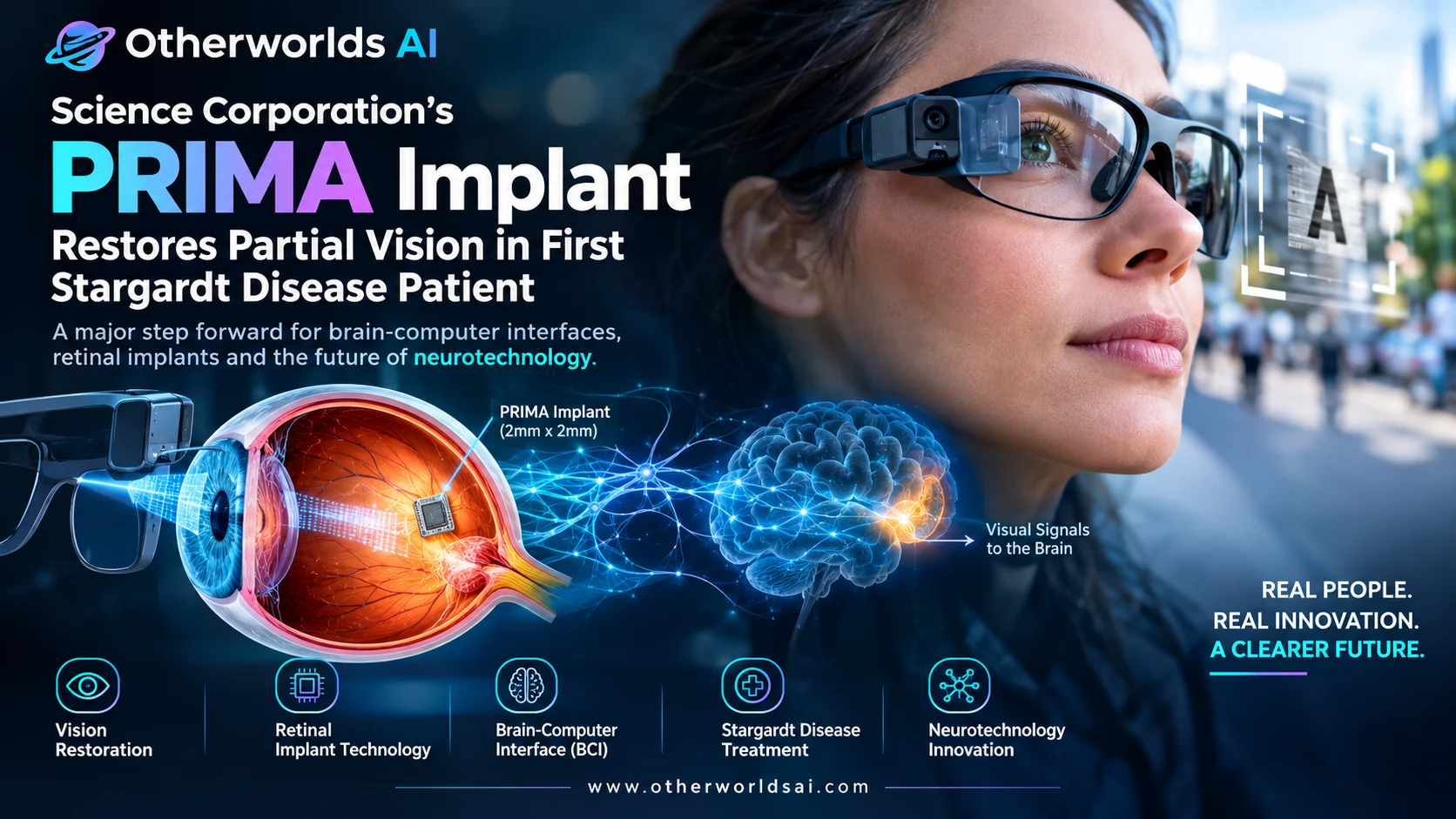

Max Hodak’s New Eye Implant Restores Partial Vision in First Stargardt Patient.
From Restoring Vision to Building the Next Generation of Brain-Computer Interfaces.
Although Science Corporation is currently advancing its retinal implant technology, Hodak sees PRIMA as part of a much larger neurotechnology strategy.
He argues that retinal prostheses, cochlear implants, and motor prostheses can all be understood as different forms of brain-computer interface technology.
The reasoning is straightforward: the nervous system communicates through electrical activity, and devices that record or stimulate this activity can potentially restore, supplement, or modify particular biological functions.
A cochlear implant helps people with certain types of hearing loss by electrically stimulating the auditory pathway. A retinal prosthesis attempts to provide visual information through electrical stimulation. A motor prosthesis may help translate neural signals into commands for controlling an external device.
These technologies differ in their engineering and clinical applications, but they share a common principle: interfacing electronics with the nervous system to address a biological limitation.
For Science Corporation, success in vision restoration could provide valuable clinical experience, engineering capabilities, and a foundation for developing more advanced neural interfaces.
How Science Corporation’s Brain Implant Differs From Neuralink:
Science Corporation was founded in 2021 after Hodak left Neuralink, the brain-computer interface company he co-founded with Elon Musk and others.
Both companies operate in the broader field of neural engineering, but their approaches to brain interfaces are not identical.
Neuralink's implant is designed to place electrode threads directly into brain tissue to record neural activity and enable communication between the brain and external systems.
Science Corporation has previously described a different approach for its planned neural sensor. Rather than inserting the device directly into brain tissue, the company has said that its sensor would be placed inside the skull and rest on the surface of the brain.
The distinction matters because electrode placement influences the type of neural signals a device can access, the surgical procedure required, and the potential risks and limitations of the system.
Science Corporation has also discussed possible applications involving neurological monitoring and conditions in which conventional electrodes may not provide the desired access to brain activity.
However, the company's broader brain-interface ambitions remain distinct from the clinical work currently being undertaken with PRIMA. Its future neural sensor should not be confused with the retinal implant that has already entered clinical testing.
Potential Applications Beyond Vision Restoration:
Science Corporation's long-term research program extends beyond the treatment of retinal disease. Hodak has discussed several potential directions for future brain-computer interface technology.
- Neurological Disease Monitoring:
One possible application is monitoring neural activity in patients with neurological conditions, including certain cases involving brain tumors. Advanced neural sensors could potentially help clinicians observe changes in brain activity and investigate how those changes relate to symptoms or disease progression. Any clinical benefits would depend on the specific device, the condition being studied, and evidence from appropriate trials.
- Stroke Recovery and Neural Rehabilitation:
Stroke can damage brain tissue and disrupt the neural connections responsible for movement, language, memory, and other functions.
Hodak has discussed the possibility that future neural interfaces could establish connections with different brain regions, potentially supporting approaches to neurological rehabilitation that go beyond conventional electrode systems.
This remains an ambitious research direction, not an established treatment. Replacing or reconstructing lost brain function is an exceptionally difficult challenge, and any such approach would require extensive experimental and clinical validation.
- Neurodegenerative Disease Research:
Hodak also indicated that the company is considering a neurodegenerative disease as a future clinical application, without publicly identifying the condition during the reported discussion.
Neurodegenerative diseases progressively affect neurons and the networks they form. Better ways to monitor neural activity could help researchers investigate disease mechanisms and assess how the brain responds to treatment. Whether an implanted sensor can improve diagnosis, monitoring, or treatment will depend on future research findings.
- Advanced Neural Engineering:
Over the longer term, Science Corporation aims to better understand how biological brain systems generate cognition and mental processes. Hodak has described an ambitious vision involving engineered brains and new approaches to understanding neural computation.

Meta's Next Big Bet: This New App Lets You Build Games Simply by Typing a Prompt
Although this vision remains speculative in many respects, it reflects a broader shift in technology research: moving beyond computers that process information externally toward systems that interact directly with biological neural networks.
Can PRIMA Restore Natural Vision?
This is one of the most important questions surrounding the technology.
Based on Hodak's description, the current implant provides a small region of black-and-white vision rather than normal, full-field color vision.
The limited implant area means that users can perceive only a restricted portion of the visual scene at a time. The system is therefore very different from a healthy human retina, which provides a much broader field of view and far more complex visual information.
Science Corporation is working on several engineering challenges to improve performance. These include developing larger implants while accounting for the curvature of the eye and reducing electrode dimensions to increase the amount of visual detail that can be represented.
Support our research
Independent analysis fueled by you.
Hodak indicated that a next-generation system was being developed with the aim of entering human testing within the following year. He also expressed optimism about making substantial improvements in visual acuity over the next five years.
These statements describe the company's ambitions, not guaranteed outcomes. Future performance will depend on engineering progress, clinical evidence, safety, and the biological response of patients.
For people considering vision-restoration treatment, eligibility and expected benefits must be determined by qualified retinal specialists based on the specific device's approved indications and current clinical evidence.
The Role of AI, Electronics, and Medical Technology:
Although PRIMA is not simply an AI-powered chatbot or a conventional machine-learning application, its development belongs to the wider transformation of healthcare through advanced computing and intelligent electronic systems.
The device illustrates several important technology trends.
Miniaturized medical electronics: Small implants can interact with biological systems in ways that were previously difficult to achieve.
-
Computer vision and optical processing: Camera-based systems can capture visual information and convert it into signals suitable for a medical device.
-
Neural interfaces: Electronic stimulation can potentially provide alternative pathways for communicating information to the nervous system.
-
Precision healthcare: Clinical testing can help determine which patients are most likely to benefit from a particular intervention.
-
Human-machine integration: Medical devices are increasingly designed to work alongside biological systems rather than simply operating outside the body.
Artificial intelligence may contribute to future advances in image processing, signal interpretation, personalized rehabilitation, and neural data analysis. However, the specific role of AI in any PRIMA implementation should not be overstated without supporting technical evidence.
The broader lesson is that the future of medical innovation will increasingly depend on collaboration among neuroscience, software engineering, microelectronics, biotechnology, and clinical medicine.
What This Means for the Future of Neurotechnology:
Science Corporation's progress highlights both the potential and the complexity of developing technologies that interact directly with the human nervous system.
Vision-restoration implants could eventually offer additional options for people whose retinal cells have been damaged by certain diseases. More advanced neural sensors may also create new opportunities for neurological research and rehabilitation.
At the same time, these technologies face substantial challenges, including surgical safety, long-term implant reliability, signal resolution, patient selection, accessibility, and regulatory approval.
There are also broader questions about privacy and the handling of neural data as brain-computer interfaces become more sophisticated. Systems capable of collecting information about brain activity will need strong safeguards, clear clinical purposes, and appropriate oversight.
The industry must therefore balance ambitious engineering goals with rigorous clinical evidence and responsible development.

Move Over Nvidia: Anthropic and Samsung Team Up to Break the AI Chip Monopoly
For now, PRIMA's early results provide a concrete example of how neural engineering may help restore a limited but meaningful biological function. Whether the technology can deliver wider benefits will become clearer as clinical trials progress.
Conclusion: A Promising Step Toward the Future of Brain-Computer Interfaces:
Science Corporation's first PRIMA implantation in a patient with Stargardt disease marks an important development in the search for new approaches to vision restoration.
The patient's early ability to recognize a letter and subsequently read a word offers an encouraging indication of what retinal prostheses may achieve, although much more evidence is needed to determine their long-term effectiveness.
For Max Hodak and Science Corporation, the vision-restoring implant also represents a starting point for a broader ambition involving brain-computer interfaces, neural sensors, and advanced neurotechnology.
As research continues, the convergence of medical electronics, neural engineering, and AI-assisted healthcare could create new possibilities for treating conditions that have historically been difficult to address.
At Otherworlds AI, we follow these developments because they illustrate how emerging technologies are moving beyond digital applications and into the physical world, where they may eventually change how people live, communicate, and receive medical care.
The future of brain-computer interfaces is still being written. PRIMA offers an early glimpse of what may become possible when technology is designed not merely to compute information, but to reconnect with the human body's own systems.