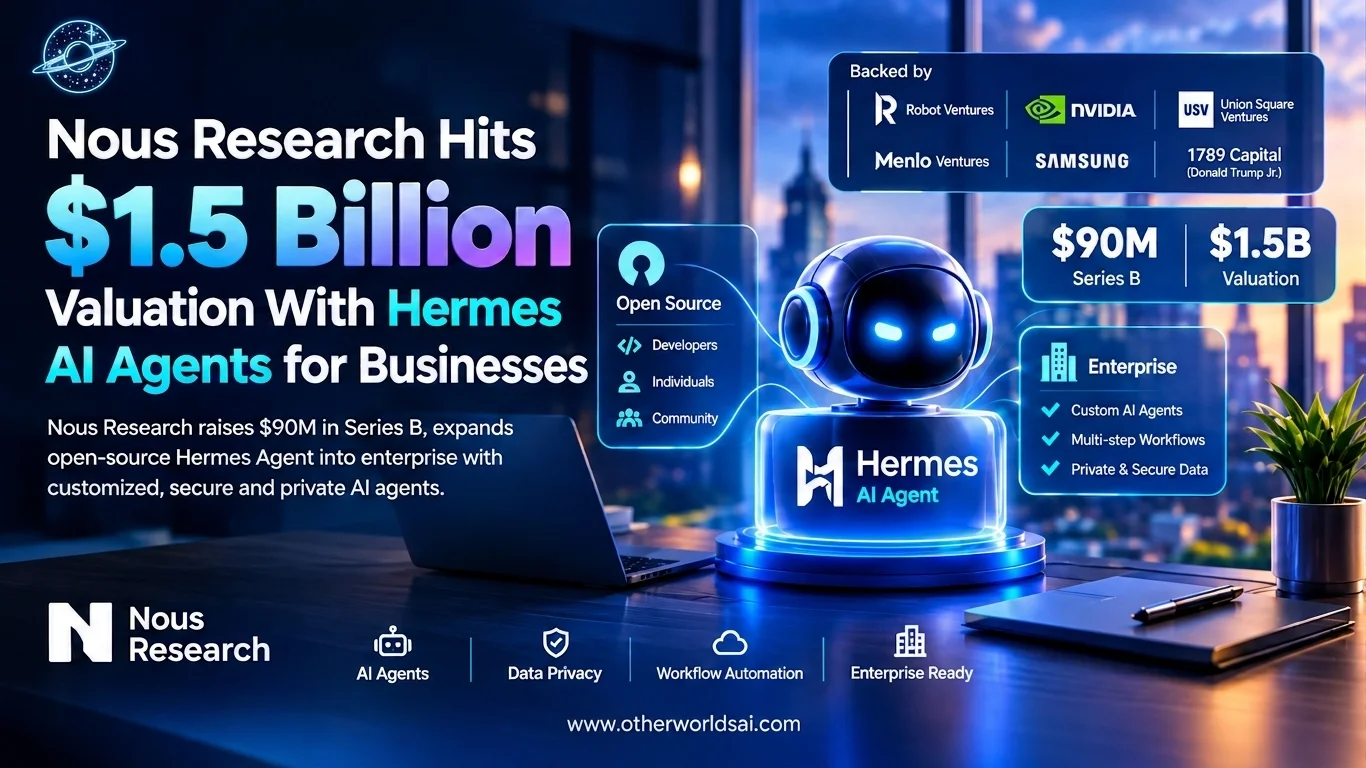

Nous Research has raised $90 million in a new Series B funding round at a $1.5 billion valuation,
marking a major milestone for the open-source AI startup and signaling its next big move: bringing autonomous AI agents to businesses.
The three-year-old company, best known for its open-source Hermes Agent, is now turning its attention from developers and individual AI users toward the enterprise market.
The move comes as businesses increasingly look for AI agents that can perform real-world tasks, automate workflows and operate securely with private company data.
For Nous Research, the latest funding is not simply about building another AI model. It represents a broader push to make open-source AI agents practical for business applications.
Nous Research Raises $90 Million at $1.5 Billion Valuation:
Nous Research has confirmed that it raised $90 million in Series B funding, giving the company a valuation of approximately $1.5 billion.
The funding round was led by Robot Ventures, with participation from major investors including Nvidia, Union Square Ventures, Menlo Ventures and Samsung. Other investors include 1789 Capital, where Donald Trump Jr. is a partner.
The latest investment brings Nous Research's total funding to approximately $158 million since the startup was founded three years ago.
The valuation is significant because Nous Research has built much of its reputation around the open-source AI ecosystem, rather than following the traditional closed-model approach used by many major AI companies.
Hermes Agent Has Become a Major Open-Source AI Project:
At the center of Nous Research's growth is Hermes Agent, an open-source AI agent that has gained considerable attention among developers and advanced AI users.
According to Nous Research, Hermes Agent has been cloned more than 24 million times and is estimated to account for approximately 2.5% of global AI token usage.
That adoption gives Nous Research an important advantage as it moves toward enterprise AI. Instead of starting from scratch with businesses that have never interacted with its technology, the company already has a large developer community experimenting with its agent.
This could help Nous Research bridge the gap between open-source AI development and enterprise AI automation.
What Is Hermes for Businesses?
The company's next major initiative is called “Hermes for Businesses.” The idea is straightforward but potentially powerful: companies will be able to deploy customized AI agents designed around their own workflows and business requirements. Rather than limiting AI to answering questions or generating text, these agents are designed to handle multi-step workflows.
For example, an enterprise AI agent could potentially:
-
Process information from multiple business systems
-
Automate repetitive administrative tasks
-
Coordinate multi-step workflows
-
Assist employees with research and analysis
-
Work with internal company information
-
Execute business processes with limited human intervention
-
Operate within a company's private data environment.
This reflects a broader shift in the AI industry from AI chatbots toward autonomous AI agents.
Why Private AI Agents Matter for Businesses:
One of the biggest challenges facing enterprises adopting generative AI is data privacy. Businesses often deal with sensitive customer information, financial records, intellectual property and internal documents. Sending all of that information to external AI systems can create security, compliance and governance concerns.
Nous Research is positioning Hermes for Businesses around this problem.
The company's enterprise offering is expected to allow businesses to deploy custom AI agents while maintaining greater control over their data and infrastructure.
This is becoming increasingly important as organizations move toward private AI, enterprise AI agents and secure AI automation.
For industries such as healthcare, finance, legal services, manufacturing and logistics, controlling where company data is processed can be just as important as the capabilities of the AI itself.
From Open-Source AI to Enterprise AI:
Nous Research's strategy illustrates an important evolution in the AI market.
Meta's Next Big Bet: This New App Lets You Build Games Simply by Typing a Prompt
Early generative AI adoption was dominated by chatbots and AI assistants. The next phase is increasingly focused on AI agents capable of taking action.
An AI chatbot primarily responds to a prompt.
An AI agent can potentially understand a goal, plan multiple steps, interact with tools and systems, and work toward completing that goal.
That difference could fundamentally change how companies use artificial intelligence.
For example, instead of asking an employee to manually collect information from several systems, analyze it and prepare a report, an enterprise AI agent could potentially coordinate those steps automatically.
This is the broader market Nous Research is entering with Hermes for Businesses.
Support our research
Independent analysis fueled by you.
Nous Research Is Already Generating Significant Revenue:
The company's rapid growth is not limited to user adoption.
According to reporting from The Wall Street Journal, Nous Research was generating approximately $36 million in annualized revenue by mid-September 2026.
The company reportedly expects to exceed $100 million in revenue before the end of 2026.
If that target is achieved, it would represent extremely rapid commercial growth for a startup that was founded only three years ago.
The combination of strong developer adoption, open-source technology, enterprise AI ambitions and rapidly increasing revenue helps explain why investors have placed a $1.5 billion valuation on the company.
The Bigger AI Agent Opportunity:
The Nous Research funding round is another indication that investors increasingly view AI agents as one of the next major markets in artificial intelligence.
Companies are no longer interested only in AI models that generate text or images. They want systems capable of actually completing work.
This includes AI customer service agents, AI sales agents, AI research agents, AI coding agents, AI workflow automation and industry-specific AI assistants.
The commercial opportunity is enormous because almost every business has repetitive workflows that could potentially be automated.
The challenge is making these agents reliable, secure and easy to integrate with existing business infrastructure.
That is where enterprise-focused AI companies will compete.
Open-Source AI Could Give Nous Research an Advantage:
One of Nous Research's most interesting differentiators is its open-source foundation.
Open-source AI can provide developers and organizations with greater visibility and flexibility compared with completely closed AI systems.
For businesses, this can potentially mean more control over deployment, customization and integration.
However, enterprise customers also require reliability, security, technical support and predictable performance.
Nous Research will therefore need to demonstrate that its open-source technology can meet the demanding requirements of large organizations.
Its Hermes for Businesses initiative will be an important test of that strategy.
What This Means for the Future of Enterprise AI:
The latest Nous Research funding is about more than one startup raising $90 million.
Move Over Nvidia: Anthropic and Samsung Team Up to Break the AI Chip Monopoly
It reflects the direction in which the enterprise AI market is moving.
Businesses increasingly want AI systems that can move beyond conversation and become active participants in their operations.
The future may involve AI agents that manage customer inquiries, coordinate internal workflows, analyze business data, update software systems, schedule activities and assist employees across entire departments.
The companies that successfully combine AI autonomy, data privacy, customization and enterprise reliability could become major players in the next generation of artificial intelligence.
Nous Research is now betting that its open-source Hermes Agent can become one of those platforms.
OtherworldsAI Perspective:
The rise of Hermes for Businesses is particularly significant because it reinforces a trend we are seeing across the AI industry: businesses are moving from AI assistants to AI agents.
For companies exploring AI automation, the real opportunity is not simply having an AI chatbot on a website. The bigger opportunity is connecting AI to actual business processes.
At OtherworldsAI, we see this transition as a move toward custom AI agents, private AI infrastructure, workflow automation and intelligent business systems.
Whether an organization needs an AI customer service agent, a sales assistant, a logistics automation system or a fully customized private AI solution, the goal is increasingly the same: build AI that does useful work, not simply AI that talks about doing it.