
Poke Becomes the First AI Agent Approved on Apple's Messages for Business — And It's Just a Text Away:
The Future of iOS? Meet the First AI Agent Approved for Apple Messages
The Palo Alto startup that turns AI agents into everyday text messages just cleared a historic milestone — and the timing couldn't be more strategic.
A Historic First: AI Agents Enter Apple's iMessage Ecosystem:
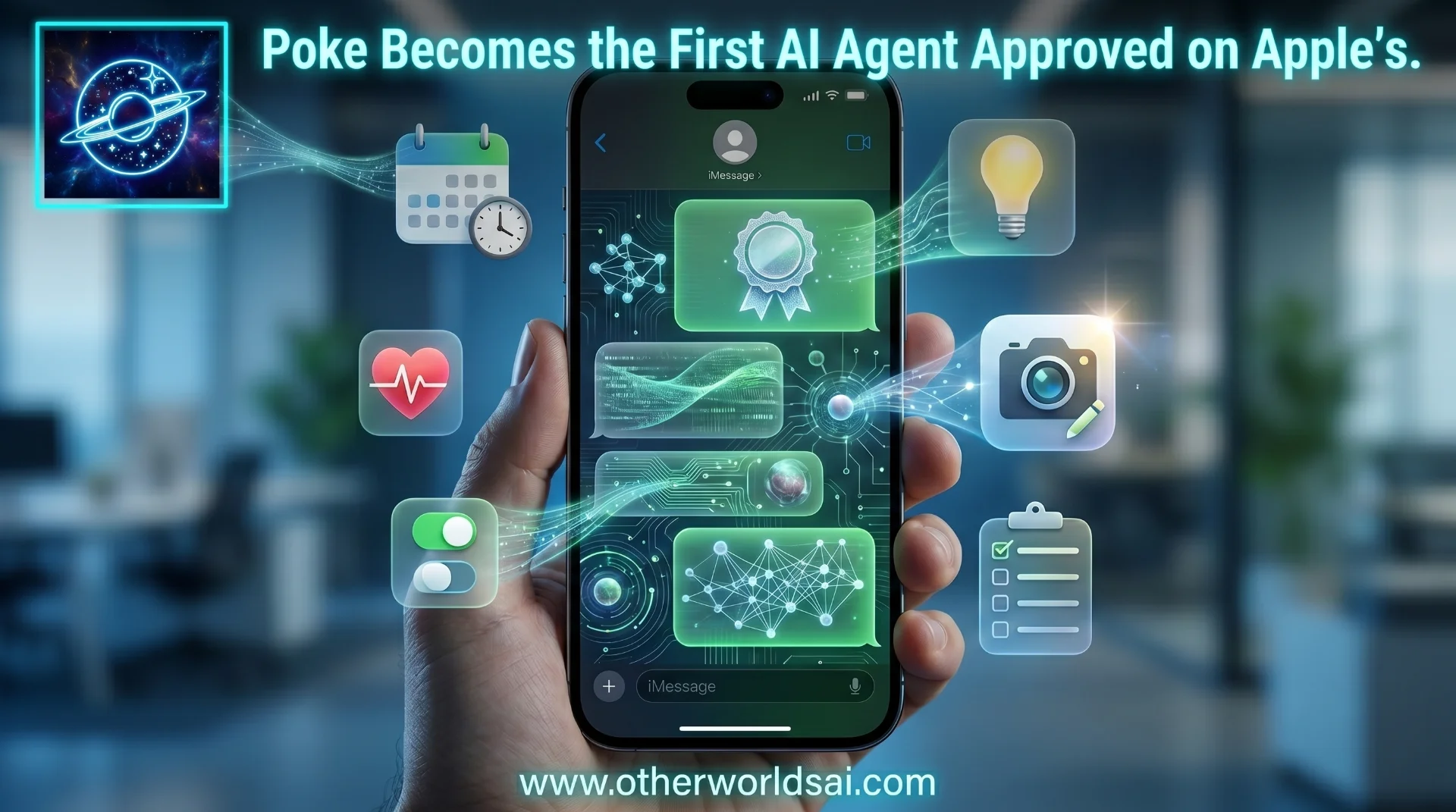
Poke, the conversational AI agent platform built by The Interaction Company of California, has just made history — becoming the first AI agent approved to operate on Apple's Messages for Business platform. For a company built around the idea that AI should be as easy as sending a text, landing inside iMessage isn't just a product milestone. It's a validation of a fundamentally different vision for how everyday users interact with AI agents: no apps to download, no dashboards to navigate, no command-line interfaces to learn. Just a message.
Apple's Messages for Business platform was not originally designed with standalone AI agents in mind. Until now, it served as a structured communication layer between major enterprises — airlines, hotel chains, retailers — and their own customers, providing a standardized iMessage interface that supported both automated chat and live agent handoffs. Poke's approval marks the first time a third-party AI agent has been granted access to this channel, opening a new frontier for AI-powered consumer services delivered natively through iMessage.
What Is Poke: The AI Agent Built for Everyone:
Launched in March 2026, Poke was designed from day one to solve a real accessibility problem in the AI agent landscape. While powerful agentic platforms exist for developers and technical users, the vast majority of everyday consumers have been locked out of the AI agent revolution — put off by complexity, jargon, and tools that assume a certain level of technical fluency. Poke flips that model entirely, offering a conversational AI agent experience delivered entirely over text messaging
The platform's capabilities already span a wide range of everyday use cases. Users can manage their calendars, build daily plans, track health and fitness goals, control their smart home devices, and edit photos — all by sending a simple text message to Poke. The service currently operates across SMS, Telegram, and WhatsApp in select markets, and has now added iMessage to its supported platforms. Since launch, Poke has relayed more than 100 million messages — a figure that speaks to both its utility and its rapid adoption among users who want AI assistance without friction.
The Apple WWDC Timing: Strategic Positioning at a Critical Moment:
The announcement lands at a particularly charged moment in the AI and mobile ecosystem calendar. Apple's annual Worldwide Developers Conference (WWDC) is just days away, and the company is widely expected to unveil a redesigned, AI-optimized version of Siri, along with new AI tools and frameworks for app developers. Rumors have also circulated that Apple may open its App Store to AI agents — a move that would dramatically expand the AI agent marketplace on iOS.
Poke's iMessage launch, however, operates through a different and arguably more elegant channel. Rather than living inside the App Store as a downloadable application, Poke runs through Apple's Messages for Business infrastructure — meaning users interact with it directly inside their iMessage interface without ever leaving the native messaging experience. This is not an app. It's an AI agent that behaves like a contact in your phone, and that distinction matters enormously for user adoption and long-term engagement.
The Business Model: Per-User Tolls and a New Distribution Cost for AI Agents:
For founders, investors, and anyone tracking the economics of AI agent distribution, the more revealing detail in this story is the pricing model. Marvin von Hagen, co-founder of The Interaction Company of California, confirmed that Poke will pay Apple on a per-user basis for access to the Messages for Business platform. While the exact per-user fee hasn't been disclosed, von Hagen noted that it is significantly lower than the rates Meta charges on WhatsApp — fees that Meta increased following EU regulatory requirements that mandated opening WhatsApp to third-party AI agents.
Von Hagen's perspective on the toll structure is refreshingly pragmatic. "I think that Apple is just noticing this is the best way to offer AI", he said, adding, "good for them, because they charge us — they charge us per user on the platform and actually make money with this, especially if it becomes really big." The per-user toll model, applied at scale across a growing base of AI agent users, represents a potentially significant new revenue stream for Apple — and a new line item that AI agent startups will need to build into their cost-of-distribution models going forward.
This emerging toll structure is a signal of how platform economics are evolving in the AI agent era. Just as app stores created a new distribution cost layer for mobile software, messaging platforms — from WhatsApp to iMessage — are establishing per-user fees as the pricing primitive for AI agent access. For early-stage startups building conversational AI agents, understanding and optimizing around these platform fees will be as important as the product itself.
Earning Apple's Trust: A Months-Long Approval Process:
Being first on any major platform is rarely accidental, and Poke's path to Apple's Messages for Business approval was a deliberate, months-long process. To gain Apple's sign-off, Poke had to demonstrate it could provide live human support when needed, clearly identify itself as an AI agent (not a human), submit verified testimonies from its messaging infrastructure providers, and redesign elements of its user interface to conform to Apple's strict design guidelines.
The interface changes were specific and non-trivial. On iMessage, Poke now displays link previews instead of inline links, and all buttons and interface elements follow Apple's own style guide. "This took a couple of months to adhere to all of these standards", von Hagen said, noting that any other AI agent startup seeking to build on the platform should expect a similar timeline. The approval process is real, substantive, and not a rubber stamp.
The deeper reason Poke was first, though, comes down to brand positioning and trust. "It was also just important that we were very aligned in terms of the positioning of the company", von Hagen explained, distinguishing Poke from consumer products that chase user numbers through aggressive or misleading tactics. "We care about quality, we care to have a brand that signals trust" — and in Apple's ecosystem, trust is the price of admission.
Funding and Valuation: $300M and Backed by Tier-One Investors:
The commercial momentum behind Poke is matched by strong investor conviction. The 10-person startup — a remarkably lean team for a platform that has already handled 100 million messages — recently closed an additional $10 million in funding, adding to the $15 million seed round raised last year. The company is now valued at $300 million post-money, backed by Spark Capital and General Catalyst, two of the most respected names in consumer and enterprise technology investing.
The capital efficiency here is striking. At 10 employees and $300 million in valuation, Poke is operating with the kind of revenue-per-employee and valuation-per-headcount ratios that investors dream about. The iMessage expansion — and the enterprise distribution unlock it represents — could accelerate Poke's growth curve considerably, particularly as Apple's ecosystem reaches hundreds of millions of iMessage users globally.
What This Means for the AI Agent Landscape and Consumer AI Adoption:
Poke's iMessage launch is a bellwether for where consumer AI is heading. The most transformative AI agent experiences will not necessarily live inside standalone apps or browser-based platforms — they will live inside the communication interfaces people already use every day. iMessage, WhatsApp, Telegram, and SMS represent the world's largest existing distribution channels, and AI agents that can operate natively within them have an enormous structural advantage over those that require new behaviors and new downloads.
For enterprise buyers and platform strategists, Poke's approval also signals that Apple is actively building out its AI agent infrastructure — and that the per-user toll model is likely to become an industry standard. As AI-powered messaging agents move from novelty to daily utility, the platforms that control messaging access — Apple, Meta, Google — will increasingly function as the distribution gatekeepers of the AI agent economy. Poke just became the first to open that gate on iMessage.
Key Takeaways:
-
First Mover: Poke is the first third-party AI agent approved on Apple's Messages for Business platform.
-
Product: Conversational AI agent for daily planning, calendar, health, smart home, and photo editing — all via text.
-
Scale: 100 million messages relayed since launching in March 2026.
-
Distribution: Now live on SMS, Telegram, WhatsApp (select markets), and iMessage.
-
Business Model: Per-user fee paid to Apple; pricing significantly below Meta's WhatsApp rates.
-
Funding: $300M valuation; backed by Spark Capital and General Catalyst; $25M raised in total.
-
Approval Timeline: Multiple months of compliance work; live human support, AI disclosure, and Apple UI standards required.
As Apple prepares to unveil its AI roadmap at WWDC, Poke's historic iMessage approval is a quiet but powerful preview: the future of AI agents may not look like a new app. It may look exactly like a text message.
Support our research
Independent analysis fueled by you.