
Apple's Slow-and-Steady AI Bet Is Finally Paying Off — And Here's Why It Matters:
From a $250 Million Lawsuit to WWDC 2026: Inside Apple's Massive AI Redemption Arc:
WWDC 2026 revealed a company that bet big on patience, privacy, and platform depth — and is now cashing in.
The AI Race Nobody Asked Apple to Win:
For years, critics placed Apple on the wrong side of the AI arms race. Analysts warned that the company's absence from headline-grabbing language model launches would erode iPhone loyalty, hurt sales cycles, and hand the future to more aggressive rivals. Wall Street worried. Tech media speculated. And Apple? It kept shipping hardware.
Then came WWDC 2026 — and with it, Apple's biggest AI announcement to date. The company unveiled Siri AI: a rebuilt, deeply integrated voice assistant powered in part by Google Gemini, embedded not as a bolt-on feature but at the very spine of iOS 27. Suddenly, the question of whether Apple was "losing" the AI race felt less important than a different question entirely: does it actually matter?
"Some appear to be racing forward, seemingly pursuing AI for the sake of AI, without clear regard for the people — all of us — that it's ultimately meant to serve." — Craig Federighi, Apple SVP of Software Engineering.
That statement from Apple's Craig Federighi was pointed and intentional. It acknowledged the growing consumer ambivalence — and in some polls, outright negativity — surrounding the AI industry. At a moment when millions of Americans worry about AI displacing jobs and degrading information, Apple planted a flag: we are the AI company that is actually on your side.
What Siri AI Actually Does:
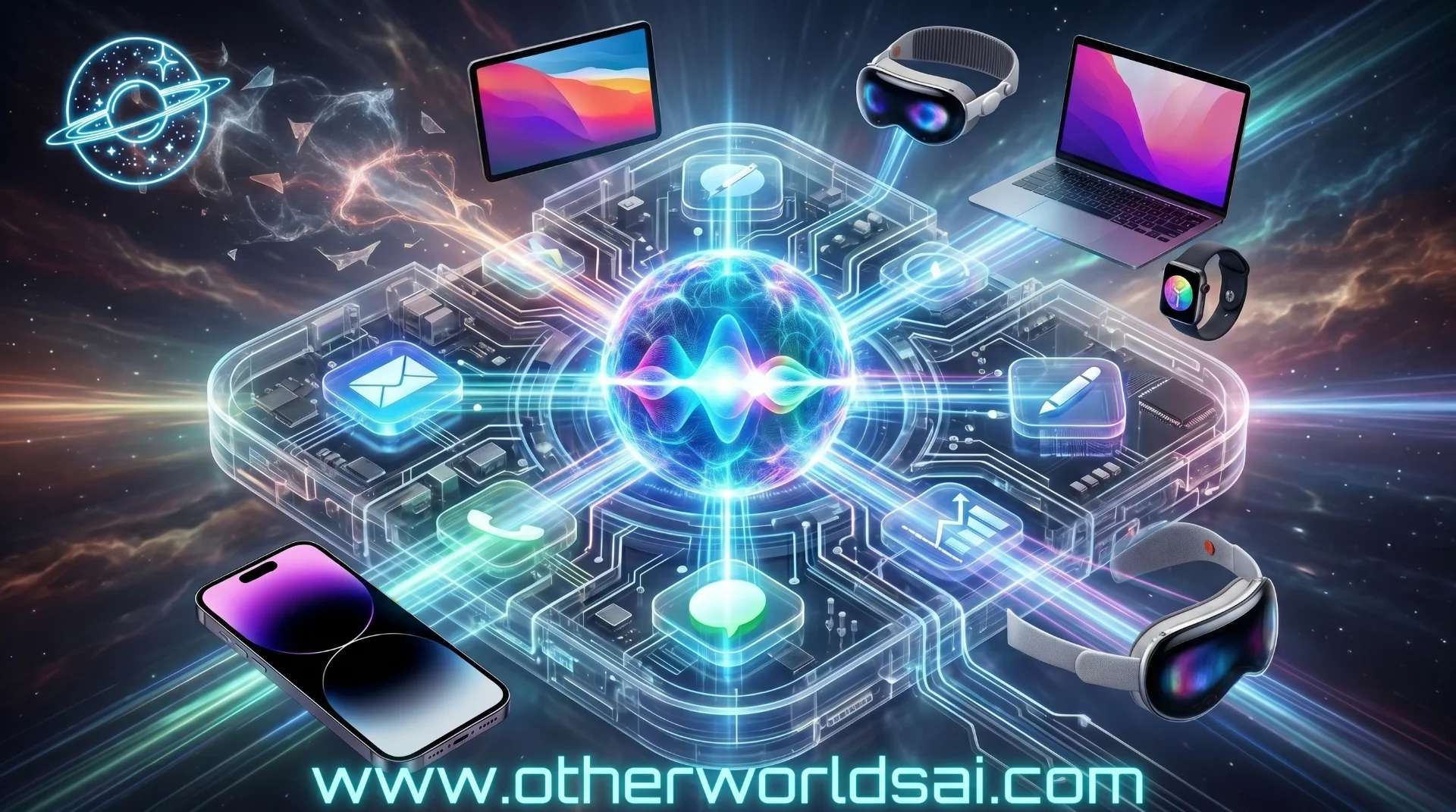
The rebuilt Siri is not a chatbot layered on top of your phone — it is woven into the operating system itself. Using what Apple calls "onscreen awareness," Siri can now understand the context of whatever is on your display and respond accordingly. It can surface information buried deep inside your inbox, your messages, or your notes without you needing to search for it manually. And through its Google Gemini integration, it can pull near-instantaneous, up-to-date information from the web and deliver it directly to your device.
Siri also now stores conversation histories, giving users the ability to revisit past exchanges — a capability long available in standalone AI chatbots but notably absent from Apple's assistant until now. The experience is designed to work seamlessly across Apple's entire device ecosystem: iPhone, iPad, Mac, Apple Watch, and Apple Vision Pro.
Perhaps most strategically significant is what this means for Apple's competitive position in the App Store economy. By embedding AI functionality at the OS level, Apple has the potential to eat into the distribution advantages that competitors like OpenAI and Google have built through their consumer apps. An AI that lives inside the operating system doesn't need to compete for download rankings.
$14B Apple's 2026 Capital Expenditure on AI
$900B Cumulative Capex Committed by Other Tech Giants
The $250 Million Lesson Apple Learned the Hard Way:
The story of WWDC 2026 is not only about what Apple announced — it is equally about how it chose to show things. In 2024, Apple unveiled Apple Intelligence and a redesigned Siri through sleekly produced promotional videos. The features looked polished, the demos were compelling, and the audience was impressed. There was just one problem: the features didn't work the way the videos implied.
By March 2025, Apple had quietly admitted to Daring Fireball that rolling out the features shown in its 2024 keynote was "going to take us longer than we thought to deliver." A federal lawsuit followed, alleging false advertising. And last month, Apple agreed to a $250 million settlement — without admitting wrongdoing, but with a reputational bruise that stung for a brand built on the promise that its products simply work.
Last month, Apple agreed to pay a $250 million settlement on a false advertising suit stemming from features shown at WWDC 2024 that failed to ship as demonstrated. The 2026 keynote was clearly designed with that history in mind. This time, many of the Siri AI and Apple Intelligence demonstrations were shown in a "live-like" format — someone standing with phone in hand, pressing buttons or issuing voice commands in real time, with a second camera showing the device's response. Pre-taped, yes — but unmistakably more grounded than a marketing video. The implicit message: these features exist on actual hardware, and you will have them.
Apple also made a significant concession on hardware requirements. Rather than gate the new Siri behind the latest iPhone to create upgrade pressure, iOS 27 and its AI features will be available on iPhone 15 Pro, iPhone 15 Pro Max, and all iPhone 16 models and later — meaning most users who upgraded in the last two years are already covered. The full lineup of supported devices extends to iPad mini (A17 Pro), iPads with M1 or later, MacBook Neo (A18 Pro), Macs with M1 or later, Apple Vision Pro, Apple Watch Series 10 and Ultra 2, and Apple Watch SE 3 when paired with a compatible iPhone.
Betting on Small Developers — And a Broader Ecosystem Play:
Beyond the consumer-facing Siri relaunch, Apple made a quieter but equally strategic announcement aimed at independent developers. The company declared that developers with fewer than two million first-time App Store downloads will be able to access its Foundation Models running in Private Cloud Compute at no cloud API cost. It is a direct parallel to Apple's Small Business Program — which offers reduced App Store commission rates to smaller developers — now extended into the AI infrastructure layer.
"It's access to frontier-tier level intelligence with unparalleled privacy protections," the presenter said during the keynote, "because getting started exploring ideas shouldn't be held back by infrastructure costs."
The announcement lands in the middle of a broader industry reckoning with AI costs. Tech giants including Meta and Amazon have discontinued internal AI token usage leaderboards where developers once competed to burn through cloud budgets experimenting with new tools. Uber recently disclosed it had exhausted its entire 2026 AI budget in just four months. Against this backdrop, Apple's offer of zero-cost access to foundational models for indie developers is a meaningful differentiator — and a potential magnet for the next generation of App Store talent.
Apple also announced an expansion of the Foundation Models framework itself: it will now support image input and integrate with the cloud model provider of a developer's choice. For more complex tasks requiring large cloud models, the framework is designed to make that transition as seamless as possible.
Why Apple's Measured Approach Is Now the Story:
The contrast with Apple's competitors is perhaps the most instructive signal in everything announced at WWDC 2026. OpenAI has shipped updates at a relentless pace while struggling to define a consistent customer: oscillating between consumer and enterprise, between assistant and platform, between subscription product and API business. Meta has committed astronomical sums to AI without a convincing explanation of how those investments connect to its core advertising revenue. Neither company has a product that reaches billions of users the way iOS does.
Apple's math tells a different story. While competitors are collectively committing roughly $900 billion in cumulative capital expenditure on AI infrastructure, Apple has planned approximately $14 billion in capex for 2026 — a fraction of the industry total, from a company that is still posting record iPhone sales quarters. Apple has also generated significant revenue from the AI industry itself, effectively taxing AI companies that use the App Store to distribute their products.
Apple is spending less, making more, and now launching AI features that — for many iPhone users — will feel indistinguishable from other AI applications already available through the App Store.
What makes the slow-and-steady playbook work for Apple is its hardware foundation. Apple Intelligence features are not cloud services competing for attention — they are enhancements to devices people already own and carry everywhere. The upgrade cycle is not a barrier; it is a delivery mechanism. When iOS 27 ships this fall, the AI features it contains will reach hundreds of millions of devices simultaneously, with no additional acquisition cost and no competing apps to displace.
What This Means for Businesses Using AI Today:
For business operators and teams evaluating AI tools, Apple's WWDC 2026 announcements carry practical implications. The expansion of Siri's capabilities — particularly its ability to surface information across email, messages, and files — mirrors the kind of context-aware workflow automation that enterprise AI platforms have been building toward. When those capabilities are available natively on the device in an employee's pocket, the bar for what a standalone AI tool needs to offer just got higher.
For small business owners specifically, Apple's zero-cost Foundation Models access for indie developers signals an incoming wave of lightweight, privacy-respecting AI tools built for the App Store. The features being demonstrated — contextual suggestions, intelligent search, seamless cross-device awareness — are the same capabilities that platforms like Otherworlds AI's Agent+ Business AI platform deliver at the enterprise layer, now becoming expected at the consumer layer too.
The AI industry is maturing, and Apple's 2026 strategy is a marker of that maturity. The race is no longer about who ships the most headline-grabbing model. It is about who makes AI genuinely useful, reliably delivered, and deeply integrated into how people already work.
Apple, characteristically, may have been late to the starting line — but it built the track.
Support our research
Independent analysis fueled by you.