
China's Domestic AI Infrastructure Ambitions: What's Fact vs. Forecast?
SenseTime's Galaxy Project Targets Domestic AI Chip Scale-Up.
Nearly 20 partners, trillions of daily tokens, and a bold 2026 forecast — what's verified, what's projected, and what it means for enterprises betting on AI infrastructure.
2.42T: DAILY TOKENS PROCESSED
10T/day: PROJECTED BY Q4 2026
~20: ECOSYSTEM PARTNERS
Section 1: A Coalition Built to Scale Domestic AI Compute:
SenseTime is teaming up with nearly 20 partners on the Galaxy Project, a push to scale China's domestic AI chip infrastructure end to end.
Co-founder and Large Device Business Group president Yang Fan unveiled the initiative in a keynote titled 'Intelligent Transformation and Symbiosis,' describing a closed loop connecting chip-level technology, ecosystem partnerships, and commercial deployment for domestically produced AI computing power.
Alongside the Galaxy Project, SenseTime signed a space computing agreement with satellite manufacturer Guoxing Aerospace and struck a research partnership with five institutions, including the Shanghai Artificial Intelligence Laboratory, focused on scientific computing applications.
The partner roster spans domestic chip vendors including Cambricon, Muxi, Hygon, Huawei Ascend, Moore Threads, Sunrise, and Biren Technology, alongside component and infrastructure firms such as Silicon Motion and Zhongke Jiahe. SenseTime says the plan covers one 'token factory,' five large-scale computing clusters, joint work across ten technology directions, and support for 200 AI startups.
2: Solving the Multi-Chip Adaptability Problem:
Domestic AI chips have historically struggled with a fragmented software stack, where models trained for one architecture often need significant rework to run on another. SenseTime says it has built a full-stack adaptation layer spanning models, frameworks, operators, toolchains, and hardware, aimed at letting customers migrate workloads across domestic chip vendors without extensive rewrites.
The company points to two applied examples: in an AI4S long-sequence protein prediction workload, it says fused operator optimisation cut overall prediction time by a factor of three, and in AIGC video generation, it claims a 93% multi-card parallel acceleration ratio for domestic chips running DiT models, alongside what it describes as zero-cost migration for mainstream AI development tools.
These are the kinds of figures that read well in a sandbox test and matter far more once they're stress-tested against real customer pipelines running mixed hardware generations.
3: Big Numbers, Bigger Questions:
SenseTime says its platform now processes 2.42 trillion tokens daily and projects that figure will climb 25-fold to 10 trillion tokens per day by the fourth quarter of 2026 — a forecast, not a measured result.
The company also reports an 85-152% increase in Model FLOPs Utilisation on mainstream domestic chips through its hybrid inference technology, inference cost-effectiveness it puts at 1.25 times Nvidia's H-series parts, and a 2.5x token output increase compared with domestic homogeneous inference setups.
None of these figures come with third-party benchmarking, and the gap between a vendor's optimised test cluster and a customer's production environment is typically where such numbers soften.
SenseTime frames domestic chip production as a collaborative effort across the entire chain of China's innovation capabilities.
— Yang Fan, Co-Founder and President, Large Device Business Group, SenseTime
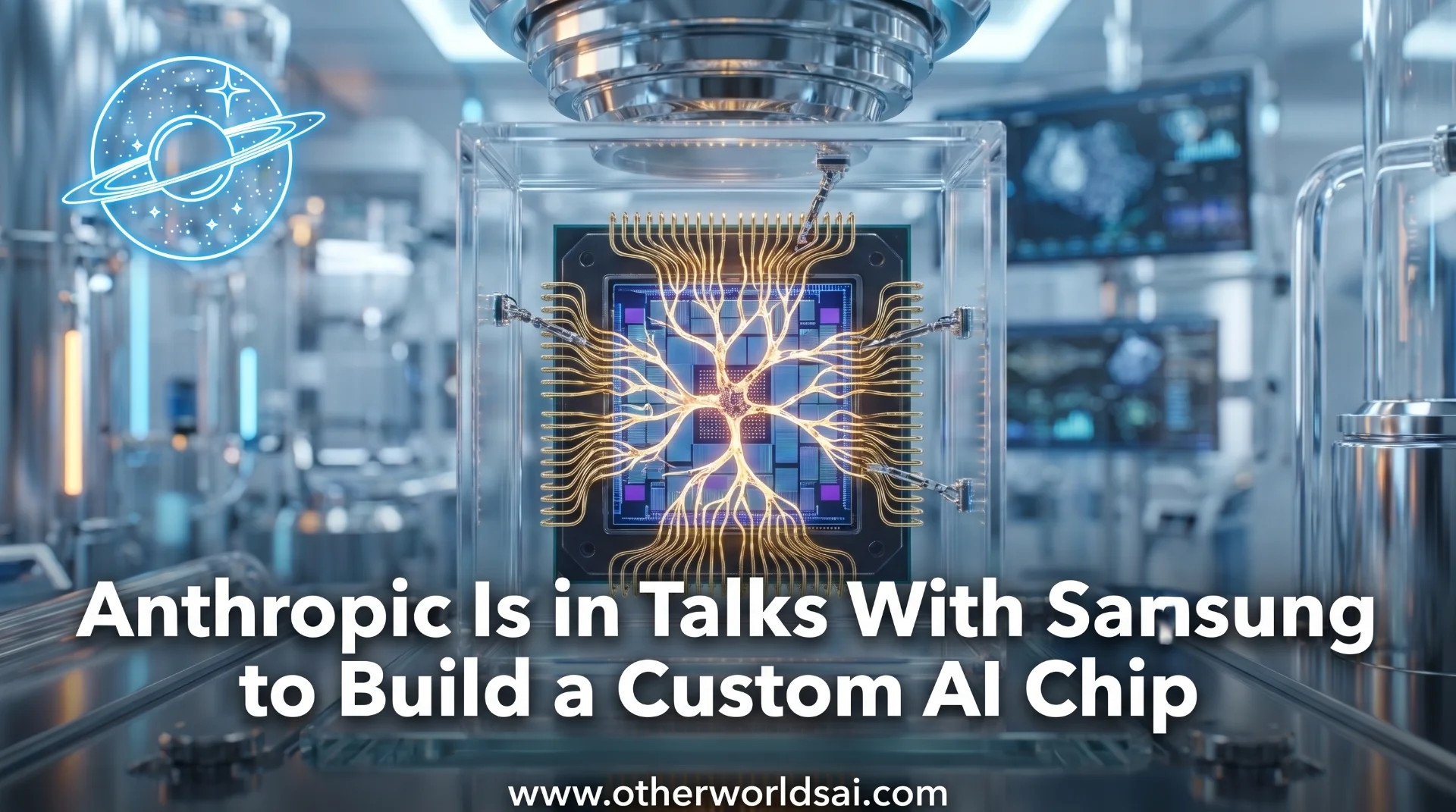
Move Over Nvidia: Anthropic and Samsung Team Up to Break the AI Chip Monopoly
4: Energy Efficiency Gets a New Benchmark:
SenseTime introduced a metric it calls Tokens Per Watt, pitched as a replacement yardstick for measuring AI data centre efficiency.
The metric is paired with a Computing-Power Collaboration Agent that handles resource scheduling, electricity price prediction, and energy storage optimisation across what the company describes as an eight-level data system with five decision chains.
Combining compute, electricity pricing, and automated scheduling, SenseTime claims an 80% increase in token output per unit of electricity cost, average power prices 10% below comparable regional data centres, and 96% accuracy in computing load prediction.
Electricity price arbitrage and load forecasting accuracy tend to perform differently once a system runs through a full seasonal cycle with genuine demand volatility, rather than the conditions under which a vendor typically runs its pilot — so these are claims worth watching over the next several quarters rather than accepting at face value.
Support our research
Independent analysis fueled by you.
5: Physical Infrastructure Spans Shanghai to Riyadh:
Beyond the headline partnerships, SenseTime is building out physical compute capacity across several continents.
The company says its Shanghai facility runs the country's first data centre rated at what it calls '5A' intelligent computing level, handling over 20 trillion tokens daily across more than 20 industries. A Yancheng site has launched with an initial 3,000 petaflops of capacity focused on energy, manufacturing, and low-altitude economy applications.
In Hong Kong, SenseTime is building what it describes as the territory's largest domestic intelligent computing centre, targeting 40,000 petaflops by 2030, and the company also plans what it calls China's first overseas domestic computing cluster in Saudi Arabia, positioned as a full-stack domestic computing base for the Middle East.
On the research side, SenseTime's tie-up with the Shanghai AI Laboratory, Beijing Zhongguancun Academy, Shenzhen Hetao Academy, the Shanghai Algorithm Innovation Research Institute, and Shanghai Jiao Tong University's AI school aims to build a shared platform spanning compute, tooling, and model capability for life sciences, materials science, and manufacturing research — part of what Yang called a key lever for paradigm innovation in basic research, tying the initiative to China's broader 'Artificial Intelligence+' policy push.
6: Space, Optical, and Quantum Computing Bets:
SenseTime's ambitions extend well past near-term infrastructure, into optical computing, quantum computing, and a space-based computing constellation.
Alongside optical computing work aimed at data centre efficiency and quantum computing applications for AI optimisation, SenseTime's partnership with satellite manufacturer Guoxing Aerospace aims to build what the two companies call the SenseTime Space Computing Constellation.
The plan calls for a first satellite launch in 2026, building toward thousands of computing satellites and computing capacity in the tens of thousands of petabytes by 2030 — a timeline with no real precedent to measure against. Yang argued the value extends past raw capability, framing space-based computing as a way to extend the reach of Chinese AI services into weak-network environments such as maritime operations and disaster response, and by extension to support China's AI exports internationally.
7: What Enterprise Buyers Should Take From This:
Strip away the forecasts and the story is still a real one: SenseTime is assembling a genuinely broad coalition to scale domestic AI compute.
But for enterprise buyers, the throughline is clear: the infrastructure ambition is real, while the performance claims underpinning it — token throughput growth, cost-effectiveness versus Nvidia, energy efficiency gains, and load prediction accuracy — remain self-reported until independent numbers catch up. The figure to watch is whether SenseTime actually hits 10 trillion tokens a day when Q4 2026 closes, and whether its space computing timeline holds up against a schedule that has no industry precedent to measure against.
The Bigger Lesson for Growing Businesses.

Meta's Next Big Bet: This New App Lets You Build Games Simply by Typing a Prompt
SenseTime's Galaxy Project is a reminder that impressive AI infrastructure headlines and proven, working AI infrastructure are two different things — the real test comes when vendor-reported numbers meet a customer's actual environment. Businesses evaluating AI don't need to bet on five-year forecasts or unverified benchmarks.
They need automation that works today, in their actual workflows. That's the philosophy behind Agent+, Otherworlds AI's business automation platform: practical AI agents that handle scheduling, follow-ups, reporting, and customer communication reliably, without the hype cycle.
Agent+ is available starting at $297/month, built on Google Opal automated workflows, with custom enterprise AI builds available for teams that need more.
See how Agent+ can work for your business at otherworldsai.com.