
The Split-Second Mistake That Sends Your Legal Leads Straight to Competitors:
Why Your Law Firm Is Losing Clients Before the Phone Even Stops Ringing:
Law firms miss roughly 35% of incoming calls and forfeit an estimated $109 billion a year industry-wide — here's how AI intake agents close the gap.
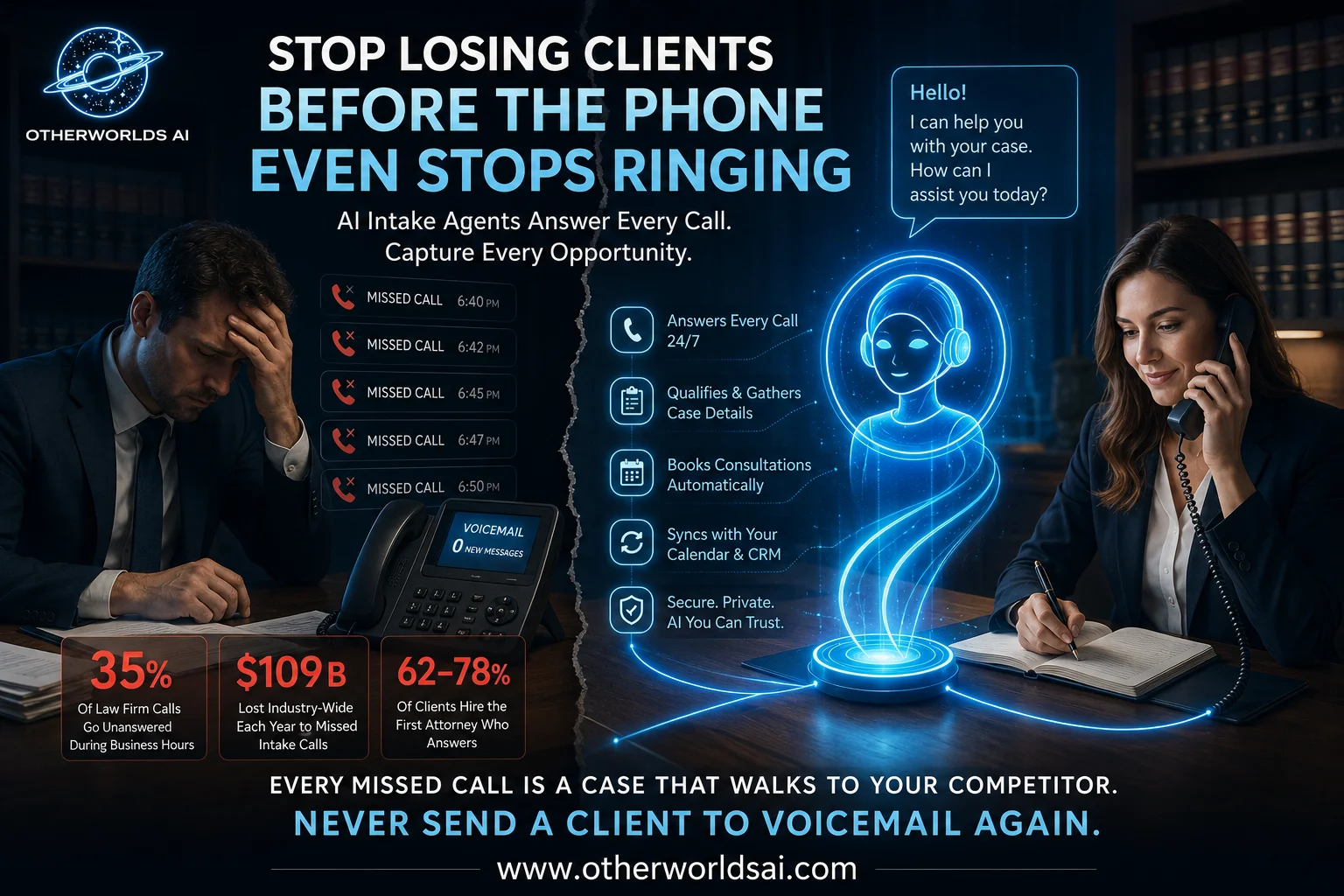
35%: Of Law Firm Calls Go Unanswered During Business Hours
$109B: Lost Industry-Wide Each Year to Missed Intake Calls
62–78%: Of Clients Hire the First Attorney Who Answers
A prospective client calls your firm at 6:40 PM after a car accident, a custody dispute, or an arrest. Nobody picks up. They don't leave a voicemail — most callers never do — they simply call the next firm on the list. Multiply that moment across every solo practice and mid-size firm in the country, and the legal industry loses an estimated $109 billion a year to calls that were never answered. It's not a marketing problem. It's an intake problem, and it has a straightforward fix.
1: The Missed Call Is a Missed Case:
Legal intake data paints a consistent picture. Prospective clients reach a live person at only about half of law firms that they call, and firms miss approximately 35% of incoming calls during business hours — a figure that climbs sharply after 5 PM and on weekends, exactly when accidents, arrests, and emergencies happen. Attorneys and legal services already pay the highest average cost per lead of any industry in paid search, so every call that goes unanswered isn't just a missed conversation — it's marketing spend that generated a lead and then watched it walk to a competitor.
The reason this hurts law firms more than most other industries is timing and emotion. People calling about a personal injury, a divorce, or a criminal charge are not casually comparing quotes. They are in crisis, they want an answer now, and they rarely give a firm a second chance. The data backs this up: a large majority of legal clients hire whichever attorney they manage to have a live conversation with first, which means every unanswered call is effectively a referral to the competitor down the street who happened to pick up.
2: Why Legal Intake Breaks Down:
This isn't a staffing failure so much as a structural one. Most small and mid-size firms route intake through whoever happens to be free — a receptionist, a paralegal, or the attorney themselves between court appearances and client meetings. When the attorney is in court, which is much of the week, calls go unhandled. When two prospective clients call in the same five-minute window, one gets answered and the other gets voicemail.
And voicemail, for legal callers specifically, functions less like a message queue and more like a dead end: the overwhelming majority of people who reach it never leave a message and never call back.
Hiring more front-desk staff addresses the symptom at significant fixed cost — salary, benefits, training — without solving the underlying problem of unpredictable call volume and after-hours demand. Legal emergencies don't respect business hours, and a firm that only answers from 9 to 5 is, by definition, unavailable during a large share of the moments when people are actually calling.
Industry research on legal intake consistently finds the same pattern: the firm that has the first live conversation with a prospective client is overwhelmingly the one that gets hired. — everyone else gets voicemail.
— Legal client intake research, 2026

Meta's Next Big Bet: This New App Lets You Build Games Simply by Typing a Prompt
3: What an AI Intake Agent Actually Does:
A 24/7 AI voice and chat agent doesn't replace your attorneys or your front desk — it closes the coverage gap they can't physically fill. Every call gets answered in seconds, day or night, whether it's the fifth call of the morning or the only call at 2 AM. The agent gathers the case details a prospective client would otherwise repeat three times — what happened, when, and what they need — qualifies the lead against your intake criteria, and books a consultation directly onto your calendar before the caller has a chance to hang up and dial someone else.
Because the agent integrates with the practice management and CRM systems firms already run, every captured lead, call transcript, and booked consultation flows straight into the system your team already checks each morning — no separate inbox, no re-keying case details, no lead sitting unclaimed in a voicemail box nobody checks until Monday.
4: The Business Case for 24/7 Legal Intake:
The math is not subtle. A firm with a $10,000 average case value that recovers even one additional client a month from calls that would otherwise go unanswered pays for an AI intake agent many times over — and that's before accounting for the marketing dollars already spent generating the call in the first place. Firms don't need to fix every operational inefficiency to see the return; they need to stop losing the leads they already paid to generate.
The firms pulling ahead in 2026 aren't the ones spending more on ads. They're the ones who made sure that when a prospective client finally works up the nerve to call, somebody — or something — answers.
Support our research
Independent analysis fueled by you.
Never Send a Client to Voicemail Again
Every missed call is a case that walks to the firm down the street. Otherworlds AI's Agent+ Business AI Agents platform answers every call and web chat in seconds, 24/7 — qualifying leads, capturing case details, and booking consultations directly onto your calendar.
Powered by proprietary custom-built AI models — never frontier models, never processed or sold data — and built to integrate with your existing practice management software and CRM.
Starts at $297/month with a one-time setup fee of $497–$1,497. For firms with more complex intake workflows, our team also builds custom enterprise AI solutions.
Learn more at otherworldsai.com