
The Hidden AI Giant Behind Nvidia’s Success Just Landed on Wall Street:
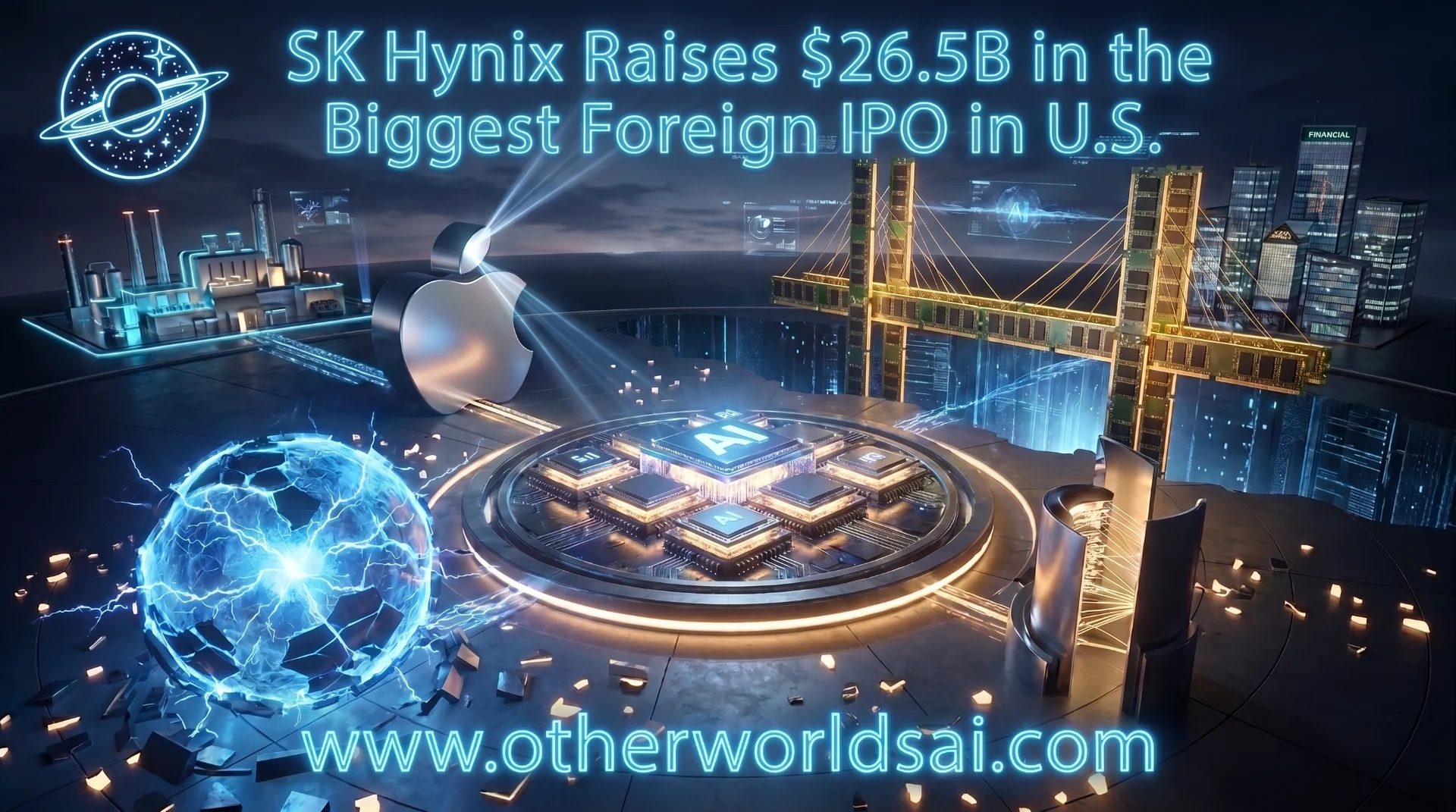
SK Hynix Raises $26.5B in the Biggest Foreign IPO in U.S. History:
Now Washington wants the memory chip giant to build the next fab on American soil.
$26.5B: Raised in U.S. IPO Debut
7X: Oversubscribed by Investors
$550B+: Korea's Domestic Chip Pledge
1: A Record-Breaking Wall Street Debut:
South Korea's SK Hynix just made U.S. IPO history. The memory chip giant announced Friday that it raised $26.5 billion (KRW 40 trillion) in its American debut, selling 177.9 million American depositary shares (ADRs) at $149 each. The structure lets U.S. investors buy in at roughly a tenth of the cost of a full share back home in Seoul. It's the largest-ever U.S. listing by a non-American company, surpassing Alibaba's $25 billion IPO in 2014.
Trading began Friday, July 10 under the temporary ticker SKHYV, with regular trading opening Monday, July 13 under the permanent ticker SKHY. Investors wasted no time showing their enthusiasm: the stock opened 14% above its IPO price, and shares kept climbing through early trading.
2: Demand Blew Past Expectations:
The offering priced at only a modest premium at home, just 2.7% above SK Hynix's own three-day average share price in Seoul, according to its Korea Stock Exchange filing. Yet demand from U.S. investors told a very different story: the offering was reportedly more than seven times oversubscribed.
Korean companies have long traded at a discount to global peers due to governance concerns, low shareholder returns, and geopolitical risk. SK Hynix's IPO suggests investors are willing to look past that discount when the underlying business sits at the center of the AI boom.
That's the so-called Korea Discount, a valuation gap investors often attribute to complex corporate governance, weak shareholder returns, regulatory uncertainty, and geopolitical risk tied to North Korea. SK Hynix appears to be the exception that proves the rule, largely because of what it makes.
3: Why Investors Can't Get Enough of SK Hynix:
The company sits at the center of the AI hardware supply chain. SK Hynix is a leading producer of high-bandwidth memory (HBM), the memory technology that powers today's AI GPUs. Nvidia relies on SK Hynix as one of its primary HBM suppliers, putting the chipmaker directly in the path of the AI infrastructure buildout that's driving global tech investment.
The IPO proceeds are earmarked for exactly that growth. Per its filing, SK Hynix plans to direct the funds toward a new fab in South Korea currently under construction to address a worldwide memory shortage, a new packaging facility, and additional EUV scanners, the machines required to manufacture next-generation chips.
4: Washington Wants Fabs on American Soil:
The U.S. government is pushing for more than just capital. U.S. Commerce Secretary Howard Lutnick visited a Micron event Thursday with a pointed message for the broader memory chip industry. He's reportedly already in talks with both Samsung and SK Hynix about building new factories in the United States, aiming to reduce South Korea's dominance over this critical technology.
● Micron is already committing at scale: the U.S. memory maker announced plans to invest $250 billion in new American manufacturing, a commitment it says will create more than 90,000 jobs and keep leading-edge chip production domestic.
● South Korea is investing heavily at home too: SK Hynix and Samsung recently pledged a combined $550 billion for new manufacturing investment inside South Korea, underscoring just how much is riding on memory chip capacity worldwide.

Meta's Next Big Bet: This New App Lets You Build Games Simply by Typing a Prompt
5: A Supply Chain Under Pressure:
The timing of these announcements isn't a coincidence. AI demand has created a global memory chip shortage, and every major producer, SK Hynix, Samsung, and Micron alike, is racing to expand capacity. Lutnick's push for U.S.-based fabs adds a geopolitical dimension to what was already an intense capital race, with Washington keen to avoid depending entirely on South Korea for a technology this critical to AI infrastructure.
For now, SK Hynix's capital is flowing back into South Korea, not the U.S., even as it taps American investors for the funds. Whether Lutnick's conversations with SK Hynix and Samsung translate into new U.S. fabs will be one of the more consequential storylines in the AI hardware race over the next few years.
6: What This Means for AI Infrastructure:
The scale of capital moving into AI infrastructure is staggering. Between SK Hynix's $26.5 billion IPO, Micron's $250 billion U.S. investment, and Korea's $550 billion domestic pledge, well over $800 billion is now committed to memory chip capacity alone. That's a signal of just how central AI compute has become to the global economy, and how much further the buildout still has to go.
The Bigger Picture: Infrastructure Decisions Are Happening at Machine Speed:
SK Hynix's record-breaking IPO and the resulting push for new U.S. fabs are ultimately about one thing: keeping pace with AI demand that shows no signs of slowing. The same urgency applies inside every organization racing to build AI-ready infrastructure, whether that's a semiconductor fab or a customer-facing workflow.
Otherworlds AI's Agent+ Business AI Platform helps growing businesses put that same AI momentum to work internally, automating operations, content, and customer engagement without waiting years for the payoff.
Support our research
Independent analysis fueled by you.
Explore Agent+ at otherworldsai.com and see how AI-driven infrastructure can start paying off this quarter, not this decade.