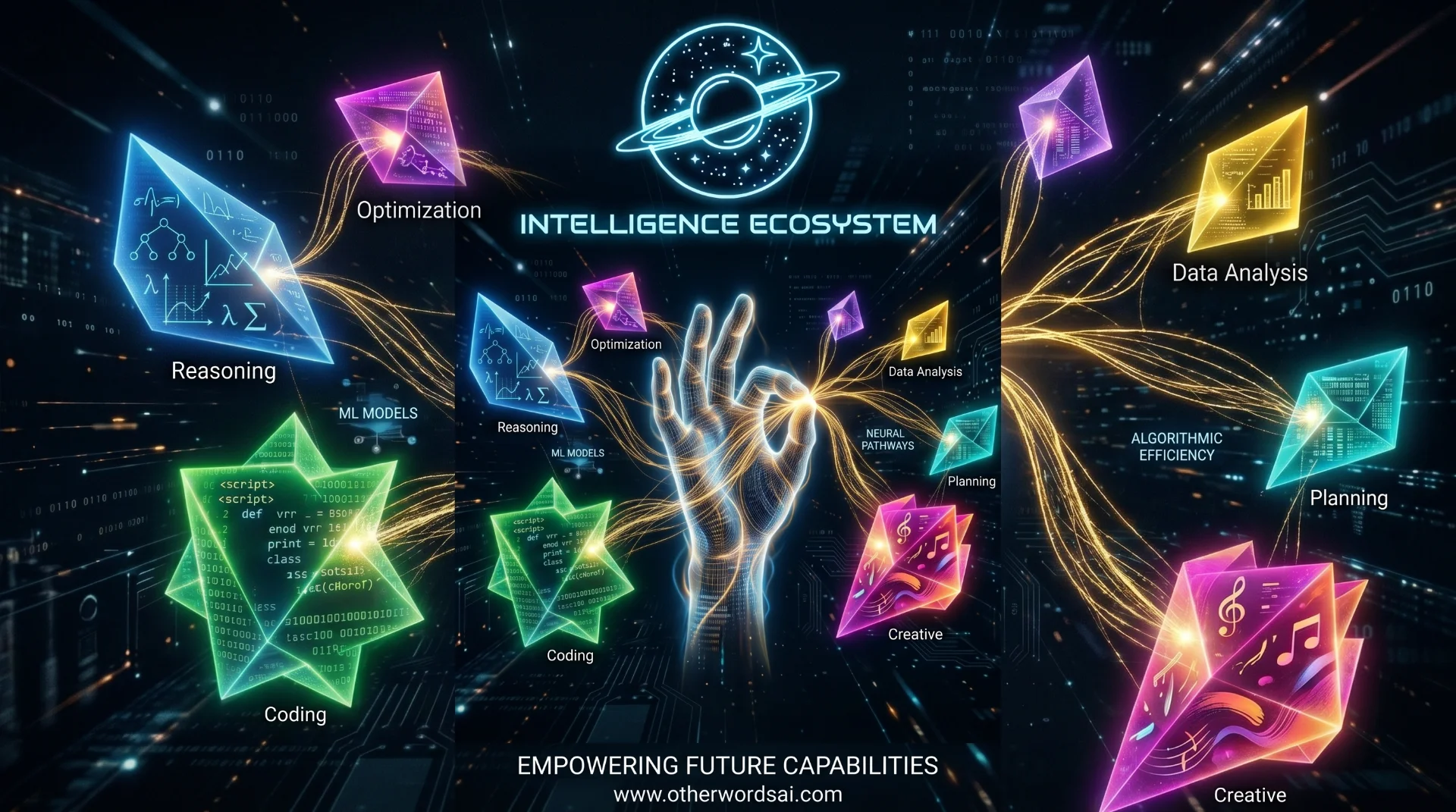

Base44's launch of its own LLM signals a broader shift in AI product strategy — one built on vertical integration, cost control, and defensible data.
Inside Base44’s $80M Move: Why the Vibe Coding Platform Built Base1:
1: The Vibe Coding Arms Race Just Got Serious:
When Base44 launched, it was a team of eight with a six-month-old product. Today, it's a $80M acquisition operating on its own AI model — and the implications for every business using AI tools are significant.
Base44, the Tel Aviv-based vibe coding platform acquired by Wix for $80 million just a year after founding, has begun rolling out Base1 — its own proprietary large language model trained on tens of millions of real user interactions. This isn't just a product milestone. It's a strategic declaration: the era of fully relying on frontier models for specialized AI applications may be winding down.
For businesses evaluating AI platforms — whether for app creation, workflow automation, or enterprise operations — this shift carries direct implications for cost, performance, and vendor risk.
$80M: Wix acquisition of Base44
$100M+: Base44 annual recurring revenue
10M+: User interactions trained on Base1
2: The Core Question — Frontier Models vs. Specialized Models:
The AI industry has been wrestling with a fundamental question: are frontier models like GPT-4 or Claude Opus really the best choice for every use case? For general-purpose tasks, the answer is often yes. But for highly specific applications — like generating production-ready code from natural language, which is Base44's entire value proposition — a model trained on domain-specific data can outperform a much larger general model.
Base44 founder Maor Shlomo put it directly: training and owning the model as part of the entire stack allows far more optimizations on latency, cost, and efficiency. This isn't theory — it's a strategy already validated by frontier AI's commercial reality.
"Models are progressing, but they'll stay very general in what they can do." — Maor Shlomo, Founder, Base44
The counterpoint, however, is real. Jonathan Userovici of Headline VC — whose firm backs Mistral AI — cautions against underestimating frontier models. He points to Harvey, the legal tech AI startup, which ultimately abandoned plans to build its own model. The lesson: specialized model development is a massive engineering investment that only makes sense at scale.
3: Defensibility in AI — Data, Distribution, and Stack Ownership:
In AI, defensibility has three pillars: data, distribution, and tech stack. Most AI startups own one, maybe two. Base44 is now betting it can own all three.
According to Userovici, players with strong brands are now leaning into data and infrastructure to cement their positions. Base44's Base1 model was developed on a dataset generated from tens of millions of real user interactions — a proprietary training asset that competitors cannot replicate without matching platform scale.
This gives Base44 a reinforcing flywheel: more users generate more data, which trains a better model, which attracts more users. It's the same compounding dynamic behind why Anthropic, OpenAI, and Google have such durable moats — and it's now filtering down to applied AI platforms.
Pillar: :Base44 (Post-Base1) :Typical AI SaaS
Distribution: :Wix ecosystem + direct platform: :Third-party channels
Data: :10M+ proprietary interactions: :Limited / shared
Tech Stack: :Fully owned (Base1 LLM): :Rented frontier models
4: The Cost Pressure Driving AI Infrastructure Change:
Enterprise AI buyers are no longer asking 'what's the most powerful model?' They're asking 'what's the right model for this task, and what does it cost?'
Userovici frames it clearly: enterprise customers don't always see an ROI when using the latest models for all use cases. As a result, an entire infrastructure layer is emerging to handle orchestration and optimization — selecting the right model for each task so that costs don't skyrocket while maintaining comparable performance.
Base44's Base1 model targets exactly this problem. Shlomo noted the company wants a model that is more optimized to what users want in terms of results — and faster and cheaper than using frontier models like Opus. For a platform doing millions of AI-assisted code generations monthly, even marginal cost reductions per inference translate into structurally better margins at scale.
"An entire infrastructure is being set up to do orchestration and optimization to select the right models so that costs don't skyrocket while maintaining the same performance." — Jonathan Userovici, Headline VC
This cost dynamic matters for businesses too. If you're running AI across multiple workflows — customer support, document processing, data analysis, code generation — using a single premium frontier model for every task is the equivalent of using a Ferrari to pick up groceries. The smarter approach is orchestration: the right model for the right job.
5: Competitive Landscape — Frontier Labs Are Coming for the App Layer:
Base44's biggest threat isn't Lovable or other vibe-coding competitors. It's Anthropic, xAI, and OpenAI moving further into the application layer themselves.
Cursor and xAI (Grok's parent company) now both belong to SpaceX. Claude Code has evolved into a vibe coding platform in its own right. These moves give frontier AI providers direct access to the feedback loops and domain-specific data they need to compete with specialized platforms — at a cost advantage that's hard to beat.
Shlomo's bet is that specialization still wins — that Base44's deep domain focus on app creation, combined with proprietary data and full stack ownership, creates an advantage that general-purpose labs can't easily replicate. It's a reasonable thesis, but one that requires continuous execution to hold.
Platform: :Model Strategy: :ARR: :Key Risk:
Base44: :Own LLM (Base1) :$100M+ :Frontier labs encroachment
Lovable: :External frontier models :$500M+ :Model dependency / cost
Claude Code: :Anthropic native :N/A (lab-owned) :General vs. specialized
Cursor + xAI: :SpaceX integration: :Undisclosed :Consolidation risk
6: What This Means for Your Business — And Why Orchestration Is the Answer:
The Base44 story isn't just about one company building an LLM. It's a signal that the AI industry is maturing into a multi-model world — and businesses that aren't thinking about orchestration are leaving performance and cost on the table.
Here's what forward-thinking businesses should take from this shift:
• Not every task needs a frontier model. Routing simpler, high-volume tasks to optimized, cost-efficient models — exactly what Base44 is building Base1 to do — is the infrastructure pattern that enterprise AI is moving toward.
Meta's Next Big Bet: This New App Lets You Build Games Simply by Typing a Prompt
• Proprietary data is your competitive moat. If you're running AI workflows without capturing and leveraging the interaction data those workflows generate, you're building on rented ground.
Support our research
Independent analysis fueled by you.
• Vendor lock-in is a real risk. Platforms dependent on a single external model provider face compounding exposure as pricing, API limits, and model capabilities shift. Orchestration across models is the hedge.
• Automation at scale requires AI that adapts. Rigid, one-size-fits-all AI implementations will be outcompeted by adaptive systems that select the right model, prompt, and workflow for each specific task.

Move Over Nvidia: Anthropic and Samsung Team Up to Break the AI Chip Monopoly
This is precisely the capability set that Otherworlds AI's Agent+ Business AI Platform was built to deliver. Agent+ provides businesses with intelligent workflow automation that doesn't lock you into a single model — it orchestrates across AI capabilities to deliver the right output at the right cost for every process in your operation.
From customer-facing interactions to back-office automation and data analysis pipelines, Agent+ brings the kind of adaptive, multi-model intelligence that previously required a team like Base44's to build from scratch. With Google Opal-powered automated workflows integrated directly into the platform, businesses can deploy sophisticated AI orchestration without an engineering department.
Agent+ gives your business the orchestration layer that enterprise AI demands — without the $80M R&D budget to build it yourself.
The AI platforms winning in 2026 aren't the ones with the biggest models. They're the ones with the smartest systems — selecting the right model, at the right cost, for the right task, in real time. That's the Otherworlds AI advantage.
Ready to bring adaptive AI orchestration to your business? Explore Agent+ at otherworldsai.com and see how intelligent automation can replace the overhead of building it yourself.