
How Stanford Researchers Used AI to Build a Drug-Busting Phage Cocktail.
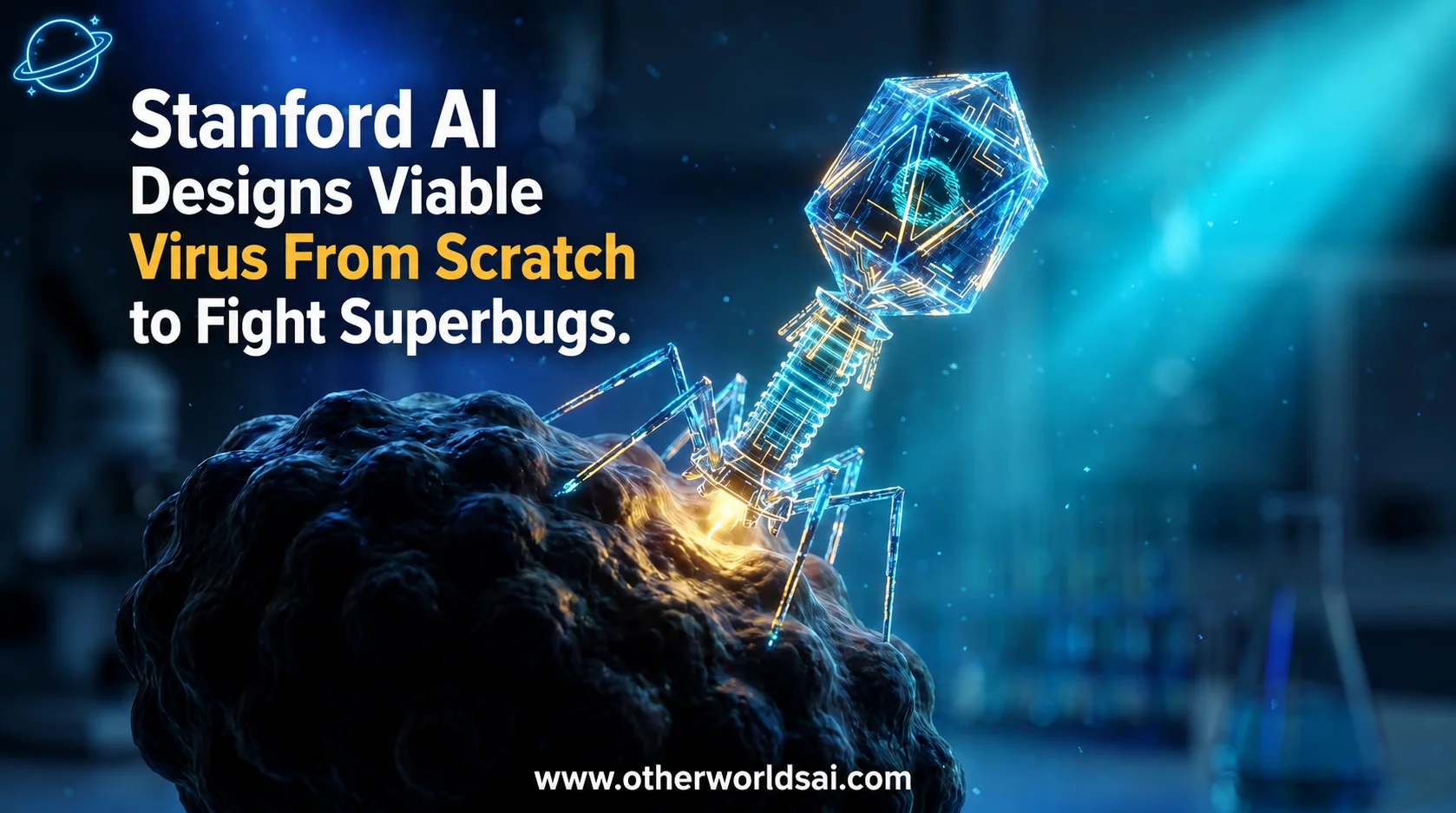
Stanford's Evo 2 AI Designs Viable Bacteriophages to Fight Drug-Resistant E. coli A generative AI model wrote an entire viral genome end-to-end — and some of its designs outperformed nature's original.
~300: phage genomes synthesized from Evo 2 output
16: phages selected for a resistance-busting cocktail
6,000: base pairs in the ΦX174 target genome
1: From a Snippet to an Entire Genome:
Researchers at Stanford have pushed generative AI past editing DNA and into authoring it outright.
Nearly 300 phage genomes generated by the Evo 2 model were synthesized in the lab, and 16 of them showed particularly strong activity against E. coli. The work centers on bacteriophage ΦX174, built by Brian Hie, an assistant professor of chemical engineering, with bioengineering graduate student Samuel King leading the experimental side.
Rather than nudging an existing sequence, the team asked Evo 2 to generate a complete ΦX174 genome in a single left-to-right pass with no added scaffolding. Hie described it plainly: the model was asked to generate the entire genome end-to-end, with nothing added by the researchers. The process produced thousands of candidate genomes before any were chosen for synthesis.
ΦX174 is a relatively small test case — its genome runs under 6,000 base pairs, compared to roughly 3 billion in the human genome. Even so, Hie noted that making sense of a sequence with a few thousand characters, gene by gene, is genuinely difficult. Some of Evo 2's designs outperformed the native phage in the lab, showing that a model can build a fully viable viral genome rather than just proposing local tweaks.
2: Screening Before a Single Base Gets Synthesized:
Generating thousands of genomes is the easy part — deciding which ones are worth building is where the real engineering happened.
King developed a computational framework to narrow the candidate pool before committing to DNA synthesis, assessing traits drawn from ΦX174 and related phages. As King put it, the process ran through generating genomes with Evo 2, evaluating them against design criteria, selecting the strongest candidates, synthesizing them chemically, and finally testing them in the lab to see which ones actually worked.
That screening step mattered for cost as much as for science — Hie said the framework kept synthesis spending focused on the candidates the team judged most likely to succeed. Evo 2 could generate at scale, but computational evaluation, chemical synthesis, and lab assays were still required to find the phages that actually held up.
3: A 16-Phage Cocktail Built to Outlast Resistance:
A single AI-designed phage isn't the point — a mixture that bacteria can't easily out-evolve is.
The team selected more than one E. coli-targeting phage because bacteria can develop resistance to any single treatment. Stanford reports that a cocktail of the 16 selected phages rapidly overcame resistance in E. coli strains that had already become immune to the native ΦX174.
“If the bacteria gains resistance to a single phage, it’s game over for the medication. But if you have multiple genetically distinct phages in a mixture, it would be harder for the bacteria to develop resistance to the entire cocktail.”
— Brian Hie, Stanford

Meta's Next Big Bet: This New App Lets You Build Games Simply by Typing a Prompt
Hie sees the same approach extending to harder targets, including methicillin-resistant Staphylococcus aureus (MRSA) and Pseudomonas aeruginosa, which Stanford identifies as a leading cause of drug-resistant infections acquired in hospitals.
4: Open-Sourced, With Open Questions Attached:
Hie has released Evo 2 as open-source software, letting other researchers download the model and design their own genomes.
That openness has already prompted safety and security discussion. Hie has acknowledged that bad actors could modify versions of the tool, while arguing that existing pathogens pose a greater practical risk simply because they're easier to access and produce today.
He's also pointed to potential upside beyond phage therapy — AI-enabled systems that could support responses to naturally occurring pandemics and provide defensive options against engineered biological threats.
Support our research
Independent analysis fueled by you.
King framed the project's significance in more immediate terms, pointing to the creative range these models now open up for researchers. Stanford says the next phase will push Evo 2 toward longer, more complex DNA, potentially including small bacterial genomes for engineered microbes that produce chemicals, medicines, or fuels. Hie summed up what's left to solve as two open questions: how to get greater genetic novelty out of the model, and how to get greater control over the outcomes it produces.
The Enterprise Lesson: Purpose-Built AI Wins:
Evo 2 didn't win by being a general-purpose model asked to do biology on the side — it won by being built, screened, and validated specifically for genome design, with a workflow that paired generative output against a rigorous evaluation framework before a single dollar went to synthesis.
That's the same principle behind Otherworlds AI's Agent+ Business AI Platform: purpose-built agents, matched to your workflow, with the evaluation and guardrails to make automation trustworthy rather than just impressive in a demo.
See how Agent+ can be built around your business at otherworldsai.com.