
Mistral Large 4 Preview: A 1 Trillion-Parameter Open-Weight AI Model Is Coming:
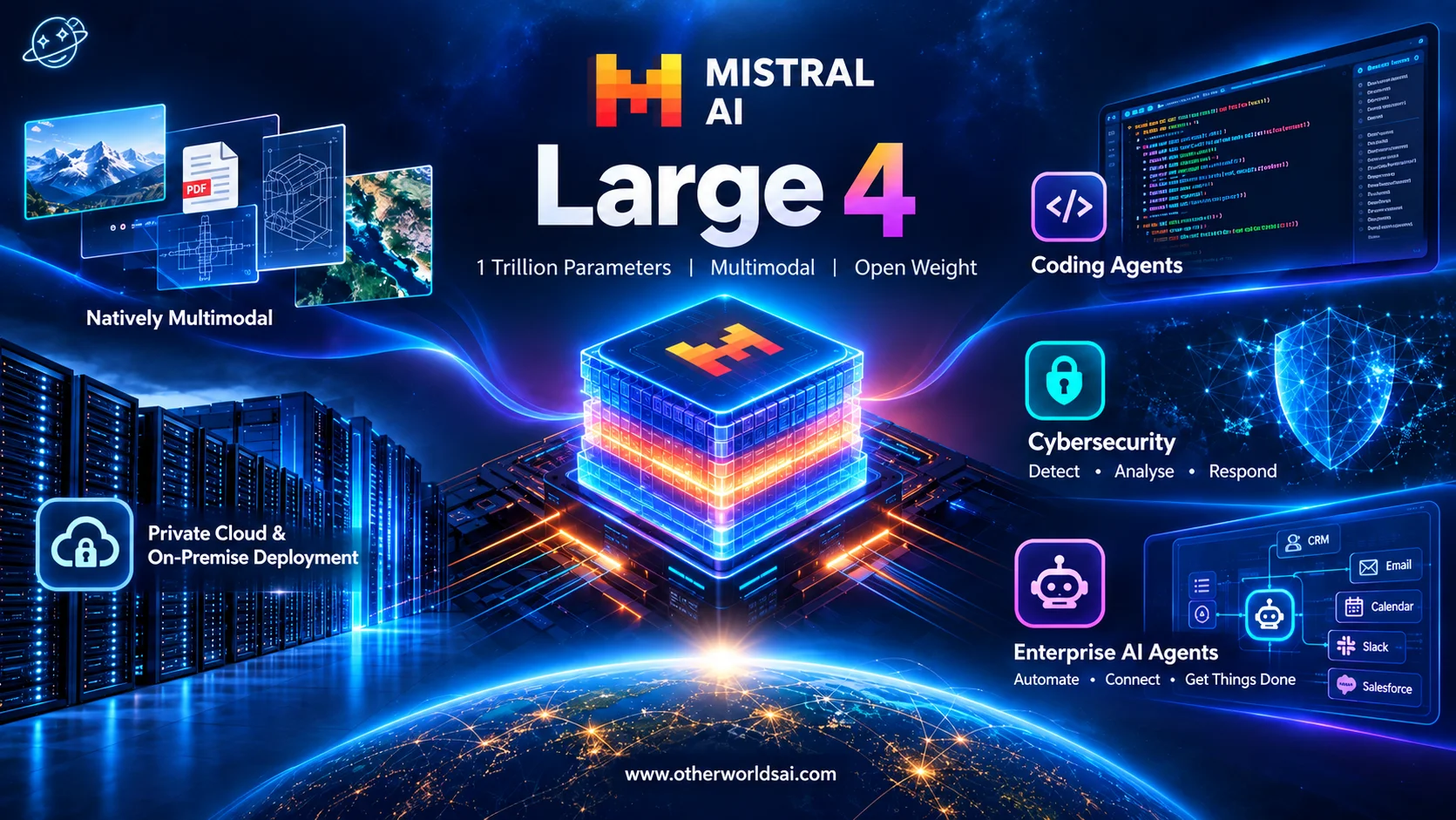
Mistral AI is preparing to make one of its most ambitious artificial intelligence models available to the open-weight community. The company has announced a public preview of Mistral Large 4, a natively multimodal AI model built with 1 trillion parameters, of which approximately 49 billion are active parameters at inference time.
The preview is already available through Mistral Studio, while Mistral says the model weights are scheduled for release by the end of October 2026.
The announcement is significant for the AI industry because Mistral Large 4 combines several capabilities that are increasingly important for enterprise AI: multimodal reasoning, coding, cybersecurity, autonomous AI agents, visual understanding, long-context processing and reinforcement learning.
For businesses considering private AI infrastructure, the upcoming open-weight release could be particularly interesting because Mistral plans to support private-cloud and on-premise deployment.
Mistral Large 4: A Giant Model With a Smaller Active Footprint:
Mistral Large 4 has been developed as a Mixture-of-Experts (MoE) style large language model, with around 1 trillion total parameters and approximately 49 billion active parameters. That distinction matters.
A trillion-parameter model does not necessarily mean that all one trillion parameters are processed for every token. With an architecture that activates only a subset of parameters for each task, the model can potentially deliver the capabilities of an extremely large AI system while making inference more practical.
Mistral has nicknamed the model “le Chonk,” a name that reportedly began as an internal meme before becoming associated with the project.
The company says Large 4 was trained from scratch using 3,800 NVIDIA Grace Blackwell GPUs in Mistral's European data centres.
The same infrastructure is being used for the current public preview.
Multilingual and Multimodal AI From the Ground Up:
One of the defining characteristics of Mistral Large 4 is that it was designed as a natively multimodal AI model.
Rather than focusing exclusively on text, the system is intended to work across different forms of information, including text and visual content.
Mistral says its training data covers more than 160 languages, including all official languages of the European Union.
That multilingual capability could make the model particularly relevant to international businesses, governments and enterprises operating across multiple markets.
For companies building AI agents, customer-service assistants, enterprise copilots and multilingual automation systems, language coverage can be just as important as raw benchmark performance.
Mistral Large 4 Takes Aim at AI Cybersecurity:
Cybersecurity is one of the areas where Mistral is putting considerable emphasis on Large 4. The company says it is currently red-teaming the model in real-world environments with cybersecurity leaders, vetted partners and state authorities.
Mistral says these organisations are being given access to the same underlying model with reduced moderation and expanded cybersecurity capabilities so that researchers can examine how the system performs in realistic security environments.
According to Mistral's reported results, Large 4 ranks among the top five models on the Artificial Analysis Cyber Index.
The company reports an 82% score on a test requiring an AI model to reproduce a real vulnerability in open-source software and subsequently patch it. Mistral says this was the highest score achieved by a model on that particular test.
The company also reports that Large 4 solved 93% of Cybench's 40 cybersecurity competition exercises.
In internal testing, Mistral says the model showed potential for:
- Malware analysis
- Vulnerability prioritisation
- Security research
- Detection-rule creation
- Software vulnerability analysis
- Incident-response assistance
These capabilities highlight an important shift in enterprise AI: large language models are increasingly being evaluated not only as chatbots, but as AI cybersecurity assistants capable of interacting with code and technical environments.
AI Security Requires More Than Refusals:
Mistral is also making an argument about how AI security models should be deployed. The company says that excessive provider-level refusals can sometimes interfere with legitimate activities such as vulnerability research, penetration testing and incident response.
Its planned open-weight release could give organisations more control over how the model is configured and deployed.
This is particularly relevant for enterprises that cannot send sensitive information to a third-party AI service.
With private-cloud and on-premise AI deployment, organisations could potentially run the model inside their own infrastructure and establish their own security, compliance and governance policies.
That approach aligns closely with the growing demand for private AI, sovereign AI infrastructure and enterprise AI data privacy.
Mistral Large 4 and Coding Agents:
Software development is another major focus of Large 4.
Mistral reports the following scores:
- 61.7% on DeepSWE v1.1
- 59.4% on SWE-Atlas-QnA
- 28.3% on Terminal-Bench 4
- 49.8% combined Coding Agent Index score
The model was also evaluated through a blind human assessment conducted with Surge AI, where professional annotators rated coding outputs without knowing which model generated them.
Large 4 Preview ranked second out of five models, receiving a score of 3.74 out of 5.
According to the supplied results, Claude Opus 5 ranked first with a score of 4.22.
These results point toward a broader trend in enterprise software development: AI models are moving beyond code completion toward coding agents capable of understanding repositories, debugging software, using tools and completing multi-step engineering tasks.
For developers, the important question is no longer simply whether an AI model can write code.
The bigger question is whether an AI coding agent can understand an entire software environment and actually complete useful work.
From Chatbots to Autonomous AI Agents:
Large 4's reported performance on business automation benchmarks is another interesting part of the announcement.
Mistral says the model achieved 59.9% on AutomationBench, which covers 657 business workflows involving applications such as Gmail, Google Sheets, Slack and Salesforce.
This type of benchmark is particularly relevant to the emerging agentic AI market. Traditional generative AI responds to prompts.
Agentic AI attempts to understand a goal, plan a sequence of actions, interact with software tools and complete the task.
That distinction is increasingly important for businesses.
An enterprise AI agent could potentially handle activities such as:
-
Customer service → understand a customer request and retrieve relevant information.
-
Sales → update CRM records and initiate follow-ups.
-
Operations → move information between business applications.
-
Finance → process structured information and prepare reports.
-
IT → investigate technical problems and recommend or execute fixes.
The future of enterprise AI is therefore increasingly about workflow automation rather than simple question answering.

The Rise of Sovereign AI: How Mistral AI Built a Regulatory Moat Against U.S. Tech Giants
Visual AI: Technical Drawings, PDFs and Satellite Images:
Mistral Large 4 also demonstrated capabilities beyond traditional text and coding tasks.
The company highlighted visual applications involving:
- Technical drawings
-
PDF documents
-
Satellite imagery
-
Visual grounding
-
Complex visual information
Mistral reports a 42% result on the Dense 200 visual-grounding benchmark, compared with 41% for GPT-6-Astra in Mistral's testing.
Support our research
Independent analysis fueled by you.
Visual grounding is particularly important for AI systems that need to understand where objects, information or relationships appear within an image or document.
For enterprise applications, this could have practical implications for document intelligence, engineering drawings, logistics, manufacturing, geospatial analysis and automated document processing.
Reinforcement Learning at Massive Scale:
One of the more technically interesting elements of Large 4 is the reinforcement-learning infrastructure behind the model.
Mistral says Large 4 uses the same training, customisation and reinforcement-learning environment offered to customers through Mistral Forge.
The reinforcement-learning system combines several different objectives, including:
- Conversational performance
- Scientific problem solving
- Safety alignment
- Factual accuracy
- Long-running tool use
Training environments can include code sandboxes, web search and external APIs. The results can then be evaluated using reward models, unit tests, LLM-based judges and static verification systems.
Mistral reports that at a scale of approximately 3,000 GPUs, a training run can produce around 33 billion tokens per day, including roughly 16 billion trainable completion tokens after filtering and masking.
The reinforcement-learning run behind the current preview is reportedly still underway. This is an important development because future AI systems are likely to depend increasingly on post-training and reinforcement learning, rather than relying only on massive amounts of pre-training data.
Why the Open-Weight Release Matters:
Perhaps the most important part of the announcement is not the preview itself. It is what comes next.
Mistral plans to release the weights of Large 4 by the end of October 2026, together with additional architecture information, benchmark results and details about its post-training methodology.
An open-weight release could allow organisations to experiment with the model in environments where conventional hosted AI APIs are not suitable.
For example, companies with strict data-residency requirements could investigate private deployments.
Healthcare organisations could explore controlled AI environments.
Financial institutions could evaluate models without necessarily sending sensitive data to an external inference provider.
Government organisations could consider sovereign AI deployments.
Technology companies could customise the model for specialised workflows.
This is one reason the open-weight AI movement is becoming strategically important.
What Mistral Large 4 Means for Enterprise AI:
The arrival of models such as Large 4 points toward a new phase of the generative AI market. The competition is no longer simply about who has the biggest chatbot.
AI companies are competing across several dimensions simultaneously:
-
Reasoning: Can the model solve difficult problems?
-
Coding: Can it operate as a software engineering agent?
-
Multimodality: Can it understand text, images, documents and other information?
-
Tool use: Can it interact with external applications?
-
Cybersecurity: Can it analyse vulnerabilities and security incidents?
-
Enterprise deployment: Can businesses run it privately?
-
Customisation: Can organisations adapt it to their own workflows?
-
Efficiency: Can massive models be deployed economically?
Mistral Large 4 is positioned directly in the middle of this competition.
What Businesses Should Watch Before the October Release:
The October open-weight release will provide more information that cannot yet be fully evaluated from the preview announcement.
Businesses should particularly watch for:
- The final model architecture
- Actual hardware and inference requirements
- Licensing terms
- Context-window specifications
- Independent benchmark evaluations
- Cybersecurity testing by third parties
- Fine-tuning capabilities
- Quantisation and optimisation options
- On-premise deployment requirements
- Real-world performance versus proprietary models.
These factors will ultimately matter more to enterprises than a single benchmark score. A model can perform exceptionally well on a benchmark and still be difficult or expensive to deploy in production.
Meta's Next Big Bet: This New App Lets You Build Games Simply by Typing a Prompt
The Bigger Picture: Open AI Models Are Becoming Enterprise Infrastructure:
Mistral Large 4 represents a broader change taking place across the artificial intelligence industry.
The next generation of AI is increasingly moving away from the idea of a model simply being a chatbot.
Instead, AI models are becoming infrastructure for autonomous software agents.
They can reason, write code, analyse documents, interpret images, interact with applications and potentially perform complex business processes.
The open-weight approach adds another dimension: control.
Businesses increasingly want AI systems that they can host privately, customise for their own requirements and integrate deeply into existing infrastructure.
If Mistral delivers on its plans, Large 4 could become an important option for companies looking for a powerful open-weight multimodal AI model without depending entirely on a closed API provider.
OtherworldsAI Perspective:
For businesses exploring private AI agent development, Mistral Large 4 is a development worth watching closely.
The combination of multimodal AI, coding agents, cybersecurity capabilities, reinforcement learning, tool use and planned on-premise deployment fits directly into the direction enterprise AI is heading.
At OtherworldsAI, we see the same fundamental shift: companies increasingly need AI systems that do more than generate text. They need AI agents that can connect with business software, understand proprietary information, automate workflows and operate within controlled environments.
The arrival of increasingly capable open-weight models could make this type of private AI infrastructure more accessible to enterprises.
The real test will come after the weights are released.
That's when developers and businesses will be able to evaluate Large 4 not just by its headline 1 trillion parameters, but by what it can actually accomplish in production.