
From Frontier AI Models to Group Chat Agents: How AI Is Moving Toward Cheaper Models and Smarter Everyday Agents:
The AI industry is entering a new phase. The competition is no longer only about who can build the largest language model or the most powerful chatbot. Increasingly, companies are competing on something more practical: how efficiently AI can reason, how cheaply it can run, and how easily people can use AI inside their existing workflows.
Two recent developments highlight this shift from very different directions.
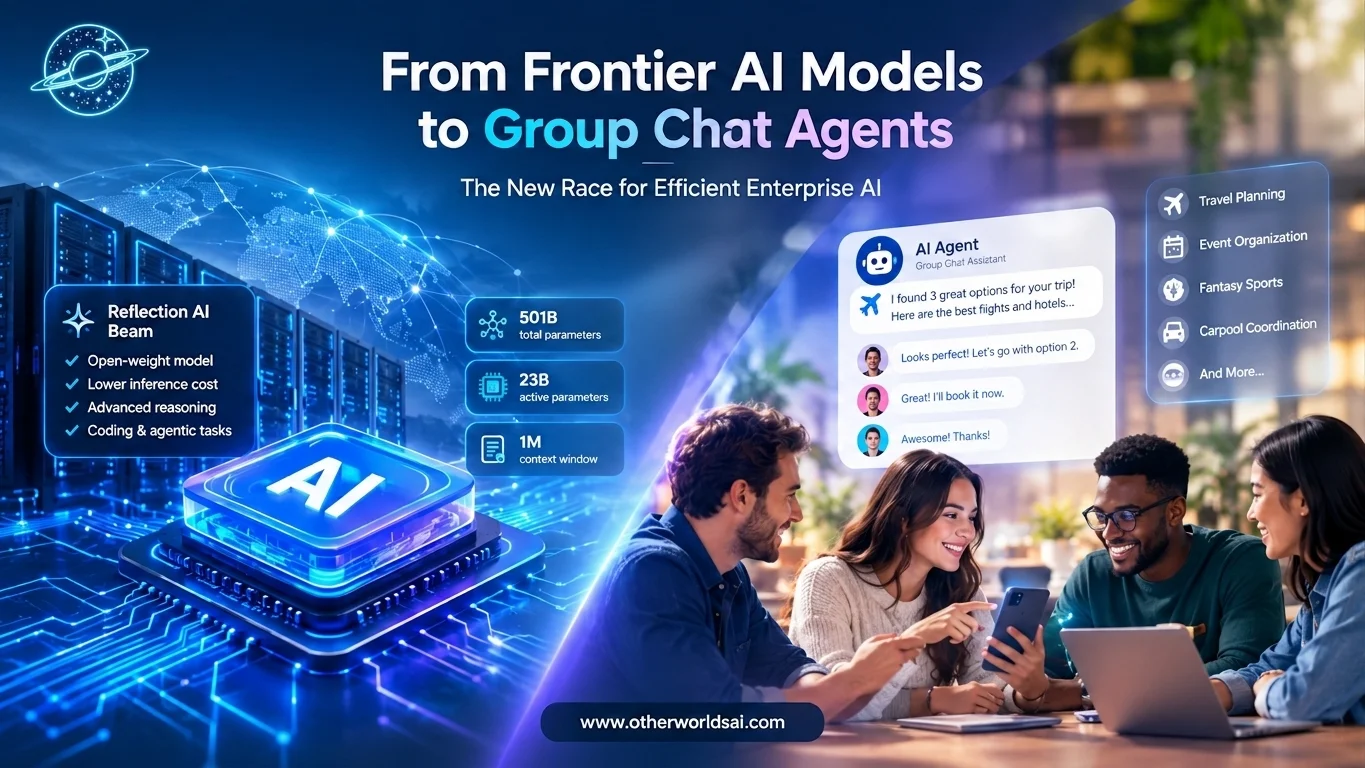
Reflection AI has unveiled Beam, a new open-weight frontier AI model designed to deliver advanced reasoning and coding performance at substantially lower inference costs. At the same time, Instinct is bringing its AI agent into group chats, allowing people to use an AI assistant collaboratively even when some participants do not have an Instinct account.
Together, these developments point toward an important direction for the AI industry: powerful AI is becoming more efficient on the infrastructure side while becoming more integrated into everyday human interactions on the application side.
Reflection AI Introduces Beam: A New Open-Weight AI Challenger:
Brooklyn-based AI startup Reflection AI has officially introduced Beam, its first frontier open-weight AI model.
The company is positioning Beam as a Western competitor to leading open models developed by Chinese AI companies, including DeepSeek, Qwen and Z.ai.
Beam is designed as a text-only mixture-of-experts (MoE) model, with a focus on advanced reasoning, software development and agentic AI tasks.
According to Reflection AI, Beam contains approximately 501 billion total parameters, while only around 23 billion parameters are active during inference. The model was pretrained on approximately 23.8 trillion tokens and supports an impressive 1 million-token context window.
That architecture is significant because the number of total parameters does not necessarily determine the amount of computing power required for every request. A mixture-of-experts system can activate only a portion of its parameters for a particular task, potentially reducing inference costs while maintaining strong performance.
The Bigger Story Is Compute Efficiency:
Reflection AI claims that Beam can achieve performance comparable to leading Chinese open-weight models on advanced reasoning benchmarks while using approximately 3–4 times less inference compute.
The company says Beam is intended to be a practical “workhorse model” for enterprises, developers and public-sector organizations.
These performance claims should still be viewed carefully because they have not yet been independently verified. Benchmark comparisons can also depend heavily on evaluation methodology, prompting techniques and model versions.
Nevertheless, the underlying strategy is important.
For businesses deploying AI at scale, inference cost matters enormously.
A model that requires fewer computing resources can potentially make thousands or millions of AI interactions more economically viable. This becomes particularly important for AI agents that continuously reason, call tools, analyze information and interact with business systems.
In other words, the future AI race may not simply be about building the smartest model. It may be about building the smartest model that organizations can actually afford to run.
Open-Weight AI Is Becoming a Strategic Battleground:
Beam also illustrates the growing importance of open-weight artificial intelligence. The AI market currently contains several competing approaches.
Companies such as OpenAI and Anthropic have largely built their businesses around closed, proprietary models and APIs. Meanwhile, companies including Meta, Mistral and a growing group of Chinese AI developers have contributed to the increasingly competitive open-model ecosystem.
Reflection AI is attempting to occupy an important position between these approaches.
The company says it plans to release Beam's model weights and technical details, while making the model available through hyperscalers, neocloud providers and open-source software integrations.
That could make Beam attractive to organizations that want greater control over their AI infrastructure rather than relying entirely on a closed API.
The AI Factory Vision:
Reflection AI is also pursuing a larger enterprise strategy around what it calls AI factories.
The concept is straightforward: organizations could build customized AI systems using their own proprietary information and infrastructure.
This is particularly relevant for enterprises, governments and sovereign nations that have sensitive data or want greater control over how their AI systems operate.
Reflection has already been testing this concept with Shinsegae Group in South Korea.
The company's enormous investment in computing infrastructure also demonstrates how seriously it is taking the frontier-model race. Reflection has reportedly secured major compute agreements involving Nvidia's advanced chips through 2029.
This highlights another reality of modern AI development:
Model innovation and computing infrastructure are becoming inseparable.
From AI Infrastructure to AI Agents:
While Reflection AI is attacking the infrastructure and model layer, another company is focusing on how people actually interact with AI.
Instinct is expanding its AI agent into group chats. The idea may appear simple, but it represents a meaningful change in how AI assistants could operate.
Instead of interacting with an AI privately, users can bring an AI agent into a conversation involving multiple people.
Imagine planning a holiday with five friends.
Instead of one person searching flights, another checking hotels and everyone arguing about dates, an AI agent could help compare options, coordinate schedules and organize the final plan inside the same conversation.
The same concept could be applied to:
- Travel planning
- Event organization
- Fantasy sports
- Carpool coordination
- Group shopping
- Restaurant planning
- Shared task management
- Holiday gatherings
- Ticket searches
The important part is that participants do not necessarily need their own Instinct account to participate in the conversation.
AI Agents Are Becoming Collaborative:
The development reflects a broader transformation in the AI assistant market.
Early consumer AI products primarily behaved like digital question-answering systems. Users asked a question.
The AI responded. Today's more advanced AI agents are increasingly expected to do more. They can potentially search for information, make plans, interact with applications, execute tasks and coordinate multiple steps.
Group-chat AI pushes that concept one step further.
Instead of an AI assistant working for one person, it can become a shared digital participant in a group workflow.
That could eventually have major implications for businesses as well.

Meta's Next Big Bet: This New App Lets You Build Games Simply by Typing a Prompt
Imagine a sales team discussing a potential customer while an AI agent analyzes the account. Or a logistics team coordinating a delivery while an agent checks schedules and availability. Or a restaurant management team discussing staffing while an AI assistant helps calculate requirements.
The interface changes from:
Human → AI to: Human + Human + AI → Shared outcome
Privacy Becomes More Important:
Putting AI inside group conversations also creates an obvious challenge: privacy. Instinct says its architecture separates a user's personal AI agent from the group's AI agent.
According to the company, the personal agent must request permission before connecting with the group agent or sharing information. Users can also control which groups they trust and revoke that trust.
The distinction is important.
An AI assistant that has access to someone's personal messages, calendar, files or other information cannot automatically be allowed to expose that information to everyone in a group conversation.
As AI agents become more autonomous, permission management, data isolation and user consent will become fundamental parts of agent design.
This is an issue that every enterprise deploying AI agents will need to address.
Support our research
Independent analysis fueled by you.
Two Sides of the Same AI Revolution:
At first glance, Beam and Instinct appear to have little in common.
-
One is a massive open-weight language model.
-
The other is a consumer AI agent for group conversations.
But they are actually part of the same larger movement.Beam represents the infrastructure and intelligence layer.
It is about making advanced AI reasoning more efficient and affordable.
Instinct represents the application and interaction layer.
It is about placing AI directly inside the conversations and workflows where people already operate.
This combination could define the next stage of AI development. AI models need to become cheaper and more capable.
AI agents need to become more useful and more deeply integrated into real-world workflows.
And businesses need infrastructure that can connect the two.
Why This Matters for Businesses:
For enterprises, these developments could have significant consequences. Companies increasingly want AI systems that can work with proprietary information, automate repetitive processes and operate within their existing technology stack.
That means businesses are looking beyond simple chatbots.
They want AI agents, private AI infrastructure, open-weight models, enterprise automation and customized AI systems.
The emergence of models such as Beam could make it easier for organizations to consider alternatives to expensive proprietary AI APIs.
At the same time, agent platforms demonstrate how AI can move from simply generating answers toward performing useful actions.
This is especially relevant to industries such as healthcare, logistics, legal services, finance, hospitality, real estate, customer service and manufacturing.
The Western Open AI Race Is Heating Up:
Reflection AI's ambitions also reveal how competitive the global AI market has become. Chinese AI companies have rapidly demonstrated that highly capable open models can be developed at increasingly competitive costs.
Western companies are now responding with their own open-weight strategies.
Reflection joins organizations such as Meta and Mistral in competing for developers who want powerful models without being completely dependent on closed AI providers.
The competition will likely focus on several factors:
-
Model intelligence: How well can the AI reason and solve complex problems?
-
Inference efficiency: How much computing power does each response require?
-
Context length: How much information can the model process?
-
Open weights: Can developers and enterprises access and customize the model?
-
Agentic capabilities: Can the model perform multi-step tasks?
-
Enterprise deployment: Can organizations run the technology securely with their own data?
-
Total cost of ownership: Can businesses deploy AI economically at scale?
The winners may not necessarily be the companies with the largest models. They may be the companies that combine performance, efficiency, accessibility and practical deployment.
What Comes Next for AI Agents?
The development of group-chat AI suggests that agents could eventually become a normal part of digital communication.

Move Over Nvidia: Anthropic and Samsung Team Up to Break the AI Chip Monopoly
Instead of opening a dedicated AI application every time they need assistance, users may simply add an AI agent to an existing conversation.
That could turn AI into something less like a separate software product and more like a digital team member.
At the same time, open-weight models could give companies greater freedom to build their own AI systems around their specific data and requirements.
This combination could accelerate the growth of private AI agents and customized enterprise AI.
The Future of AI May Be Smaller, Cheaper and More Connected:
The AI industry spent the first major phase of the generative AI boom competing to build increasingly powerful models.
The next phase may be different.
The focus is shifting toward efficient AI models, open-weight systems, autonomous AI agents, private enterprise AI and real-world automation.
Reflection AI's Beam shows the push toward more efficient frontier models.
Instinct's group-chat agent demonstrates how AI can become embedded directly into human collaboration.
Together, they reveal where the industry could be heading: AI that is not only more intelligent, but also cheaper to operate, easier to customize and increasingly present wherever people work and communicate.
For businesses, that means the question is no longer simply “Should we use AI?”
The more important question may soon become:
“Which AI model and agent architecture gives our organization the best combination of intelligence, cost, privacy and control?”
That is the competition that could define the next generation of enterprise AI.