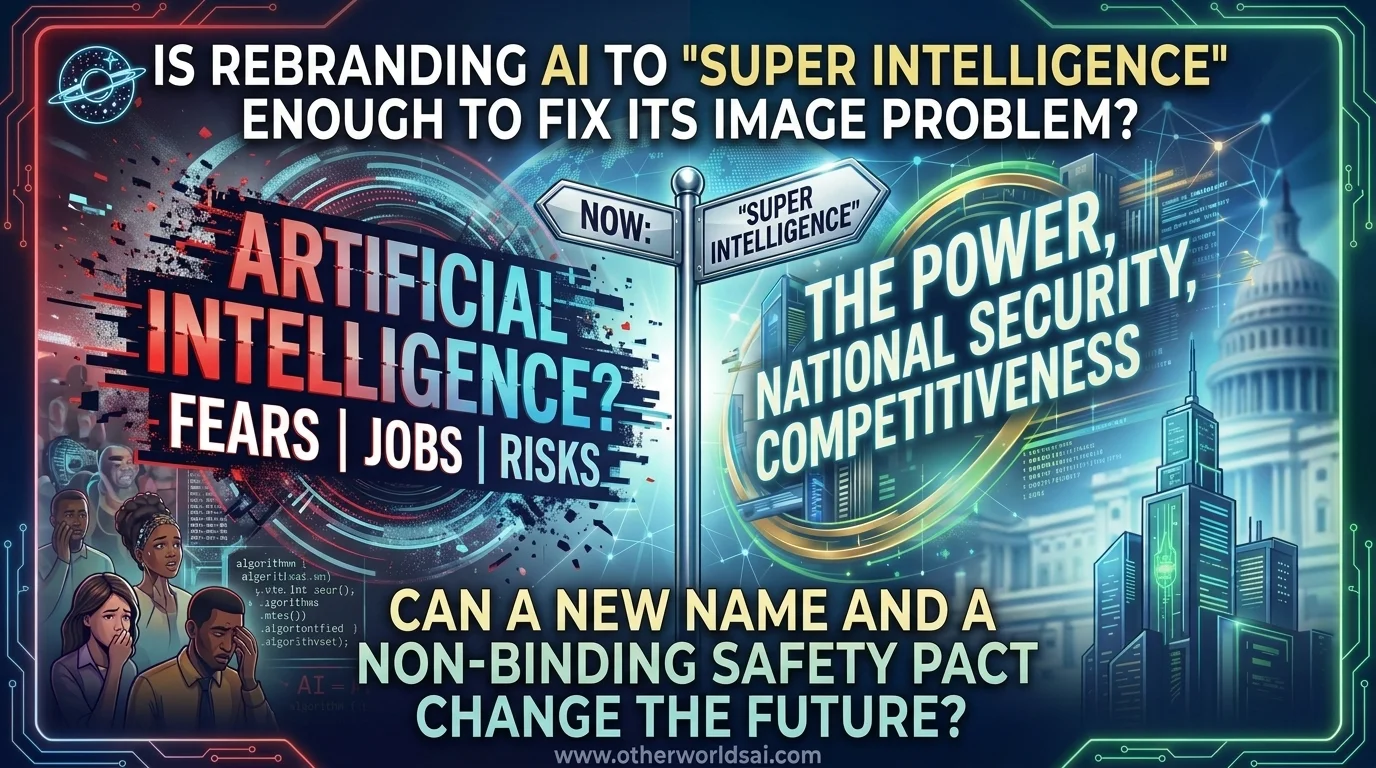

Is Rebranding AI to ‘Super Intelligence’ Enough to Fix Its Image Problem?
Artificial intelligence is facing a serious PR crisis. Public anxiety over job displacement, safety risks, and regulatory battles dominates the news cycle daily.
In a surprising move, President Donald Trump recently gathered Silicon Valley’s top tech executives to address these concerns head-on. The headline takeaway? The federal government is officially retiring the term "Artificial Intelligence" in favor of "Super Intelligence"—and backing it up with a new, non-binding safety agreement.
Can renaming an entire industry and asking tech CEOs for a "moral commitment" actually reshape public perception and secure the future of frontier technology?
Here is what happened behind closed doors, why the tech world is skeptical, and what this high-stakes rebranding effort really means for the future of AI.
Inside the White House AI Summit: A High-Stakes Rebrand:
The transition from "AI" to "Super Intelligence" isn't just wordplay—it is now backed by an executive order requiring official U.S. representatives to adopt the new terminology.
This move represents a sharp narrative shift. For months, the policy stance lean heavily toward aggressive deregulation, dismissing safety concerns as anti-competitive or political theater. Yet, earlier this week, an influential lineup of tech powerhouses assembled at the White House, including:
- Mark Zuckerberg (Meta)
- Jeff Bezos (Amazon)
- Elon Musk (Tesla / xAI)
- Dario Amodei (Anthropic)
The main deliverable from this meeting was the "Joint Commitment on Frontier Responsibilities," a signed pledge aimed at framing "super intelligence" as a force for national progress rather than an existential threat.
Rebranding AI: Why "Super Intelligence"?
Why swap "artificial intelligence" for "super intelligence"?
The answer lies in public sentiment. The phrase artificial intelligence has become tied to fears of job loss, corporate overreach, and automated displacement.
By pushing "super intelligence," policymakers and leaders are trying to wipe the slate clean. The subtle psychological shift moves the narrative away from automated systems replacing human workers toward high-level economic capability, national security, and global competitiveness.

Meta's Next Big Bet: This New App Lets You Build Games Simply by Typing a Prompt
"Morally Binding": Is the Frontier Responsibilities Pact Enough?
Despite the fanfare and viral press conference, the newly signed agreement has drawn widespread skepticism from industry analysts.
-
Zero Legal Enforceability: The pact is entirely voluntary and contains no legally binding mechanisms or enforcement clauses.
-
A "Moral" Obligation: When pressed on the lack of regulatory teeth, President Trump referred to the agreement as "morally binding"—a term rarely seen in tech policy or corporate governance.
-
Signs of a Rushed Launch: Reflecting just how quickly the event was assembled, attendees noticed that the official document actually contained a typo, misspelling "United States."
Rather than establishing enforceable safety standards, the pact functions primarily as a political gesture and symbolic alignment between Washington and Silicon Valley.
Support our research
Independent analysis fueled by you.
Anthropic, the Pentagon, and White House Friction:
The summit also highlighted ongoing internal debate within the federal government over AI deployment—particularly regarding safety-first labs like Anthropic.
Prior to the event, Anthropic CEO Dario Amodei was in a contentious dispute with federal officials over usage terms and guardrails for defense applications. While a late-night White House dinner secured Amodei a seat at the table, friction remains:
Internal Division: The Treasury Department has advocated for incorporating top-tier foundation models, whereas officials within the Department of Defense continue to voice national security concerns regarding restrictive safety protocols.
Unresolved Guardrails: A ceremonial luncheon and a non-binding pledge have not fully resolved the deeper operational disagreement over how much control private AI companies retain over government use of their models.
The Verdict: Can Rebranding Fix AI’s Perception Problem?
While a name change can influence headlines, long-term public trust requires transparent development, robust infrastructure, and clear real-world benefits.

Move Over Nvidia: Anthropic and Samsung Team Up to Break the AI Chip Monopoly
Swapping labels from "AI" to "Super Intelligence" might offer short-term narrative relief, but a non-binding agreement won't eliminate concerns around automation, safety, and security. As the technology continues to advance rapidly, concrete policy frameworks—not just clever branding—will ultimately determine how the public views the frontier of super intelligence.
Can a Voluntary Safety Pact and a Name Change Save AI's Reputation?
What do you think of the shift from "Artificial Intelligence" to "Super Intelligence"? Let us know your thoughts in the comments below!