
In a city overflowing with AI startups and robotics labs,
Physical Intelligence manages to stand out by barely standing out at all. From the street, its San Francisco headquarters is almost invisible — marked only by a small pi symbol on a door that blends into the surroundings.
There’s no glowing logo, no reception desk, and no polished startup aesthetic. Yet behind that door, one of Silicon Valley’s most ambitious efforts to build general-purpose robot intelligence is underway.
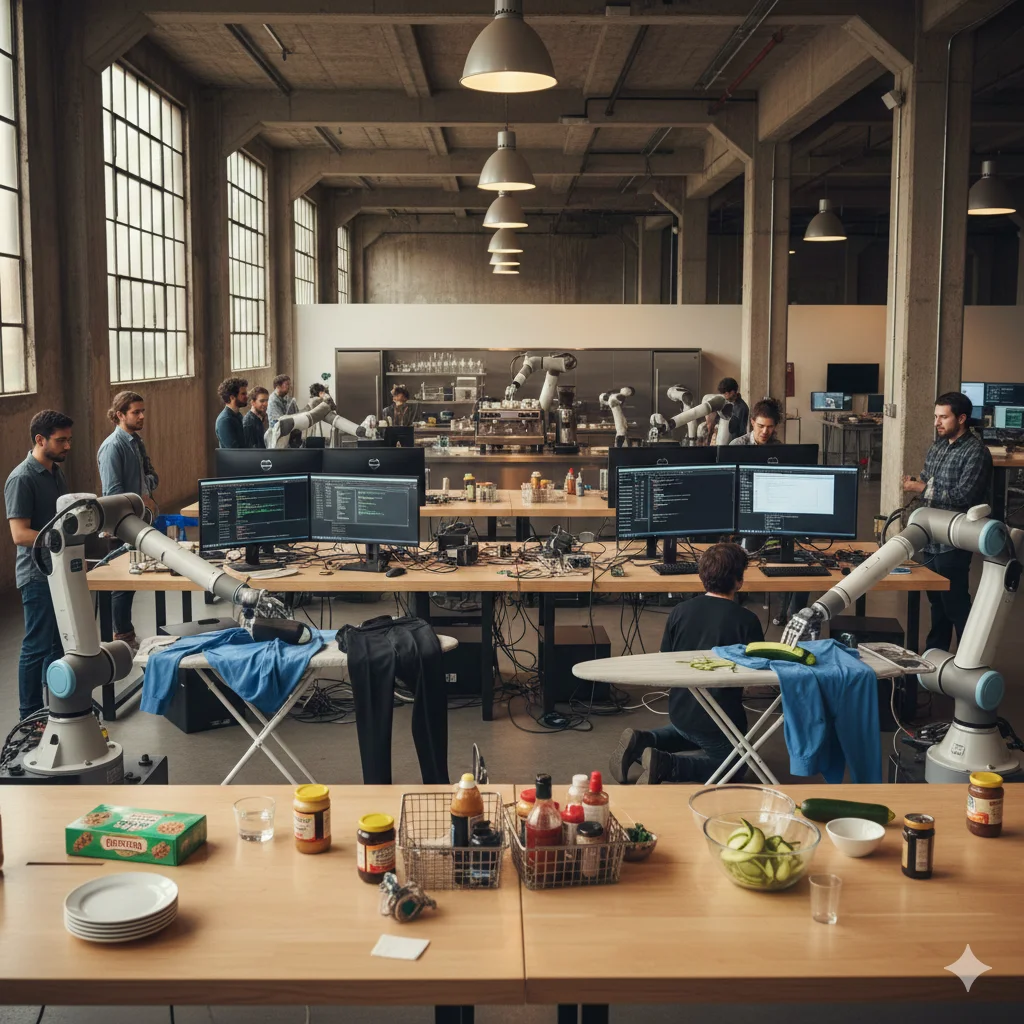
Step inside, and the energy is unmistakable. The office is a massive concrete space softened by long blonde-wood tables spread across the room. Some are clearly used for lunch breaks, cluttered with Girl Scout cookie boxes, jars of Vegemite, and wire baskets overflowing with condiments.
Others tell a far more technical story — they’re covered with computer monitors, robotics components, tangled wires, and fully assembled robotic arms learning how to perform everyday tasks.
Robots Learning Human Tasks — One Mistake at a Time:
At any given moment, several robotic arms are in motion. One is attempting to fold a pair of black pants, struggling awkwardly with the fabric. Nearby, another robot is determinedly trying to turn a shirt inside out — a deceptively difficult task for machines. A third robotic arm seems to have found its niche, efficiently peeling a zucchini before attempting to place the shavings into a separate container.
These aren’t demos designed to impress visitors. They’re live experiments in robot learning and adaptation.
“Think of it like ChatGPT, but for robots,” says Sergey Levine, co-founder of Physical Intelligence and an associate professor at UC Berkeley. Gesturing toward the coordinated chaos, Levine explains that the company is building robot foundation models — large AI systems designed to understand and execute a wide range of physical tasks rather than a single programmed behavior.
How Physical Intelligence Trains General-Purpose Robots:
What’s happening inside the headquarters is part of a continuous training loop. Data is collected from robotic stations inside the office and from real-world environments such as warehouses and homes. That data is then used to train general-purpose robotic foundation models.
Once a new model is ready, it’s deployed back to test stations like the ones on display. Each robot — whether folding pants, flipping shirts, or peeling vegetables — is running an experiment. The zucchini-peeling robot, for example, is testing whether the model can generalize the core concept of peeling so it can later handle apples, potatoes, or other unfamiliar objects.
This ability to generalize across tasks and environments is one of the hardest problems in AI-powered robotics, and it’s where Physical Intelligence is placing its biggest bet.
A Test Kitchen Built for Robots, Not Humans:
Beyond the main workspace, the company operates a test kitchen both in this building and elsewhere. Unlike traditional robotics labs, Physical Intelligence relies on off-the-shelf hardware and realistic environments to train its systems.
One standout piece of equipment is a high-end espresso machine. While it might look like a luxury perk, Levine clarifies that it’s not for the engineers — it’s for the robots. Every foamed latte is training data, not a caffeine reward.
Around the room, dozens of engineers focus intensely on their work, either glued to their screens or hovering over robotic arms in mid-experiment. The atmosphere feels less like an office and more like a factory for intelligence.
Why Cheap Hardware Is a Feature, Not a Bug:
Perhaps the most surprising detail about Physical Intelligence is its approach to hardware. The robotic arms used throughout the lab cost about $3,500 each — and even that price includes a significant markup from suppliers. If built in-house, the material cost would fall below $1,000.
Just a few years ago, many roboticists would have doubted that such inexpensive machines could do anything meaningful. But according to Levine, that’s exactly the point. Strong AI can compensate for weak hardware. Instead of relying on expensive, custom-built robots, Physical Intelligence is focused on building smarter brains that can make the most of affordable machines.
Why Physical Intelligence Is Getting So Much Attention:
As Silicon Valley races toward more capable and adaptable robots, Physical Intelligence is emerging as one of the most talked-about startups in the space. Its emphasis on robot foundation models, real-world data, and general-purpose intelligence places it at the center of the next major shift in robotics.
Hidden behind an unassuming door in San Francisco, the company may be laying the groundwork for a future where robots can learn tasks the way humans do — through experience, trial, and adaptation.
Support our research
Independent analysis fueled by you.