
In a Science First, AI-Designed Viruses Successfully Hunt and Kill Bacteria.
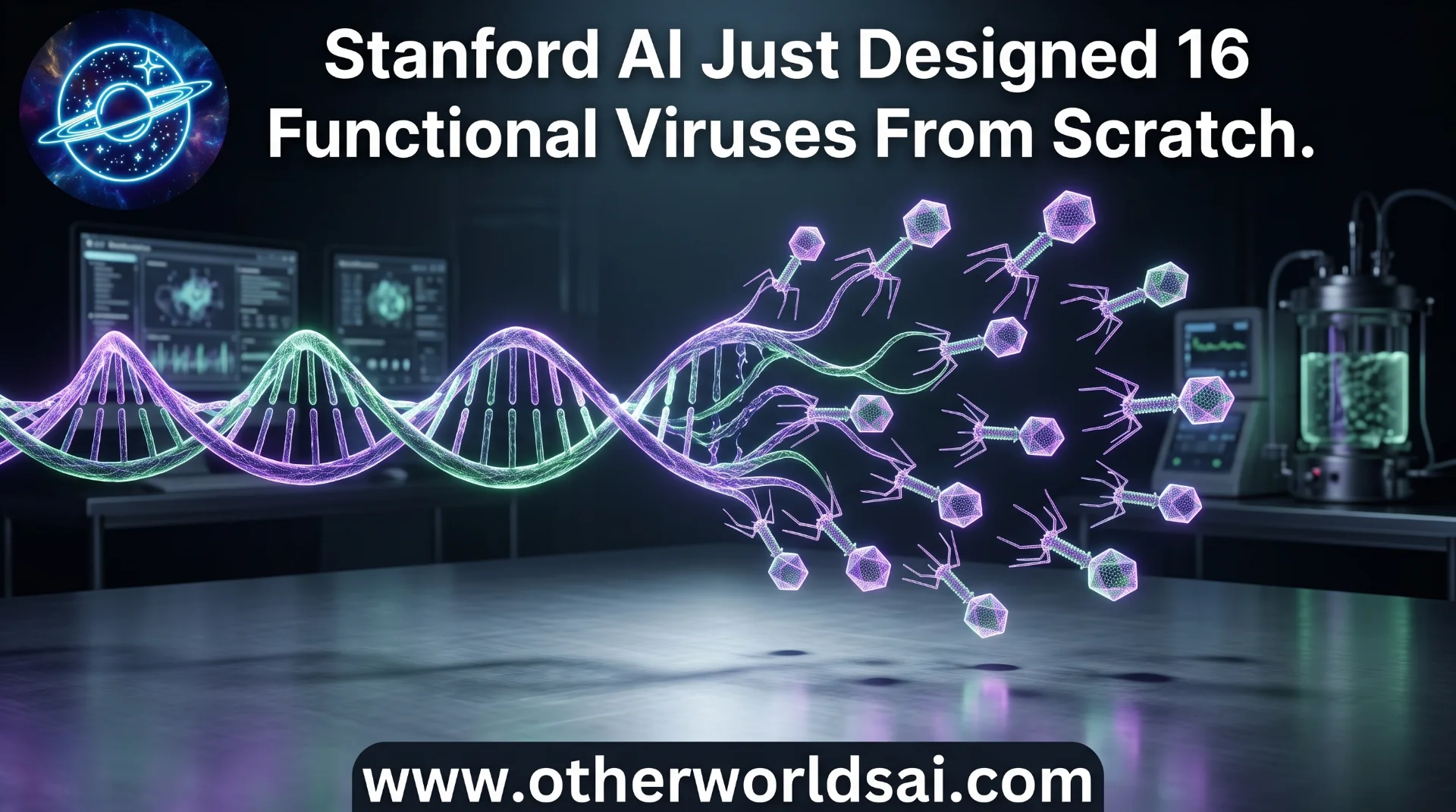
AI Just Designed 16 New Viruses to Kill Bacteria — Here's Why It Matters Beyond the Lab Stanford and the Arc Institute used generative AI to create functional bacteriophages — a milestone that shows AI is moving from analyzing biology to designing it.
16: Functional AI-designed bacteriophages validated in the lab
9 Trillion: DNA base pairs used to train the Evo 2 genome model
$9.5M: NIAID grant behind Stanford's new phage therapy center
1: What Actually Happened:
Researchers at Stanford University and the Arc Institute have used generative AI models to design entirely new bacteriophages — viruses that infect and destroy bacteria rather than humans.
In laboratory testing, 16 of the AI-generated genomes turned out to be fully functional: they infected and killed E. coli, the same way a naturally occurring phage would. The team used genome language models called Evo 1 and Evo 2, trained to recognize patterns in DNA the way large language models recognize patterns in text, then used the well-studied phage ΦX174 as a design template.
Hundreds of AI-designed genomes were synthesized and tested. Sixteen worked — and several of those outperformed their natural counterparts, showing higher fitness or faster bacterial killing under certain lab conditions. The findings were published in Science in August 2026.
2: From Digital Design to Living Biology:
This wasn't AI spotting an existing virus hiding in a dataset. It generated genetic sequences that had never existed before, and scientists then had to synthesize and test them to see which ones actually worked.
That distinction matters. Most generated sequences didn't become functional biological systems — the AI expanded the search space dramatically, but laboratory validation was still what separated a workable design from a dead end. Generative biology, at least for now, is a partnership between the model and the bench, not a replacement for either.
Evo 2, the foundation model behind the work, was trained on roughly nine trillion DNA base pairs. It's the same broad idea that has reshaped text, image, and code generation over the last few years, now pointed at the genome.
"AI is no longer merely studying the biological world — it is beginning to participate in designing it."
3: Why It Matters — Medicine and Biosecurity Both:
Bacterial resistance to antibiotics is one of the more pressing problems in modern medicine, and phage therapy has been a promising but slow-moving alternative for over a century.
The bottleneck has always been discovery: finding a naturally occurring phage that matches a specific resistant bacterial strain. AI-generated candidates could shorten that search considerably. In this study, a combination of AI-generated phages was even able to overcome resistance to the original template phage in several E. coli strains — a meaningful result for a field where bacterial resistance undercuts treatment options quickly.
The same capability raises an obvious question in the other direction: what happens when similar tools are pointed at organisms that infect humans, animals, or plants, rather than bacteria? The researchers built safety boundaries into this specific experiment, but the broader concern isn't this result — it's how fast the underlying capability is advancing relative to biosecurity oversight, DNA synthesis screening, and international coordination.
4: The Pattern Every Industry Should Recognize:
Strip away the biology, and the shape of this story is familiar:** an AI model moves from analyzing a domain to actively designing within it, and the organizations that get there first gain a real head start.
It's the same shift we help clients navigate every day at Otherworlds AI — just applied to genomics instead of operations. A model that used to summarize data now generates candidates, tests hypotheses, and narrows a massive search space down to the handful of options worth a human's attention.
In biology, that means 16 viable phages out of hundreds of candidates. In business, it means AI agents that can draft, evaluate, and execute across scheduling, customer communication, and internal workflows — with people still validating the output, just at a fraction of the time.
Your Business Doesn't Need a Genome Model — It Needs Agent+
Stanford's researchers needed a genome foundation model to expand their search space in biology. Most businesses just need the same underlying shift — AI that moves from analyzing your operations to actively running parts of them.
Otherworlds AI's Agent+ platform, powered by Google Opal automated workflows, brings that capability to your business for $297/month, alongside custom enterprise AI builds for teams that need something built to spec.
Visit otherworldsai.com to see how Agent+ can start working for your team this week.
Support our research
Independent analysis fueled by you.