
The Future of Preventative Health Is Living Right on Your Wrist.
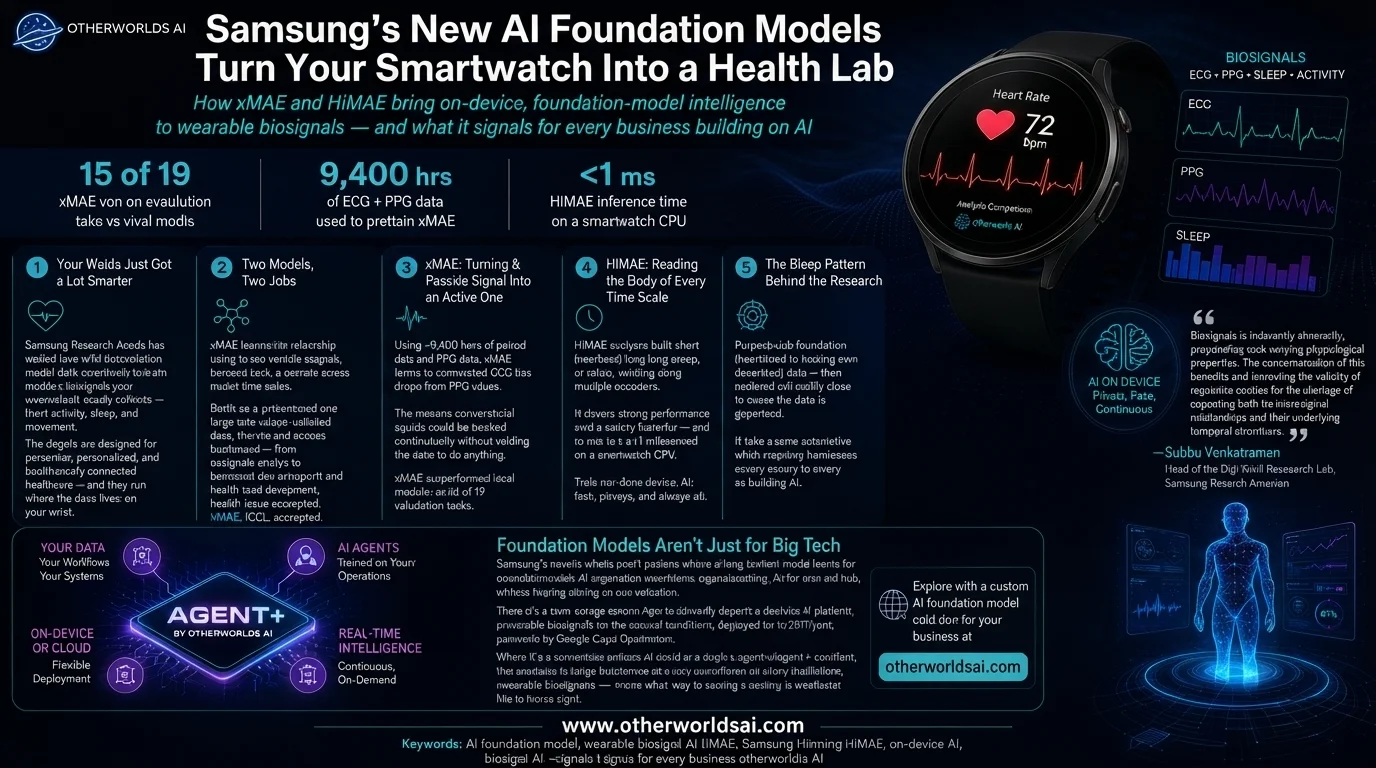
Samsung's New AI Foundation Models Turn Your Smartwatch Into a Health Lab.
How xMAE and HiMAE bring on-device, foundation-model intelligence to wearable biosignals — and what it signals for every business building on AI.
15 of 19: xMAE won on evaluation tasks vs. rival models
9,400 hrs: of ECG + PPG data used to pretrain xMAE
<1 ms: HiMAE inference time on a smartwatch CPU
1: Your Watch Just Got a Lot Smarter:
Samsung Research America has unveiled two new AI foundation models built specifically to learn from the biosignals your smartwatch already collects — heart activity, sleep, and movement.
The announcement came out of the company's Digital Health Team, tied to the Connected Care vision Samsung outlined at the Health Forum during Galaxy Unpacked in July 2026. The pitch: preventive, personalized, and continuously connected healthcare, powered by models that live on the device rather than a distant server.
Sharanya Desai, Head of Digital Health Algorithms at Samsung Research America, framed the work as foundational — literally. The goal is health insights that are efficient, precise, and continuous, built on models that can run with limited sensors and limited compute.
2: Two Models, Two Jobs:
The research introduces xMAE and HiMAE — each solving a different half of the wearable-data problem.
xMAE (Physiology-Aware Masked Cross-Modal Reconstruction for Biosignal Representation Learning) learns the relationship between two different cardiac signals. HiMAE (Hierarchical Masked Autoencoder) learns patterns across multiple time scales — from a single heartbeat to a night of sleep. Both were accepted at top-tier machine learning venues: xMAE at ICML, HiMAE at ICLR.
Where a traditional model is trained for one narrow task, both of these are pretrained once on large volumes of unlabeled biosignal data, then reused across many downstream tasks — biosignal analysis, biomarker development, and health issue prediction, all from the same foundation.
3: xMAE: Turning a Passive Signal Into an Active One:
The clever part of xMAE is what it does with photoplethysmography, or PPG — the passive light-based sensor already sitting in most smartwatches.
A full ECG reading measures the heart's electrical activity directly, but it requires the wearer to stop and actively take a measurement. PPG, by contrast, runs continuously and passively in the background, detecting changes in blood flow. Samsung describes the relationship between the two signals like seeing lightning and then hearing thunder: related events, offset in time.
"Biosignals are inherently dynamic, with unique time-varying physiological properties. The key contribution of this research lies in proving the viability of health foundation models capable of capturing both the inter-signal relationships and their underlying temporal structures." — Subbu Venkatraman, Head of the Digital Health Research Lab, Samsung Research America.
By training on roughly 9,400 hours of paired ECG and PPG data, xMAE learns to reconstruct ECG-like insight from PPG alone — meaning cardiovascular signals could eventually be tracked continuously, without asking the user to do anything at all.
In testing, Samsung reports xMAE outperformed both single-signal models and existing multimodal approaches on 15 of 19 evaluation tasks, spanning cardiovascular disease prediction, abnormal test-result detection, and sleep-stage classification.
4: HiMAE: Reading the Body at Every Time Scale:
HiMAE takes on a different challenge: wearable data doesn't carry the same information at every time scale.
A heartbeat is a fast-changing, short-window signal. Sleep and activity patterns build up over hours. HiMAE uses multiple encoders to analyze short and long segments separately, letting a single pretrained model shift its focus depending on the task — heart-rate analysis on one end, sleep prediction on the other.
What stands out is the efficiency: Samsung reports HiMAE achieves strong performance with a smaller footprint than existing models, and can generate results in under one millisecond on a smartwatch-class processor. That's on-device inference, not a round trip to the cloud — diagnostic markers, predictive classifications, and user guidance generated locally, continuously, and privately.
5: The Bigger Pattern Behind the Research:
Strip away the biosignals, and Samsung's approach is a case study in a much broader shift: purpose-built foundation models trained on an organization's own specialized, unlabeled data — then deployed efficiently, close to where the data is generated.
That's not a healthcare-only idea. It's the same architecture reshaping how businesses across every industry are starting to think about AI: instead of one generic model bolted onto everything, a model — or an agent — trained on your own operational patterns, running where you need it, on a budget that scales with a business rather than a hospital R&D lab.
Foundation Models Aren't Just for Big Tech.
when a single pretrained model learns the patterns hidden in an organization's own data — and then runs efficiently, in real time, without shipping everything to the cloud.
That's the same principle behind Agent+, Otherworlds AI's enterprise AI platform: purpose-built agents trained on your workflows, deployed for $297/month, powered by Google Opal automation. Whether it's a custom enterprise AI build or a ready-to-deploy Agent+ workflow, Otherworlds AI helps businesses turn raw operational data into continuous, on-demand intelligence — the same way Samsung is turning a heartbeat into a health signal.
Explore what a custom AI foundation model could do for your business at otherworldsai.com.
Support our research
Independent analysis fueled by you.