
Meta's AI Mode Is Reshaping Facebook — And What It Means for Your Business:
How Facebook’s New AI Mode Changes Social Media Discovery for Brands:
Meta is going all-in on AI inside Facebook, and the implications for how businesses get discovered — and how customers ask questions — are bigger than most realize.
Section 1: The Headline Feature — AI Mode for Facebook Search:
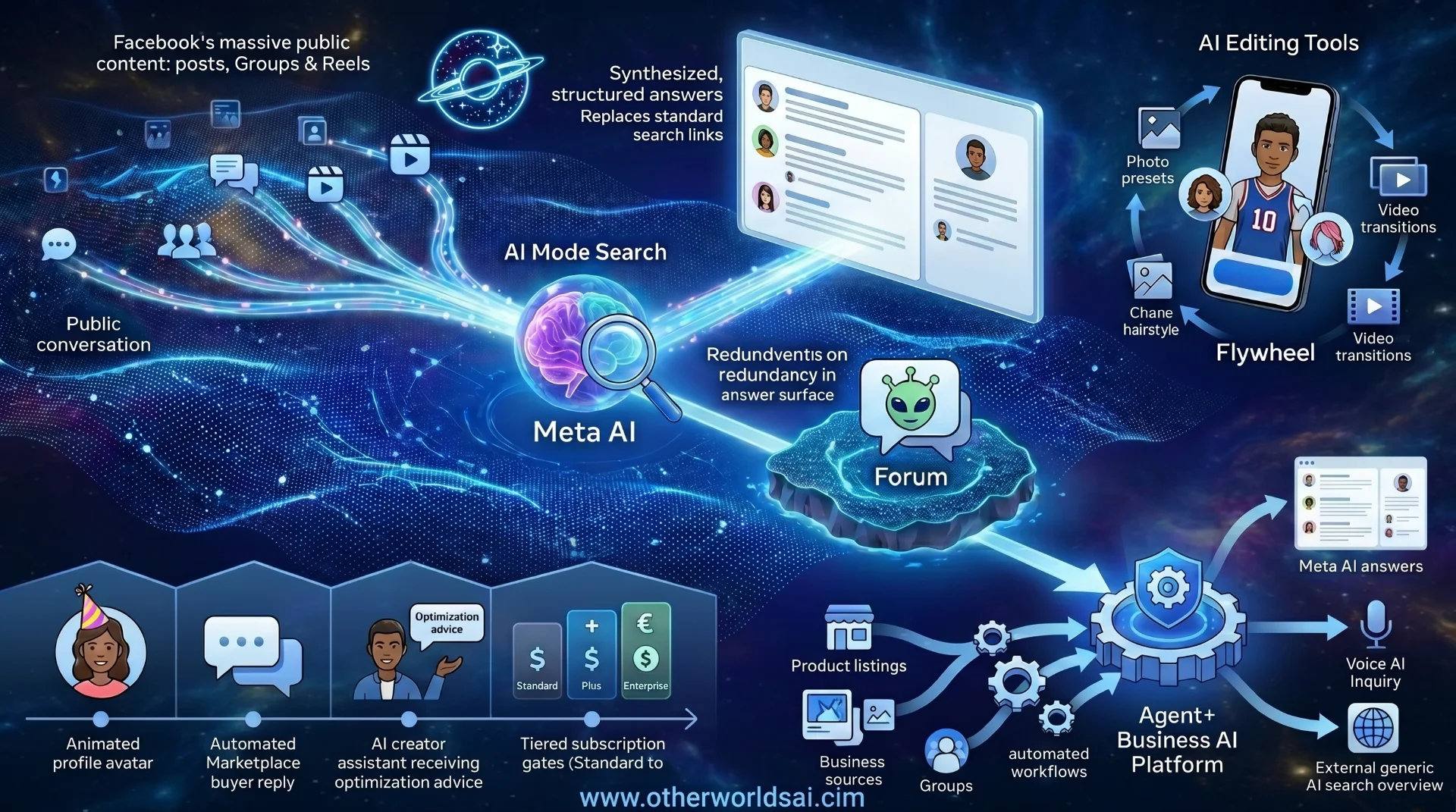
Meta officially flipped the switch on 'AI Mode' for Facebook search, and it's a meaningful departure from how the platform has worked for the past two decades. Instead of returning a list of posts and profiles, AI Mode surfaces a synthesized, plain-language answer drawn from public content across the platform — including Groups, Reels, and general posts. Users ask a question in natural language, and Meta AI stitches together what people are actually saying to generate a response.
The shift mirrors what Google has been doing with its own AI Mode — pulling search results into AI-generated summaries rather than forcing users to scroll through ten blue links. The difference is that Meta's source material is crowdsourced conversation rather than the indexed web. That makes it more socially contextual, but also more prone to misinformation, since the AI is drawing from everyday user posts rather than vetted editorial sources.
Instead of scrolling through search results, users can now ask Facebook a question in plain language and get a synthesized answer based on what people are actually discussing — a fundamental shift in how the platform surfaces information.
This is not a minor UI refresh. It's a structural change in how Facebook positions itself — from a social graph you navigate to a knowledge surface you query. For businesses that have built community in Facebook Groups, this creates both an opportunity and a risk: your content could now surface in AI answers to competitor searches, or your competitors' could surface in yours.
Section 2: Forum and the 'Ask' Tab — Meta's Reddit Play:
AI Mode didn't arrive alone. Last month, Meta quietly launched Forum, a Reddit-style app that includes its own AI 'Ask' tab. The concept is nearly identical to AI Mode: pose a question, get an answer synthesized from ongoing discussions in Facebook Groups. The difference is that Forum packages this as a standalone destination app, separate from the main Facebook experience.
The timing of both launches together is deliberate. Meta is building redundant on-ramps to the same AI-powered answer layer — one embedded in the core Facebook search bar, one as a standalone product. This gives the company flexibility to see which surface users engage with more, while also covering the 'curiosity query' use case that has historically driven traffic to Reddit and Quora.
Platform Strategy: Dual AI answer surfaces: Facebook AI Mode + Forum Ask tab.
Source Material: Public posts, Groups, Reels across Meta's network.
Comparable Product: Google AI Mode (search summaries from indexed web)
Key Risk Answers sourced from unvetted user-generated content.
Standalone App Forum — Meta's Reddit-style Q&A destination
The reliability question looms over both products. When the underlying source material is public group chatter, the AI is only as accurate as the community it's summarizing. Meta hasn't announced specific guardrails or source-labeling mechanisms for AI Mode answers, which means early adopters — and early business users — should treat these AI responses as a starting point, not a final word.
Section 3: AI Editing Tools — From Search to Content Creation:
Beyond search, Meta has layered in a suite of AI-powered creative tools that let users manipulate photos and videos directly inside Facebook. The new features include collage cutouts, transition effects for video montages, and AI photo presets — letting users virtually try on different outfits, hairstyles, and accessories without leaving the app.
**The 'Wear It' feature stands **out as a consumer engagement hook. Sports fans can tap the 'AI Edit' icon in Stories and virtually wear their favorite team jersey. Users can also restyle their profile picture directly, choosing wardrobe options surfaced by AI. For brands — particularly apparel, sports merchandise, and lifestyle companies — this is a preview of where product discovery is heading: immersive, low-friction, and embedded inside the content feed rather than redirected to an external store.
Meta's new AI photo presets let users virtually try on different clothes, hairstyles, and accessories — a preview of how product discovery will increasingly happen inside the social feed rather than on brand websites.
These creative tools feed directly into Meta's engagement strategy. The more time users spend creating and iterating inside Facebook, the more content gets produced, the more the algorithm has to surface, and the more ad inventory Meta generates. It's a flywheel — AI as the engine that keeps users from leaving the platform to use Canva or CapCut.
Section 4: The Broader AI Feature Rollout — A Year in Review:
Monday's announcements are the latest in a rapid-fire sequence of AI features Meta has shipped across Facebook over the past several months. In February, the company introduced animated profile pictures that bring still photos to life — adding motion effects like waves or virtual party hats. In March, Meta added an AI feature to Facebook Marketplace that automatically replies to buyer messages on sellers' behalf, reducing friction for small business sellers who can't monitor their inboxes in real time.
Most recently, earlier this month, Facebook launched an AI creator assistant that offers personalized recommendations to content creators — including optimal posting times and audience sentiment summaries drawn from comment sections — based on each creator's content history and performance data. Taken together, these releases represent a coherent product strategy: make Facebook smarter, stickier, and more valuable to both consumers and creators.
February 2026: Animated profile pictures with AI motion effects.
March 2026: AI auto-reply for Facebook Marketplace sellers.
June 2026 (early) AI creator assistant — post timing + comment summaries.
June 2026: (now) AI Mode search + AI photo presets + video editing tools.
Upcoming: Additional AI-tier subscription plans for Facebook & Instagram.
Section 5: Subscriptions and Monetization — The AI Revenue Layer:
Alongside the feature announcements, Meta is now monetizing its AI investments directly. The company recently launched global subscription plans for Facebook, Instagram, and WhatsApp starting at $3.99 per month, unlocking additional features for paying users. More AI-specific subscription tiers are reportedly in development, suggesting Meta intends to build a tiered AI access model similar to what OpenAI and Google have pursued with ChatGPT Plus and Gemini Advanced.
For enterprise decision-makers, this signals a shift in the cost structure of social media presence. Features that are currently free — or that will be gated behind AI subscriptions — may increasingly require platform spend alongside advertising spend.
Businesses that haven't built diversified AI strategies outside of Meta's ecosystem will find themselves increasingly dependent on paying for access to tools their competitors will also have.

Meta's Next Big Bet: This New App Lets You Build Games Simply by Typing a Prompt
Meta's new subscription tiers signal that AI features on social media are moving from free engagement tools to paid capabilities — a shift that will affect every business that relies on Facebook for customer acquisition.
Section 6: What This Means for Your Business — The Agent+ Advantage:
Meta's AI Mode rollout is a signal, not just a feature update. It tells us that AI-powered discovery — whether through search, social, or voice — is becoming the default interface between customers and the information they want. Businesses that wait for these platforms to fully mature before adapting will find themselves playing catch-up while early movers capture AI-surfaced visibility.
At Otherworlds AI, this is exactly the shift the Agent+ Business AI platform was built for. Agent+ connects your business operations, customer-facing content, and data sources into a unified AI layer — so that whether a customer finds you through Meta's AI Mode, a Google AI Overview, or a direct inquiry, your business is able to respond intelligently, consistently, and at scale. You're not reliant on Meta's algorithm deciding what your Groups say about you.
With Google Opal automated workflows integrated into Agent+, your team can automate the content operations that feed AI discovery — ensuring your Facebook Groups, product listings, and customer-facing posts are consistently optimized for the AI answer layers now being built on top of every major platform.
The businesses that show up in Meta AI Mode's synthesized answers won't be the ones who posted most frequently — they'll be the ones whose content was structured, relevant, and consistent enough for an AI to confidently surface it.
The question isn't whether AI will change how your customers find you on social media — it already has. The question is whether your business has the infrastructure to be found. Agent+ is that infrastructure.
Ready to get ahead of the next platform shift? Visit otherworldsai.com to learn more.