
META'S BUSINESS AI HITS 10 MILLION CONVERSATIONS A WEEK AND THE FREE RIDE WON'T LAST FOREVER:
Meta’s Free AI Ride is Ending: Zuckerberg Signals New Charges for Business Tools:
INTRODUCTION: The Quiet Giant Makes a Loud Statement:
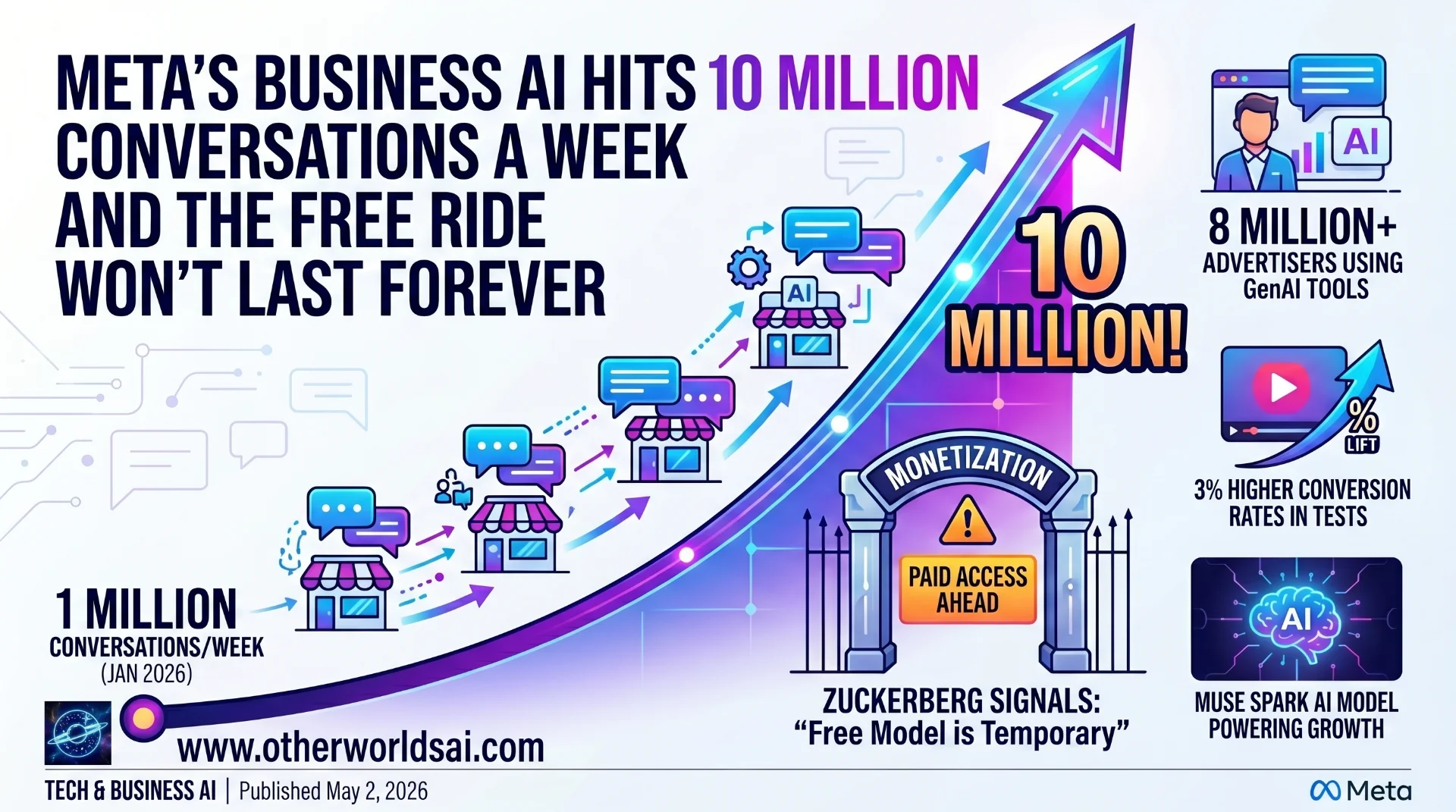
Meta may not dominate the AI headlines the way OpenAI or Google do, but quietly and methodically, the social media giant has been building an AI empire inside the platforms that billions of people and millions of small businesses already use every day. This week, those efforts came into sharp relief. During Meta's first-quarter 2026 earnings call, the company disclosed a staggering milestone: its business AI tools are now facilitating 10 MILLION CONVERSATIONS PER WEEK — a tenfold leap from just 1 million at the start of the year.
That kind of growth doesn't happen by accident. It is the result of a calculated strategy to embed Meta AI directly into the messaging apps — WhatsApp, Messenger, Instagram, and Facebook — that small and medium-sized businesses rely on for customer communication. And while those tools are free today, CEO Mark Zuckerberg made clear that the era of free access is likely entering its final chapter.
From 1 Million to 10 Million — The Numbers Behind Meta's AI Surge:
The headline stat from Meta's Q1 2026 earnings call is hard to ignore. Meta's business AI tools jumped from roughly 1 million weekly conversations at the beginning of 2026 to 10 MILLION CONVERSATIONS PER WEEK by late March — a 10x increase in under three months. CFO Susan Li confirmed the scale of progress directly during the call, noting that the company plans to expand access to even more countries in Q2 while adding new capabilities to its AI tools.
Two forces are driving this explosive adoption. First, Meta recently expanded its business AI assistant beta program across the United States, EMEA, APAC, and LATAM, putting the tools in front of a vastly larger pool of businesses simultaneously. More markets mean more businesses, and more businesses mean more conversations. Second, and perhaps more importantly, Meta has baked these AI capabilities directly into the platforms that small businesses already know and use — removing virtually all friction from adoption.
What Is Meta Business AI? Understanding the Tool Powering This Growth:
At its core, Meta's business AI assistant is an AI-powered customer communication tool designed specifically for small and medium-sized businesses (SMBs) operating on Meta's messaging platforms. It can handle customer inquiries, respond to frequently asked questions, and manage conversations at scale — all without requiring a dedicated support team behind it.
The tool is now powered by MUSE SPARK, Meta's latest large language model and the first to be released under the newly formed Meta Superintelligence Labs division. Sessions per user grew double digits following Muse Spark's introduction, with more advanced models already in training. This isn't a legacy chatbot — it's a modern generative AI system designed to evolve rapidly.
For small businesses, the value proposition is straightforward: automation of customer conversations at a scale that would otherwise require multiple staff members, delivered through messaging apps those customers already use. WhatsApp alone has over 2 billion users worldwide, and roughly 68% of WhatsApp users say it is the most convenient way to engage with a brand.
Zuckerberg's Signal — The Free Model Is Temporary:
Right now, Meta's business AI tools are completely free for most businesses, and that has undoubtedly accelerated adoption. But during the Q1 earnings call, Mark Zuckerberg was transparent about where things are heading:
"Business AIs today are currently free for most businesses on our messaging apps, but as we make more progress, we expect that we will also work towards establishing a longer-term monetization model." — Mark Zuckerberg, CEO
This is a deliberate scaling strategy, not a permanent arrangement. By offering the tools for free while expanding aggressively across global markets, Meta is achieving the kind of adoption depth that makes a future monetization model commercially viable. Once millions of businesses have integrated Meta AI into their daily customer communication workflows, introducing a pricing structure becomes a far smoother conversation.
The comparison to Meta's broader monetization playbook is instructive. WhatsApp itself was free for years before Meta began building paid messaging infrastructure around it — and today, paid messaging on WhatsApp is one of the company's fastest-growing revenue streams. The business AI story appears to be following a similar arc.
GenAI Ad Creative Tools — 8 Million Advertisers and a 3% Conversion Lift:
The business AI milestone wasn't the only AI story from Meta's Q1 earnings call. CFO Susan Li also revealed that MORE THAN 8 MILLION ADVERTISERS are now using at least one of Meta's generative AI ad creative tools, with particularly strong adoption among small and medium-sized businesses. These tools are not just popular — they are producing measurable results.
"Usage of our ad creative tools is also scaling, with more than 8 million advertisers using at least one of our GenAI ad creative tools, and particularly strong adoption among small and medium-sized businesses. These tools are benefiting performance as well, with advertisers using our video generation feature seeing more than 3% higher conversion rates in tests." — Susan Li, CFO Meta
A 3% conversion rate improvement may sound modest in isolation, but at the scale Meta operates — $56.3 billion in Q1 revenue, up 33% year over year — a 3% lift across millions of ad accounts represents substantial commercial impact. Businesses that have been skeptical of AI-generated creative content are now seeing hard data that makes the case for adoption.
Meta Ads AI Connectors — The Next Step in AI-Powered Advertising:
Beyond the existing GenAI creative tools, Meta is launching a new layer of automation this week. The company announced the open beta of META ADS AI CONNECTORS, which will allow advertisers to connect their Meta ad accounts directly to an AI agent. This marks a meaningful step toward fully automated, AI-driven ad campaign management on Meta's platforms.
The implications for small businesses are significant. Rather than manually managing bidding strategies, creative rotations, and audience targeting, businesses will be able to hand those tasks to an AI agent that responds to performance data in real time. For resource-constrained SMBs that cannot afford dedicated marketing teams, this kind of automation could be transformative.
WhatsApp's Quiet Revenue Revolution:
While the AI tools garnered most of the attention, WhatsApp is quietly becoming one of Meta's most interesting revenue stories. Zuckerberg noted that Meta's family of apps generated $885 MILLION IN REVENUE in Q1 2026, driven largely by paid messaging on WhatsApp and app subscriptions. That category saw a 74% year-over-year rise — a figure that barely registered just 18 months ago.
Adding another dimension to this revenue story, Meta began testing WHATSAPP PLUS this month — a premium subscription tier giving users access to custom icons, themes, and notification sounds. While the current feature set is largely cosmetic, the move signals that Meta sees meaningful potential in premium consumer features on its messaging platform, a market it has barely begun to monetize.
Q1 2026 Financials — Meta's AI Bet Is Paying Off:
Underpinning all of this AI expansion is a financial position of extraordinary strength. Meta reported a PROFIT OF $26.8 BILLION in Q1 2026, up sharply from $16.6 billion in the same period a year earlier. Total revenue reached $56.3 BILLION, a 33% year-over-year increase — growth that gives the company enormous runway to invest in AI infrastructure even as it scales toward profitability on those investments.
That investment appetite is substantial. Meta raised its full-year capital expenditure guidance to a range of $125 billion to $145 billion, up from its earlier projection of $115–135 billion, citing rising memory costs and the need for additional data center capacity. The company also acknowledged it has consistently underestimated its compute needs — a telling admission that demand for its AI products is outpacing even its own aggressive projections.
KEY Q1 2026 STATS AT A GLANCE:
Total Revenue: :$56.3 billion (+33% YoY)
Net Profit : :$26.8 billion (vs $16.6B prior year)

Meta's Next Big Bet: This New App Lets You Build Games Simply by Typing a Prompt
Apps Revenue : :$885 million
Support our research
Independent analysis fueled by you.
Weekly Business AI Chats : :10 million (up from 1M in January 2026)
Advertisers Using GenAI Tools : : 8 million+
Video Ad Conversion Lift : : 3%+ in tests
What This Means for Small Businesses — Act Now, While It's Free:
The window for free access to Meta's business AI tools is open — but probably not for much longer. For small and medium-sized businesses that rely on WhatsApp, Messenger, Instagram, or Facebook for customer communication, now is the time to integrate Meta AI into those workflows and understand what it can do before pricing structures are introduced.
The competitive case for adoption is clear. Businesses that build familiarity with Meta's AI tools, train them on their specific customer queries, and establish efficient AI-assisted communication processes will have a significant head start when the market shifts to paid access. They will also be better positioned to evaluate Meta's eventual pricing model against alternatives.
The broader signal from Meta's Q1 data is that AI-powered business messaging is no longer a future possibility — it is a present reality. Ten million conversations per week, 8 million advertisers using GenAI creative tools, and a 3% conversion lift are not projections. They are measured outcomes. For businesses still on the sidelines of the AI-powered customer engagement revolution, the question is no longer whether to engage — it is how quickly they can move.
CONCLUSION: Meta Is Playing a Long Game, and It's Winning:
Meta's Q1 2026 results confirm what the company's strategy has long suggested: the path to AI monetization runs through the messaging apps that people and businesses already use. By embedding AI capabilities into WhatsApp, Messenger, and its advertising platform, Meta has created an adoption environment with minimal friction and maximum reach. The 10 million weekly conversations milestone is a proof point, not a ceiling.
Zuckerberg's vision — framing personal superintelligence as Meta's chief product goal — is an ambitious one. But the Q1 numbers suggest the foundation is being laid with precision.
Meta may not always win the AI headline wars, but it may well win the AI adoption war — one WhatsApp conversation at a time.