
Image AI models now drive app growth, beating chatbot upgrades:
Why Your Next Favorite AI App Will Be Focused on What You See, Not Just Text:
Introduction: A New Era of AI-Powered Mobile Growth:
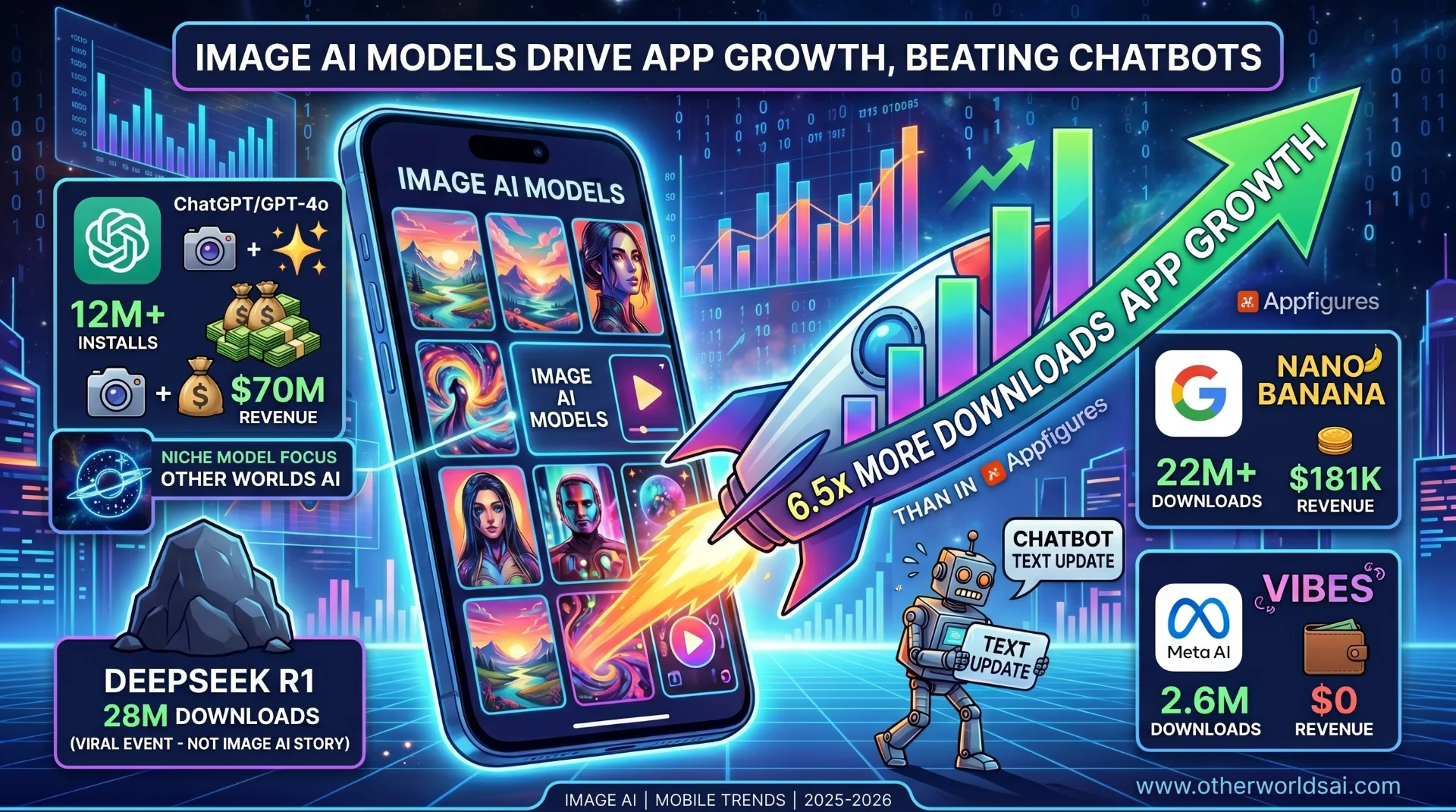
The AI mobile app landscape is undergoing a dramatic transformation. What was once driven by chatbot upgrades and language model releases has now firmly shifted toward image AI models. According to a groundbreaking new report from Appfigures — a leading app intelligence provider — image model releases are generating 6.5x more downloads than traditional model updates. This marks a pivotal moment for AI app growth strategy, mobile AI adoption, and the business of artificial intelligence.
For anyone tracking AI mobile app trends, generative AI app downloads, or the competitive dynamics between ChatGPT, Gemini, and other AI platforms, this report signals one clear message: visual AI is the new growth engine.
The Shift: Why Image AI Models Outperform Chatbot Updates:
For a long time, new language model releases dominated headlines and download charts. When OpenAI launched GPT-4o or GPT-4.5, or when Google pushed major updates to Gemini's conversational capabilities, app downloads followed. Voice chat interfaces and smarter reasoning brought users to the platform. But those gains, while real, were modest compared to what image AI features have since delivered.
The Appfigures data makes the contrast stark: image model launches are not just nudging the needle — they are fundamentally changing how millions of users discover and install AI apps. The ability to generate, edit, or enhance images directly inside a mobile AI app has become one of the most compelling use cases in consumer technology.
Image model releases generate 6.5x more downloads than traditional AI model updates. — Appfigures, 2025–2026 Report.
ChatGPT and GPT-4o Image Model: The Download Surge:
OpenAI's GPT-4o image model launch in March of last year stands as perhaps the clearest case study in AI app growth through visual features. Following the release of GPT-4o's image generation capabilities, ChatGPT added more than 12 million incremental installs in just 28 days. That is approximately 4.5x more downloads than ChatGPT saw from its GPT-4o text model, GPT-4.5, and GPT-5 releases combined.
Even more impressive was the revenue impact. OpenAI's image generation model drove an estimated $70 million in gross consumer spending over those same 28 days, compared to its prior baseline. This shows that the GPT-4o image model did not just attract curious one-time users — it converted a meaningful portion of new installs into paying subscribers. ChatGPT gained 12M+ incremental installs in 28 days after the GPT-4o image model launch — 4.5x more than text model releases.
$70 million in estimated gross consumer spending followed ChatGPT's image model rollout in just 28 days.
Google Gemini and Nano Banana: Massive Downloads, Modest Revenue:
Google Gemini's story with image AI is both a triumph and a cautionary tale. When Google released its Gemini 2.5 Flash image model — nicknamed Nano Banana — last August, the results in terms of downloads were extraordinary. Gemini added more than 22 million new downloads in the 28 days following the launch, lifting the app's overall download rate by more than 4x during that window.
However, the revenue picture told a very different story. Despite its enormous download spike, Nano Banana drove only an estimated $181,000 in gross consumer spending during the same 28-day period. That is a fraction of what ChatGPT earned with its image model launch, and it highlights a critical distinction in AI app monetization: downloads and revenue do not always move together.
The Gemini case underscores one of the central challenges in the AI app economy. Curiosity and novelty can drive massive install numbers, but converting those installs into paying subscribers requires more than a viral image model feature. Product experience, pricing strategy, and user retention all play essential roles in turning AI app downloads into sustainable AI app revenue.
Gemini's Nano Banana image model: 22M+ new downloads in 28 days — but only ~$181K in estimated gross consumer spending.
Meta AI and Vibes: Visual AI Expands Beyond Static Images:
The trend toward visual AI driving mobile growth is not limited to image generation alone. Meta AI's introduction of Vibes — an AI-powered short-form video feed — in September 2025 added an estimated 2.6 million incremental downloads in its first 28 days. While technically a video AI model feature, Vibes fits squarely within the broader pattern of visual AI content driving user acquisition.
Like Gemini's Nano Banana, however, Vibes did not translate into meaningful revenue. Meta AI's video AI feature generated no significant consumer spending despite its download lift. This further reinforces the data point that image and video AI model releases are powerful tools for AI app user acquisition — but monetization remains a separate challenge that not all platforms have solved equally well. Meta AI's Vibes video AI feature: 2.6M incremental downloads in 28 days — with no meaningful revenue increase.
DeepSeek R1: The Outlier That Proves the Rule:
No analysis of AI app growth in 2025 would be complete without addressing DeepSeek. When DeepSeek R1 launched in January 2025, it drove a staggering 28 million downloads — more than any image model release tracked in this report. But the Appfigures team explicitly noted that DeepSeek does not fit the image AI model growth pattern.
DeepSeek's breakout moment was driven by curiosity and industry disruption, not visual AI features. The model went from obscurity to the top of the app store almost overnight after the tech world learned about its remarkably cost-efficient training techniques. This was a once-in-a-generation viral moment — a story about geopolitics, AI efficiency, and competitive disruption — not a replicable product launch strategy.
In other words, DeepSeek's success was the exception, not the blueprint. For most AI apps, the path to sustained download growth in 2025 and 2026 runs through image and visual AI model innovation — not language model upgrades or one-time viral events. DeepSeek R1: 28M downloads in January 2025 — a unique viral disruption event, not an image AI growth story.
Downloads vs. Revenue: The Critical Distinction for AI App Monetization:
One of the most important takeaways from the Appfigures report is the gap between AI app downloads and AI app revenue. Image model launches are extraordinarily effective at giving people a reason to install and try an AI app. The novelty of a new image generation tool, the shareability of AI-created visuals, and the word-of-mouth dynamics of visual content all combine to drive installation spikes.
But installation is only the beginning of the monetization journey. As the Gemini and Meta AI examples show, even tens of millions of new installs can produce minimal revenue if users do not convert to paid subscriptions. Only ChatGPT demonstrated the full flywheel in action: viral image AI feature → mass downloads → meaningful revenue conversion.
For AI companies and mobile developers, this creates a clear strategic imperative. Image AI model releases should be treated as top-of-funnel user acquisition tools — but they must be paired with strong onboarding, compelling paid-tier differentiation, and retention strategies that turn first-time image generation users into long-term subscribers.
What This Means for the Future of AI App Strategy:
The Appfigures findings point to a clear shift in how AI companies should think about product launches, marketing, and user growth. In the early days of consumer AI, the announcement of a smarter, faster, or more capable language model was enough to generate headlines and downloads. That era appears to be fading.
Today's AI app users are increasingly driven by what they can see, create, and share. Image generation AI, AI photo editing, AI video creation, and visual AI tools have moved from novelty to necessity in competitive AI app strategy. Platforms that lead with compelling visual AI experiences are winning the user acquisition battle — and, in ChatGPT's case, the revenue battle too.
Looking ahead to the rest of 2026, the race for AI app growth will likely intensify around visual features. Expect major AI platforms to continue prioritizing image model releases, video AI tools, and real-time visual generation capabilities as their primary growth levers. The data is clear: in the battle for mobile AI dominance, a picture is worth not just a thousand words — but millions of downloads.
Key Takeaways: Image AI Models and Mobile App Growth:
📊 Image model releases drive 6.5x more downloads than traditional AI model updates.
🚀 ChatGPT's GPT-4o image model added 12M+ installs and $70M in consumer spending in 28 days.
Meta's Next Big Bet: This New App Lets You Build Games Simply by Typing a Prompt
📱 Google Gemini's Nano Banana generated 22M+ downloads but only ~$181K in revenue.
Support our research
Independent analysis fueled by you.
🎥 Meta AI's Vibes video feature drove 2.6M downloads with no meaningful revenue.
⚡ DeepSeek R1's 28M downloads were a unique viral event — not an image AI growth story.
💡 Downloads from image AI launches don't automatically convert to revenue — monetization strategy matters.
Move Over Nvidia: Anthropic and Samsung Team Up to Break the AI Chip Monopoly
Conclusion: The Visual AI Revolution Is Here:
The Appfigures report is a landmark data point in the evolution of AI mobile apps. It confirms what many industry observers had suspected: the consumer AI market is fundamentally visual now. Image generation AI is no longer a premium add-on or a niche feature — it is the primary engine of mobile AI app growth.
For AI companies, developers, marketers, and investors, the message is unmistakable: build for the eyes. Image AI model releases, visual content tools, and generative media features are the most powerful growth catalysts in the current AI landscape.
The platforms that master both the download surge and the revenue conversion will define the next chapter of the AI app economy.
Published: May 2026 | Category: AI Trends, Mobile Apps, Image Generation AI