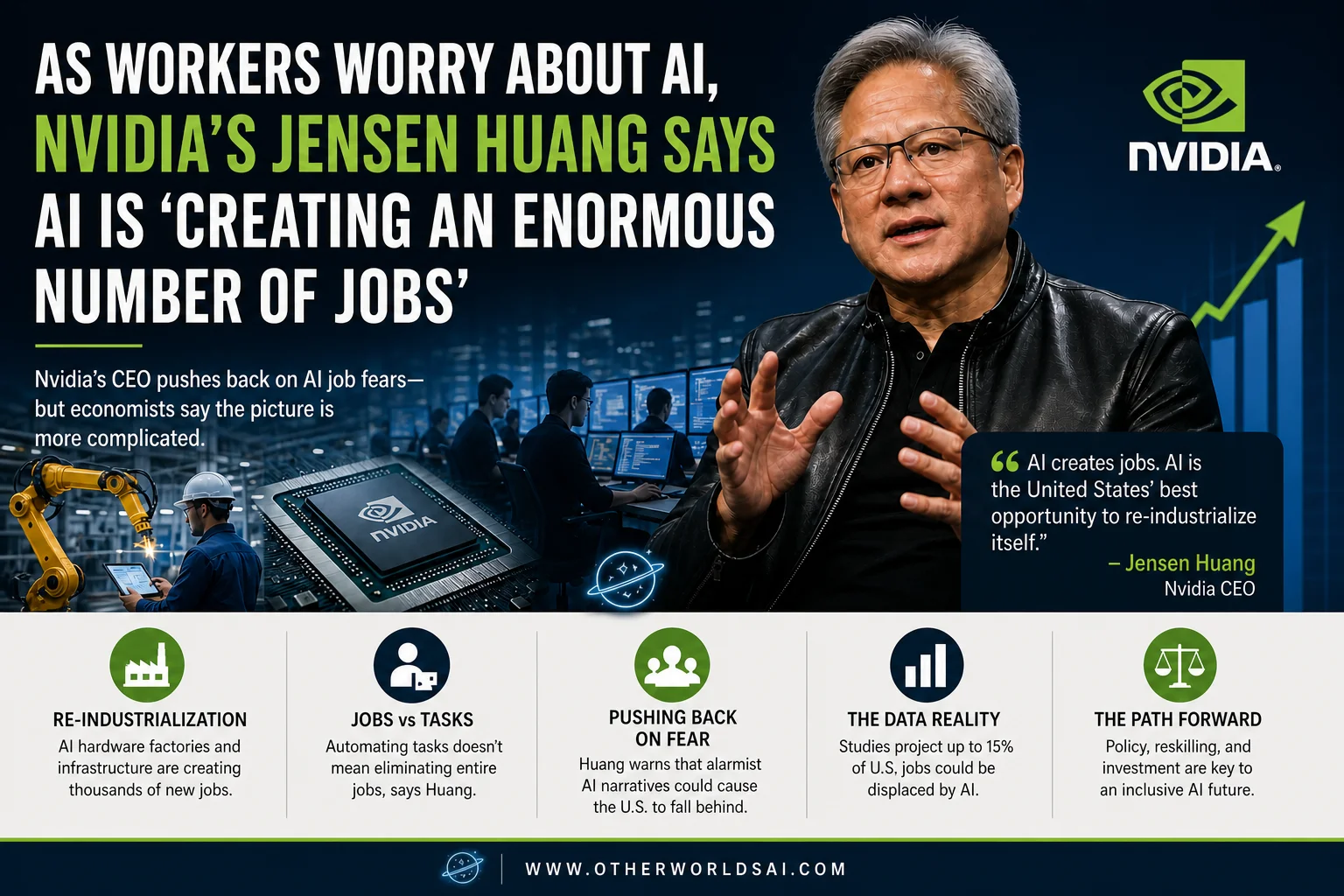

As workers worry about AI, Nvidia’s Jensen Huang says AI is ‘creating an enormous number of jobs:
Jensen Huang Says AI Creates Jobs—But Economists Warn of a 15% Workforce Wipeout:
When it comes to the specter of AI’s labor-displacing potential, Jensen Huang thinks that the American worker has nothing to fear. During a conversation Monday night with MSNBC’s Becky Quick hosted by the Milken Institute — an economic policy think tank, the jovial Nvidia CEO said that AI was an industrial-scale generator of jobs, not the harbinger of mass unemployment that so-called “AI doomers” have often accused it of being.
A number of different topics were broached during the talk, but a central theme that kept coming back was the ongoing economic anxiety surrounding the AI industry and whether it was something Americans should be legitimately worried about. At one point Quick noted:
“This is happening so quickly. Is there a bigger dislocation than we’ve seen in the past that leads to greater inequality? And what do we do about that?”
Throughout the night, Huang struck an optimistic note. “AI creates jobs,” Huang asserted during the discussion, adding that “AI is [the] United States’ best opportunity to re-industrialize” itself. Huang noted that the AI industry is powered by a new breed of industrial factories—the kinds producing the hardware that acts as critical infrastructure for the AI business. (Huang’s company notably sells a lot of that hardware.) Those factories necessarily need workers, as does the rest of the blossoming AI industry.
Just because a specific task is automated, that doesn’t mean that a person’s entire job is going to be replaced, Huang reasoned. People who believe this “misunderstand that the purpose of a job and the task of a job are related” but not ultimately the same thing, he said. In other words, Huang’s argument is that even when AI takes over a discrete task within a role, the broader function that employee serves in an organization is likely to remain.
Relatedly, Huang was critical of people who allege AI will dominate humanity or that it will wipe out huge sectors of the economy. “My greatest concern is that we scare…people—all the people that we’re telling these science fiction stories to, to the point where AI is so unpopular in the United States, or people are so afraid of it, that they don’t actually engage it,” he said.
Ironically, much of the “doomer” rhetoric has been generated by the AI industry itself, and critics maintain that such hyperbole has been used as a marketing gimmick designed to gin up buzz and excitement for products that aren’t anywhere near the capabilities that such rhetoric suggests.
It remains to be seen what kind of long-term impact AI will have on the overall economy. That said, reputable financial and academic organizations have suggested that as much as 15% percent of jobs in the U.S. will be eliminated over the next several years as a result of AI.
Introduction: The Debate That's Defining the AI Era:
Few questions loom larger over the modern workforce than this: will artificial intelligence create more jobs than it destroys? As millions of workers across industries grapple with that uncertainty, Nvidia CEO Jensen Huang stepped into the debate this week with a characteristically bold and optimistic answer. Speaking at a high-profile Milken Institute event hosted by MSNBC's Becky Quick, Huang declared that AI is not the job-killing machine that critics fear — it is, in his view, one of the greatest job-creation engines in modern economic history.
The remarks came at a moment of significant public anxiety about AI's long-term impact on employment. With major financial institutions and academic organizations issuing sobering forecasts about automation-driven job displacement, Huang's bullish stance puts him squarely at odds with a growing body of economic research — and raises important questions about whose version of the AI future Americans should believe.
Jensen Huang at the Milken Institute: AI Is a Job Creator, Not a Job Killer:
Standing before one of the world's most influential economic policy audiences, Jensen Huang made no attempt to soften his position on AI and employment. "AI creates jobs,"
Huang stated plainly during the conversation, framing artificial intelligence not as a threat to the American worker but as the country's most powerful opportunity for economic reinvention. His remarks were wide-ranging, but a central thread ran through the entire evening: optimism about what AI means for the future of work in America.
Huang's argument rested on a distinction that he believes is widely misunderstood by the public and by policymakers alike. Just because AI automates a specific task does not mean it will eliminate the job that task belongs to. People who believe otherwise, Huang argued, "misunderstand that the purpose of a job and the task of a job are related" — but they are not the same thing.
In other words, even as AI takes over discrete functions within a role, the broader value that an employee brings to an organization is likely to endure. "AI creates jobs. AI is the United States' best opportunity to re-industrialize itself." — Jensen Huang, Nvidia CEO
Re-Industrialization: The Factory Argument for AI Job Growth:
One of Huang's most concrete arguments for AI-driven job creation centers on the physical infrastructure that powers the AI economy. The AI industry, Huang pointed out, depends on a new generation of industrial factories — facilities producing the semiconductors, processors, and hardware that serve as the backbone of modern artificial intelligence.
Those factories require workers. Lots of them. And as the AI industry scales, so too does demand for the people who build, operate, and maintain that infrastructure. It is worth noting, of course, that Nvidia is one of the primary beneficiaries of this industrial buildout. The company sells the GPUs and AI chips that data centers and AI platforms depend on, making it one of the most valuable companies in the world.
Huang's enthusiasm for the job-creating potential of AI hardware factories is, in that sense, also an argument for the continued growth of his own business — a fact that critics are unlikely to overlook.
Nevertheless, the broader point stands: the AI supply chain is vast, and it does employ a significant and growing number of workers. From chip fabrication to data center construction, from hardware logistics to AI model deployment, the ecosystem supporting artificial intelligence spans millions of jobs across the global economy.
The 'AI Doomer' Debate: Huang Pushes Back on Existential Fears:
Beyond the jobs question, Huang used the Milken Institute stage to challenge what he called the dangerous narrative of AI as an existential threat. The Nvidia CEO has long been skeptical of so-called "AI doomer" rhetoric — the school of thought that warns of AI systems eventually dominating or displacing humanity on a civilizational scale. On Monday night, he made his sharpest critique yet of how that rhetoric is shaping public perception.
"My greatest concern is that we scare people," Huang said, warning that alarmist AI narratives risk making the technology so unpopular that Americans disengage from it entirely. In his view, the real danger is not that AI becomes too powerful — it is that fear-driven public sentiment causes the United States to fall behind in the global AI race.
If Americans are too frightened of AI to adopt and develop it, he argued, the country loses one of its most significant competitive advantages on the world stage. "My greatest concern is that we scare people... to the point where AI is so unpopular that they don't actually engage it." — Jensen Huang
The Irony: When 'Doomer' Rhetoric Comes From Inside the House:
**There is a deep irony embedded in Huang's critique of AI **fearmongering that deserves acknowledgment. Much of the most alarming rhetoric about AI's existential risks has not originated with outside critics or Hollywood screenwriters — it has come from within the AI industry itself.
Prominent AI researchers, lab executives, and technology investors have, at various points, made sweeping claims about AI systems that could surpass human intelligence, automate entire professions, or pose risks to civilization.
Critics have long argued that this kind of hyperbole serves a calculated purpose. By framing AI as an almost mythically powerful force — one that demands urgent attention and massive investment — the industry generates the buzz, funding, and regulatory attention that keeps it at the center of public discourse.
Whether intentional or not, existential AI narratives have functioned as extraordinarily effective marketing for an industry still working to demonstrate its real-world capabilities at scale.
Huang's pushback against doomer rhetoric, while genuine in its concern for public trust, thus carries a certain complexity. He is asking the public to be less afraid of a technology that his own industry — including, at times, his own company — has worked hard to present as world-historically significant.
What the Data Actually Says: AI and Job Displacement:
Huang's optimism is understandable from the perspective of an industry leader, but the economic research paints a more nuanced and, in some respects, more sobering picture. Reputable financial and academic institutions have projected that as much as 15% of jobs in the United States could be eliminated over the next several years as a direct result of AI-driven automation. That is not a fringe estimate — it reflects the consensus view of organizations that study labor markets with rigorous, data-driven methodologies.
The critical question, as economists have long pointed out, is not just whether jobs are displaced but whether new jobs are created quickly enough to absorb displaced workers — and whether those new jobs are accessible to the people who lost their old ones. Historically, major technological disruptions have eventually produced net job gains, but the transition periods have often been painful and prolonged, with the heaviest costs falling on the most economically vulnerable workers.
The AI moment may follow that historical pattern — or it may not. The speed at which AI capabilities are advancing, combined with the breadth of industries being affected simultaneously, has led some economists to worry that this technological transition could be more disruptive, and less self-correcting, than those that came before. Reputable organizations project up to 15% of U.S. jobs could be eliminated in the coming years due to AI-driven automation.
The Anxiety Is Real: What Workers Are Actually Experiencing:
For all the high-level debate between optimists like Huang and more cautious economists, the lived experience of workers navigating the AI transition is increasingly visible. Across industries from customer service to legal research, from graphic design to software development, workers are reporting that AI tools are changing the nature of their jobs — sometimes expanding their capabilities, sometimes reducing their hours, and sometimes eliminating their positions entirely.
Becky Quick captured this tension directly during the Milken Institute conversation, pressing Huang on whether AI's rapid pace of change could produce "a bigger dislocation than we've seen in the past" — one that leads to greater economic inequality. It is a legitimate concern, and it is one that Huang's optimism, however sincere, does not fully resolve. The promise that AI will create jobs in aggregate is cold comfort to the call center worker, the paralegal, or the junior programmer whose specific role is being automated right now.
A Balanced View: What Both Sides Get Right:
The truth about AI and employment is almost certainly more complicated than either pure optimism or pure pessimism allows. Huang is right that AI is generating real demand for new kinds of work — in AI infrastructure, model development, data labeling, AI safety, and a growing range of AI-adjacent roles. He is also right that the automation of individual tasks does not automatically mean the elimination of entire jobs. Many roles will evolve rather than disappear.
At the same time, the economists and researchers projecting significant job displacement are not simply being alarmist. The scale and speed of AI adoption, combined with the technology's ability to perform cognitive tasks that were previously considered automation-proof, represents a genuinely new challenge for labor markets.
Policymakers, educators, and businesses will need to invest seriously in reskilling, workforce transition, and social safety nets to ensure that the benefits of AI are broadly shared.
What is clear is that the debate itself — the one Huang engaged in so confidently on Monday night — is one of the most consequential economic conversations of our time. How societies answer the question of AI and work will shape the distribution of prosperity, the stability of labor markets, and the social contract between technology and the people it is supposed to serve.
Key Takeaways: Jensen Huang, Nvidia, and the AI Jobs Debate:
🎤 Jensen Huang declared at the Milken Institute that "AI creates jobs" and is America's best chance at re-industrialization.

Move Over Nvidia: Anthropic and Samsung Team Up to Break the AI Chip Monopoly
🏭 Huang argues that AI hardware factories and the broader AI supply chain are generating significant new employment.
Support our research
Independent analysis fueled by you.
⚠️ Huang warned that fear-driven AI narratives risk making the U.S. disengage from technology that could be a national competitive advantage.
🔄 Ironically, much of the alarming AI rhetoric Huang pushes back against has originated within the AI industry itself.

Meta's Next Big Bet: This New App Lets You Build Games Simply by Typing a Prompt
📊 Reputable economic organizations project up to 15% of U.S. jobs may be eliminated by AI in the coming years.
💬 The jobs-vs-tasks distinction Huang draws is valid — but it does not address the displacement pain experienced by individual workers.
Conclusion: Optimism Is Not Enough:
Jensen Huang is one of the most consequential figures in the AI economy, and his optimism about AI-driven job creation is neither uninformed nor insincere. Nvidia sits at the center of the AI industrial complex, and Huang has a ground-level view of the investment, infrastructure, and workforce expansion that AI is generating. His argument that task automation does not equal job elimination deserves to be taken seriously.
But optimism, however well-founded, is not a workforce policy. The workers facing displacement today need more than reassurance — they need retraining programs, transition support, and economic policies that ensure the enormous wealth being generated by AI companies like Nvidia flows back into the communities and labor markets being reshaped by the technology.
The AI era will almost certainly create new jobs. The defining challenge of the next decade is ensuring that the people who lose old jobs to AI are the ones who get to fill the new ones.
That is a question Huang's optimism raises — but does not yet fully answer.
Published: May 2026 | Category: AI & Employment, Tech Leaders, Future of Work