
Google to Invest Up to $40 Billion in Anthropic: Inside the Deal That's Reshaping the AI Arms Race:
Google vs. NVIDIA: How custom TPU chips and a $40B check are shifting the AI balance of power.
In the most consequential AI investment of 2026, Google is doubling down on Anthropic with a $40 billion commitment — cementing a relationship that blurs the line between competitor, cloud provider, and strategic partner. Here is what the deal means, why it matters, and where the AI race goes from here.
The $40 Billion Bet: What Google Is Actually Committing To:
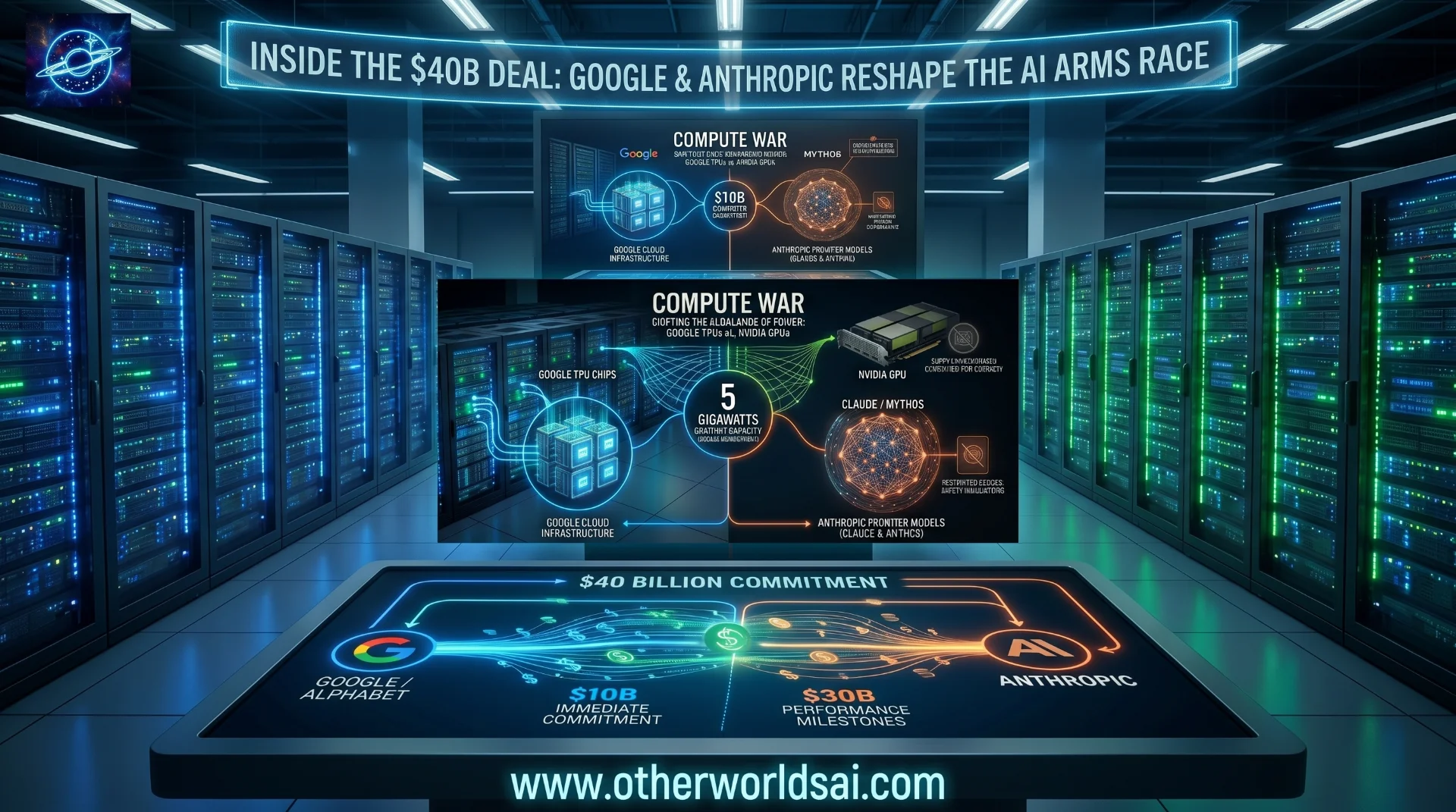
In what is already being called the defining AI investment of 2026, Google has announced plans to invest up to $40 billion in Anthropic — the AI safety company behind the Claude family of large language models. The deal, first reported by Bloomberg, is structured in two tranches: an immediate $10 billion commitment at a $350 billion valuation for Anthropic, followed by an additional $30 billion contingent on Anthropic hitting specific performance milestones.
This is not a simple financial transaction — it is a strategic realignment of the entire AI landscape. Google, through its Alphabet subsidiary, is embedding itself as both the primary funder and the primary infrastructure provider for one of the most formidable AI labs in the world. The implications for the AI arms race, for cloud computing dominance, and for the future of foundation models are profound.
"$40 billion. $350 billion valuation today. Reports of investors eager to back Anthropic at $800 billion or more. The numbers alone tell the story of how fast this race is moving." Adding further fuel to the valuation story: Anthropic's worth stood at $350 billion as recently as February 2026, yet investors have already been circling at $800 billion or higher, according to Bloomberg. The company is also reportedly exploring an IPO as early as October 2026 — which would make it one of the most watched public market debuts in recent memory.
Anthropic's Mythos Model: Power, Restriction, and the Cost of Capability:
The timing of Google's investment is not coincidental. Just this month, Anthropic released Mythos — its most powerful AI model to date — to a limited group of select partners. Mythos is not a general-purpose chatbot upgrade; it is a frontier model with significant cybersecurity applications, capable of performing tasks at a level that has prompted Anthropic to restrict its broader rollout while safety evaluations are conducted.
The caution is warranted, but the situation has already become complicated. Reports have confirmed that Mythos has fallen into unsanctioned hands — accessed by unauthorized users despite Anthropic's efforts to control its distribution. This is precisely the kind of scenario that frontier AI safety researchers have long warned about: models powerful enough to cause serious harm escaping the carefully managed pipelines their creators intended.
Mythos is both Anthropic's greatest demonstration of capability and its most visible governance challenge — a model so powerful that even its creator is restricting it, yet already circulating beyond its intended boundaries.
Beyond the safety dimension, Mythos carries another challenge: cost. Running frontier models at scale is extraordinarily compute-intensive, and Mythos is no exception. This reality is a direct driver of Anthropic's aggressive infrastructure expansion — and of Google's decision to deepen its compute commitment at precisely this moment.
The Compute War: Why Access to AI Infrastructure Is the New Oil:
The AI race of 2026 is not primarily a race of algorithms — it is a race of compute. Whoever controls the chips, the data centers, and the energy to power them controls the pace of AI development. This reality is reshaping corporate strategy across the entire technology industry, and Anthropic's deal-making sprint over the past month is a textbook example of how frontier AI labs are scrambling to secure their computational futures.
OpenAI has moved with characteristic aggression to lock in compute capacity, assembling a web of multi-hundred-billion-dollar deals across cloud providers, chip suppliers, and energy companies. This month alone, OpenAI expanded its agreement with AI chip startup Cerebras, committing to spend more than $20 billion on Cerebras chips in exchange for an equity stake — a deal that signals how deeply compute procurement has become intertwined with investment strategy.
"The AI race is increasingly defined by access to the compute needed to train and deploy these systems — and right now, that compute is scarce, expensive, and fiercely contested." Anthropic has been running a parallel infrastructure sprint of its own.
Facing widespread user complaints about Claude usage limits in recent weeks — a direct symptom of constrained compute capacity — the company has responded with a series of rapid-fire infrastructure agreements designed to unlock the scale its models demand.
Anthropic's Infrastructure Deals: CoreWeave, Amazon, and Now Google:
The scale of Anthropic's infrastructure buildout over the past 30 days is extraordinary. Earlier this month, the company signed an agreement with CoreWeave — one of the fastest-growing cloud computing providers in the world — for dedicated data center capacity. CoreWeave, backed by NVIDIA and known for its GPU-dense infrastructure, gives Anthropic access to raw compute outside the traditional hyperscaler relationships.
Then came Amazon. This week, Anthropic secured an additional $5 billion investment from AWS, part of a sweeping agreement under which Anthropic is expected to spend up to $100 billion for approximately 5 gigawatts of compute capacity over time. Like Google's deal, the Amazon arrangement exemplifies the circular investment model that has come to define AI financing: the investor and the infrastructure provider are the same entity, and capital flows in a loop.
CoreWeave for GPU density. Amazon for cloud scale. Google for TPUs and strategic alignment. Anthropic is not picking one infrastructure partner — it is building a diversified compute portfolio at a scale few companies in history have attempted.
And now Google completes the trifecta. The new investment expands Anthropic's existing Google Cloud relationship, with Google now providing a fresh 5 gigawatts of compute capacity over the next five years — with room to scale even further. Combined with the earlier partnership between Anthropic, Google, and chipmaker Broadcom (which is designing custom AI chips for Google), Anthropic is securing access to 3.5 gigawatts of TPU-based computing capacity beginning in 2027, with today's deal layering another 5 gigawatts on top.
Google vs. Anthropic: Competitor, Cloud Provider, and Strategic Investor:
Perhaps the most fascinating dimension of this deal is the relationship it represents. Google is not a neutral investor in Anthropic — it is a direct competitor. Google's Gemini family of models competes head-to-head with Anthropic's Claude across enterprise, consumer, and developer markets. And yet Google is simultaneously Anthropic's most critical infrastructure partner, providing the TPU chips that power Claude's training and deployment at scale.
This is the defining paradox of the modern AI ecosystem: the companies competing most fiercely for AI dominance are also deeply, structurally interdependent. Google needs Anthropic to succeed enough to keep buying Google Cloud compute. Anthropic needs Google's TPUs — which are widely regarded as among the best alternatives to NVIDIA's in-demand processors — to train its frontier models. Neither can simply walk away from the other.
Google is betting $40 billion on a company that is simultaneously its cloud customer, its AI competitor, and its most important validation that Google Cloud can support frontier AI workloads. It is a relationship with no clean analog in business history.
For Anthropic, the strategic calculation is equally nuanced. Accepting Google's capital at a $350 billion valuation — while investors are reportedly willing to pay $800 billion or more — suggests that the non-financial dimensions of the Google relationship carry significant weight. Access to TPUs, to Google's infrastructure expertise, and to a partner with the resources to write $40 billion checks is not something Anthropic can easily replicate elsewhere.
Anthropic's IPO Horizon: The $800 Billion Question:
With its valuation trajectory pointing sharply upward and its infrastructure secured at unprecedented scale, Anthropic is reportedly considering an IPO as early as October 2026. If it proceeds at the $800 billion-plus valuation that investors have expressed willingness to pay, it would rank among the largest technology IPOs ever conducted — eclipsing most of the landmark listings of the past decade.
The IPO timing, if it materializes, would be a significant signal for the broader technology market. After years of suppressed public market activity driven by rising interest rates and investor caution, a successful Anthropic debut would likely open the floodgates for a wave of long-delayed AI and tech startup listings.
It would also provide the first truly transparent look at the unit economics of a frontier AI lab — how much it actually costs to train and serve models at scale, and whether the revenue growth justifies the extraordinary capital investment.

Anthropic’s Surprise Double Launch Directly Targets OpenAI and Google’s AI Dominance
"Investors have been eager to back Anthropic at $800 billion or more. An October IPO would answer the question the entire industry is asking: what is frontier AI actually worth at market price?"
Support our research
Independent analysis fueled by you.
The Bigger Picture: What the Google-Anthropic Deal Means for Everyone:
The Google-Anthropic $40 billion deal is not just a headline — it is a structural event that will shape the trajectory of AI development for years to come. It confirms that the compute war is the central strategic battleground of the AI era. It demonstrates that the line between investor and infrastructure provider has effectively dissolved. And it signals that the major technology platforms are willing to make bets of historic scale to avoid being left behind in the race to AI dominance.
For founders, investors, and developers, here are the essential takeaways:
• - Compute is the new oil — whoever controls the chips, data centers, and energy infrastructure controls the pace of the AI revolution. Every major AI lab is racing to lock in capacity now.
Meta's Next Big Bet: This New App Lets You Build Games Simply by Typing a Prompt
• - The circular investment model is the dominant AI financing architecture — Google funds Anthropic, Anthropic spends on Google Cloud, Google profits. Understanding this loop is essential for anyone deploying capital in AI.
• - Frontier model safety is an unsolved distribution problem — Mythos reaching unauthorized users demonstrates that capability and control are not advancing at the same pace.
• - Anthropic's IPO could be the market-defining event of late 2026 — its valuation trajectory will set the benchmark for how the public markets price frontier AI for years to come. • - The Google-Anthropic relationship is the template for a new kind of corporate alliance — competitor, customer, and investor simultaneously, with billions of dollars holding the arrangement together.
The AI arms race has entered a new phase — one measured not in model benchmarks, but in gigawatts of compute, billions of dollars of committed capital, and the strategic depth of infrastructure relationships.
Google's $40 billion bet on Anthropic is the clearest signal yet that this phase has truly begun.