
Era Raises $11M to Build the AI Gadget Software Platform Powering the Next Generation of Intelligent Devices:
Era: The $11M Bet on the Future of AI Hardware.
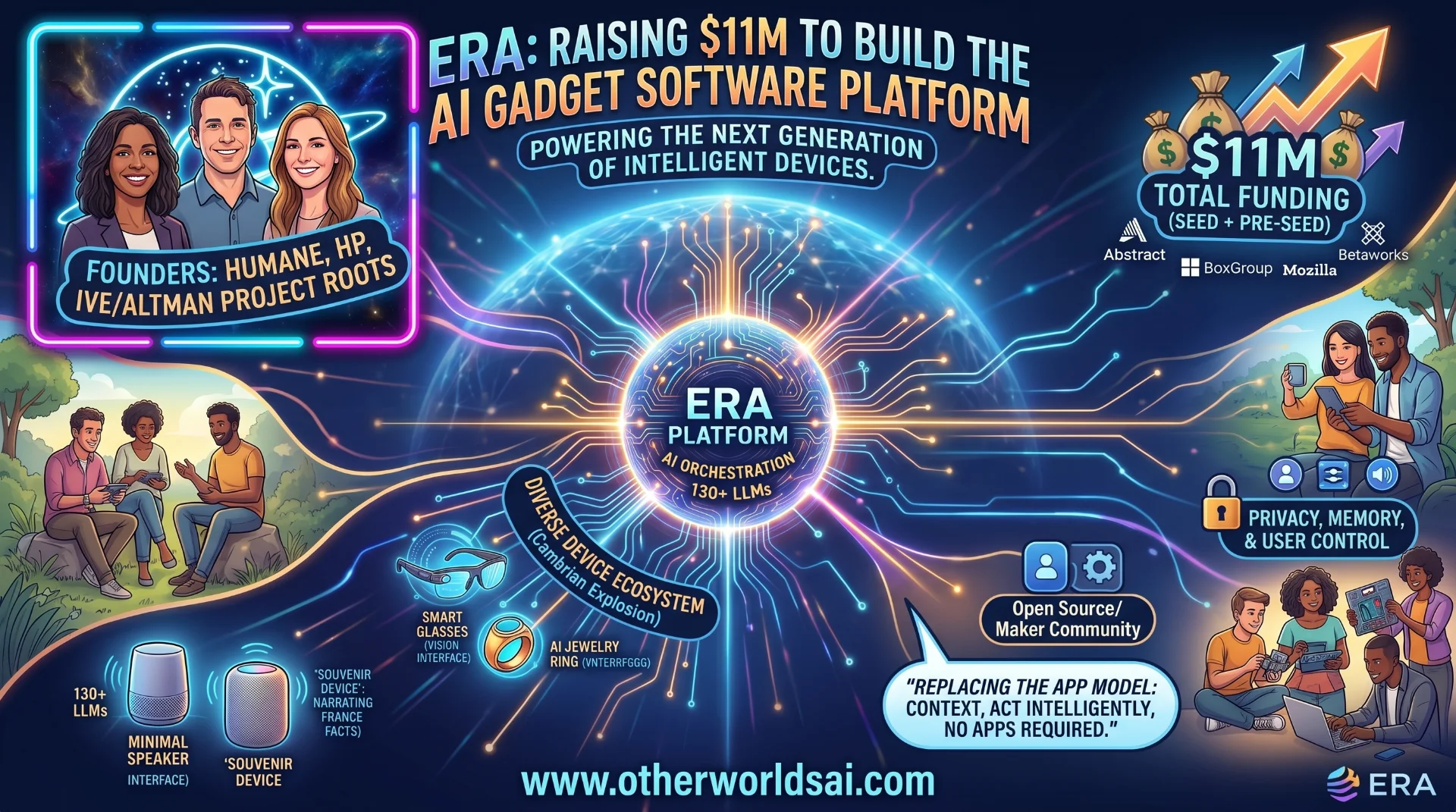
A new era in AI hardware is quietly taking shape — and a startup aptly named Era is betting it will be the software backbone behind every intelligent gadget to come. The New York-based company has raised $11 million in total funding to build a platform that empowers hardware makers, indie creators, and global brands to develop AI-powered devices — without building the intelligence layer from scratch.
Funding Breakdown: Era's $11M Raise and the Investors Betting on AI Gadgets:
Era's $11 million funding stack signals serious confidence in the AI device ecosystem. The company recently closed a $9 million seed round led by Abstract Ventures and BoxGroup, with participation from Collaborative Fund and Mozilla Ventures. This came on the heels of a $2 million pre-seed round from Topology Ventures and Betaworks — investors who specialize in early-stage, category-defining technology companies.
A star-studded group of angel investors further validates Era's vision. The round includes Flickr co-founder Caterina Fake, iPhone keyboard creator Ken Kocienda, OAS founder Tony Wang, Little Guy co-founder Daniel Kuntz, Sandbar co-founder Mina Fahmi, former Rabbit CPO ShaoBo Z, and Poetry Camera creator Kelin Zhang — a lineup that bridges hardware innovation, AI product leadership, and consumer tech.
The Platform Vision: Building the Intelligence Layer for AI-Powered Hardware:
Era is not building devices — it is building the engine that will power them. At its core, Era provides a software platform for AI gadgets that enables hardware makers to create AI agents, manage model orchestrations, and deploy multimodal intelligence across any form factor — from smart glasses and AI jewelry to home speakers and beyond.
The platform currently offers access to over 130 large language models (LLMs) from more than 14 providers. This breadth ensures that hardware developers can select the right model for their specific use case, whether that involves custom voice creation, real-time inference, or intelligent device interactions.Era's platform handles the complex orchestration layer — so device makers can focus on building compelling user experiences.
Casey Caruso, founder and managing partner at Topology Ventures, highlighted what sets Era apart in the crowded AI infrastructure space: the platform's dynamic routing across models and ability to manage real-world constraints like connectivity. These aren't just technical checkboxes — they are essential capabilities for devices operating in the physical world, where reliability and adaptability are non-negotiable.
Meet the Founders: A Team Forged at Humane, HP, and the Sam Altman–Jony Ive Project:
Era was founded in 2024 by a team with deep, hands-on roots in the AI hardware revolution. CEO Liz Dorman previously worked at Humane — the high-profile AI pin startup — where she led AI orchestration, later transitioning to HP as part of Humane's acquisition.
CTO Alex Ollman brought expertise in agentic frameworks for enterprises from his time at HP. CPO Megan Gole worked at Sutter Hill Ventures on the highly anticipated Jony Ive and Sam Altman io project before joining Era — lending the startup a direct connection to some of the most ambitious hardware thinking in Silicon Valley.
Together, this founding team brings a rare combination of enterprise AI architecture, consumer hardware product experience, and venture-level strategic thinking. Their background makes Era uniquely positioned to understand both the technical complexity and the market dynamics of building software infrastructure for the next generation of AI devices.
The Cambrian Explosion of AI Gadgets: Why Era Is Betting on Hardware Diversity:
Era's core thesis is that we are on the cusp of a hardware renaissance — and not just for one type of device. Dorman described it plainly: "We're gonna have a Cambrian explosion of what's possible, and this is because tech is commoditized." As AI model inference becomes cheaper and hardware components more accessible, the barrier to creating intelligent devices is falling dramatically.
Rather than chasing one winning form factor, Era is building a horizontal platform that scales across all of them. Smart glasses, AI rings, connected bracelets, intelligent home speakers — Era's infrastructure is designed to power any device that needs an AI brain. The company envisions a future where brands, makers, and developers worldwide can plug into its platform and launch custom AI gadgets for their audiences without reinventing the wheel.
A recent showcase in New York illustrated this vision in action. Era gathered artists who had received its developer kit and put their AI gadget prototypes on display: a souvenir that narrates facts and jokes about France, a stock-watching device that tells users when they can afford to quit their job, and an air quality monitor that communicates through voice. While experimental, these devices point toward a future where AI is embedded in everyday physical objects — hyper-personalized, contextually aware, and radically accessible.
Replacing the App Model: Era's Radical Vision for Intelligent Devices:
One of the most provocative ideas at the heart of Era is the notion that the app model itself is ready to be disrupted. Dorman articulated this boldly: "I think one of the incredible things that we can do with these AI models today is that you can replace that app layer." Instead of navigating menus and tapping through interfaces, Era envisions devices that understand context, respond naturally, and act intelligently — no apps required.
This is more than a product vision — it is a philosophical statement about who gets to shape technology. Dorman was direct: "The future of tech should not be made by people in San Francisco… I want a choice over my devices again." Era's open platform approach — designed for makers, artists, open-source developers, and global brands alike — is a deliberate push against the walled garden model that has dominated consumer electronics for a decade.
Privacy, Memory, and User Control: Era's Commitment to Ethical AI Gadgets:
As AI gadgets become more personal, data privacy becomes a critical differentiator. Era is building its platform with a clear commitment: users should be able to choose their own memory and model providers in a privacy-preserving way. This positions Era not just as an infrastructure provider, but as an advocate for user agency in a space where data collection is often invisible and unchecked.
The platform is also built to scale — designed to support millions of devices simultaneously. Whether a brand wants to run a limited AI gadget experiment for a niche audience or deploy at global scale, Era's architecture is ready. This scalability, combined with its privacy-first posture and open ecosystem ethos, could make Era the de facto standard for AI gadget infrastructure.
The AI Hardware Landscape: Lessons from Humane, Rabbit, and the Road Ahead:
The AI hardware market has been littered with high-profile stumbles — and Era is acutely aware of them. Humane was acquired by HP after its AI Pin failed to find a mass market. Rabbit has gone quiet. Even well-funded, well-publicized efforts have struggled to cross the chasm from novelty to necessity. The honest reality is that no AI hardware company has yet found a definitive, scalable model for success.
Yet some signals are encouraging. Plaud has carved out a viable niche in AI meeting note-taking. Emerging startups like Sandbar and Taya are gaining early traction. Era's bet is that as users encounter more compelling AI device use cases, some will stick — and when they do, the winners will be those with the strongest software layer underneath the hardware.
Era's positioning is strategically differentiated from device makers. By building the intelligence infrastructure rather than a single gadget, Era is not dependent on any one product category winning. If glasses become the dominant AI form factor, Era powers them. If it's earbuds, or rings, or kitchen devices — Era is already there. This platform-first strategy is what gives the startup a shot at lasting relevance in a volatile market.
Open Source and Maker Community: Era's Plan to Build an Ecosystem:
Era is not just courting big brands — it is actively cultivating a grassroots ecosystem. Following the success of its New York artist showcase, the company plans to make its platform available to the open-source and maker community, inviting independent developers and hardware hobbyists to experiment, build, and share what they create.
This community-first strategy is a smart growth play. By lowering barriers for indie makers, Era generates real-world use cases, stress-tests its platform across diverse applications, and builds the kind of grassroots credibility that money cannot buy. If Era's platform becomes the go-to toolkit for AI hardware hackers and indie creators, it will naturally become the reference architecture for larger commercial deployments too.
The Bottom Line: Era Is Building the AWS of AI Gadgets:
Era's $11M raise is more than a funding milestone — it is a declaration that the AI gadget revolution needs an infrastructure layer, and Era intends to be it. With a battle-tested founding team, a platform supporting 130+ LLMs across 14+ providers, a scalable architecture, and a bold vision for user-controlled, privacy-preserving AI devices, Era is methodically laying the groundwork for what could become the foundational platform of the post-smartphone era.
The app economy had Apple and Google. The cloud had AWS and Azure. If Liz Dorman and her team execute on their vision, the AI gadget ecosystem may have Era.