
Beyond the Perfect Burger: Why AI Food Photography Breaks Down Under Real-World Conditions.
The AI Menu Problem: Why AI-Generated Food Images All Look Too Perfect:
Walk into a modern café, fast-food restaurant, or food delivery website and you may notice something strange about the menu.
The burgers look perfectly symmetrical. The cheese melts in exactly the right way. Every scoop of ice cream is impossibly round. Shrimp appear unnaturally smooth. Even the smallest details seem polished beyond reality.
At first glance, everything looks appetizing.
Look a little closer, however, and something feels wrong.
This is the growing AI-generated menu problem.
As restaurants and food businesses increasingly experiment with generative AI, AI image generation, and automated marketing, a strange visual sameness is beginning to emerge. AI-generated food images often look attractive, but they can also appear artificial, repetitive, and subtly unsettling.
And there is a reason.
Why Do AI-Generated Food Images Look So Similar?
Modern AI image generators are trained on enormous collections of images and other data. Systems learn patterns from this information and use those patterns to predict what an image should look like when a user provides a prompt.
Ask an AI tool to create a photograph of a cheeseburger, for example, and it doesn't understand a burger in the same way a chef, photographer, or food stylist does. Instead, it has learned statistical patterns from millions of examples.
Many of those examples come from restaurants, advertisements, stock photography, menus, social media, and commercial food photography. These sources already tend to favor a particular aesthetic: bright lighting, perfect presentation, symmetrical ingredients, glossy surfaces, and highly appetizing compositions.
The result is predictable.
AI doesn't simply reproduce food photography. It can reproduce the visual conventions that dominate food photography.
That is why an AI-generated burger can look less like an actual burger and more like an idealized version of what advertising says a burger should look like.
The "Perfect Food" Problem.
Real food is messy.
Bread has irregular textures. Cheese melts unevenly. Vegetables have different shapes. Fried food contains imperfections. A restaurant kitchen rarely produces two plates that look exactly the same.
AI-generated food images often remove these imperfections.
A hamburger may have perfectly aligned layers. Every lettuce leaf can appear strategically positioned. Sauce may flow in a physically improbable way. Ice cream can look unnaturally smooth.
Individually, these details may seem harmless.
Together, they create an image that is almost—but not quite—real.
This is where the AI uncanny valley becomes important.
Research into AI-generated food imagery has suggested that highly realistic synthetic food can produce an uncanny response. Interestingly, images that are obviously fake may not create the same discomfort. The strongest reaction can occur when an image looks almost completely authentic but contains subtle visual inconsistencies.
In other words, our brains can detect something that we cannot always explain.
AI Convergence Is Making the Problem Worse.
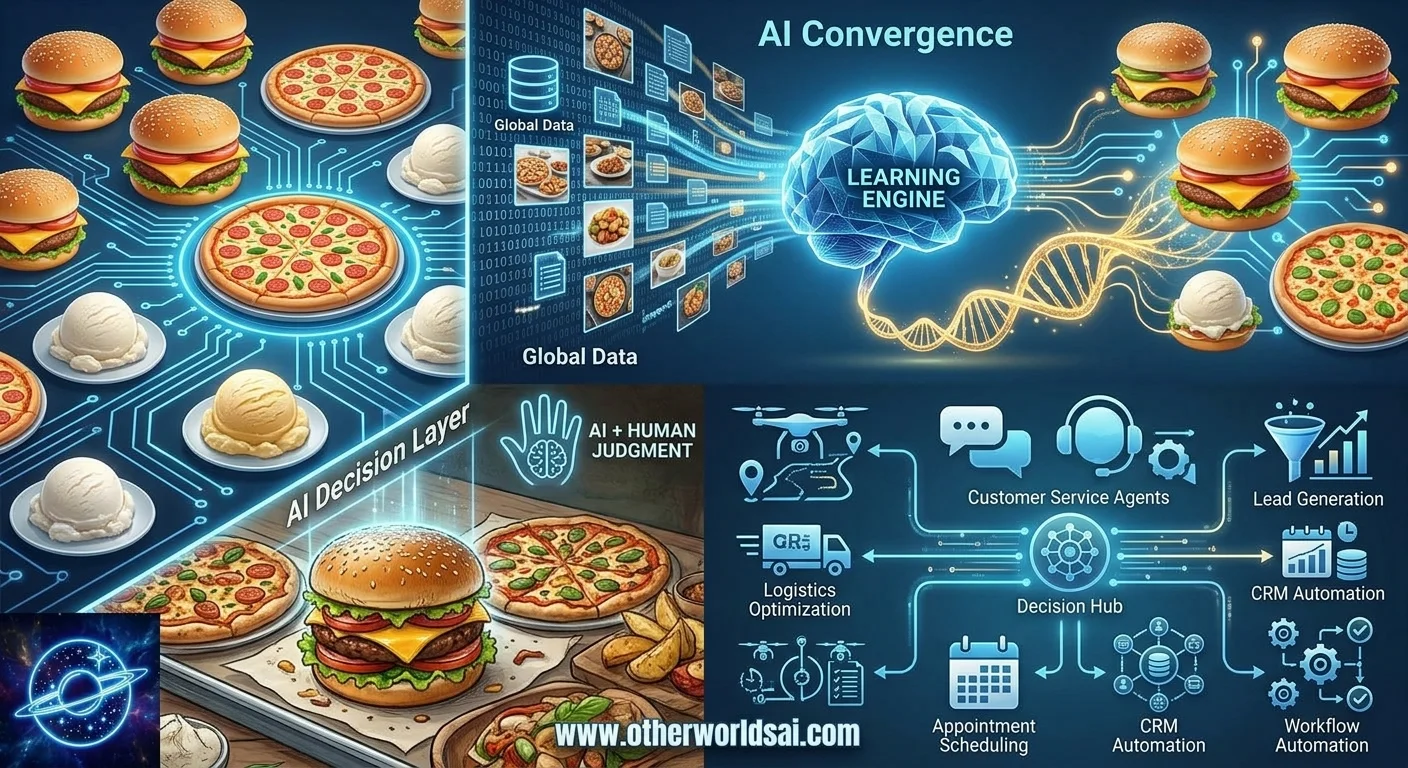
There is another issue behind the sameness: AI convergence.
Artificial intelligence models learn from existing data. If much of that data already contains similar visual styles, the model naturally learns those patterns.
Imagine asking an AI system to create a menu for a fast-food restaurant.
It may draw inspiration from the visual language associated with major chains and commercial food advertising. Those businesses already use similar colors, compositions, photography techniques, and product arrangements.
The AI then produces something that resembles those existing styles.
If synthetic content subsequently becomes part of future training datasets, the cycle can become even stronger.
This is different from complete model collapse, where training repeatedly on generated data can cause serious degradation in model performance. Convergence is subtler. The AI still works.
It simply starts producing increasingly familiar-looking results.
That can create a world where thousands of restaurants appear to have menus designed by the same invisible art director.

Meta's Next Big Bet: This New App Lets You Build Games Simply by Typing a Prompt
Why Editing AI Images Again and Again Can Make Them Worse.
There is an additional problem that businesses using AI image generators may encounter. Suppose a restaurant creates an AI-generated menu image. Later, the owner wants to change the price.
-
Then the restaurant wants to modify the burger.
-
Then the background needs to be changed.
- Then the restaurant name needs updating.
With every generation or edit, the image may move slightly further away from the original concept.
Food can become rounder, smoother, more polished, and less physically realistic. This is particularly important for businesses using AI as part of restaurant marketing automation.
Support our research
Independent analysis fueled by you.
AI is extremely useful for rapidly producing marketing content, but repeated generative editing should not automatically be treated as equivalent to editing an original photograph. There is a fundamental difference between modifying an authentic image and repeatedly asking an AI model to reconstruct it.
Why Customers Notice AI-Generated Content?
Consumers may not always be able to identify exactly why an image looks artificial. They simply know that something doesn't feel right.
This phenomenon matters because restaurants depend heavily on visual trust.
Food photography is not merely decoration. It influences expectations.
When a customer sees a burger online, they are forming an idea of what they will receive. If the actual product looks significantly different, disappointment can follow.
That makes authenticity increasingly important in the age of AI-generated content.
Businesses therefore need to consider not only whether AI can produce attractive images, but whether those images accurately represent the real product.
AI Isn't the Problem—Poor AI Use Is.
The answer isn't necessarily to abandon AI.
In fact, artificial intelligence for restaurants can provide enormous value. AI can help businesses automate customer service, answer questions, manage bookings, generate promotional copy, analyze customer interactions, create social media content, and provide 24/7 support.
The problem occurs when businesses use AI simply because it is cheaper or faster without considering where authenticity matters.
For example, AI can be excellent for creating conceptual advertising artwork, seasonal promotional graphics, campaign ideas, and visual experiments.
But if a restaurant is selling a specific burger, pizza, dessert, or meal, an authentic photograph may sometimes be more effective than an AI-generated substitute.
The smartest strategy is therefore not "AI versus humans."
It is AI plus human judgment.
What This Means for the Future of AI Marketing:
The AI menu phenomenon reveals a much larger issue in digital marketing.
Artificial intelligence is becoming exceptionally good at producing content at scale. But scale does not automatically equal authenticity.
As more companies adopt AI content creation tools, businesses will need to differentiate between content that is merely visually impressive and content that genuinely communicates their brand.
This is where responsible AI implementation becomes important.
Companies need AI systems that understand their brand identity, customer expectations, products, and business objectives—not simply systems that generate generic content.
At OtherworldsAI, the broader opportunity is to use AI as an intelligent business layer rather than merely as a content-generation machine.
AI can automate repetitive processes while businesses maintain control over their brand, customer relationships, and creative direction.
Move Over Nvidia: Anthropic and Samsung Team Up to Break the AI Chip Monopoly
The Future Belongs to Authentic AI:
The next stage of AI automation will not simply be about generating more images, more advertisements, or more content.
It will be about generating better content.
That means understanding when AI should create something from scratch, when it should modify authentic material, and when a human should remain in control.
The strange-looking AI burger is therefore more than an amusing internet phenomenon. It is a warning.
When artificial intelligence learns to make everything "perfect," it can accidentally remove the imperfections that make real things believable.
For restaurants, brands, marketers, and businesses adopting generative AI, the lesson is simple:
Use AI to enhance authenticity—not replace it.
The most successful businesses in the AI era may not be the ones producing the most content. They may be the ones that know exactly which content should be created by AI, which should come from humans, and where the two should work together.
That is the real opportunity behind the next generation of AI business automation and AI-powered marketing.