
Artificial intelligence is no longer limited to screens, software applications, chatbots, and cloud platforms.
A new generation of AI-powered machines is beginning to understand and interact with the physical world.
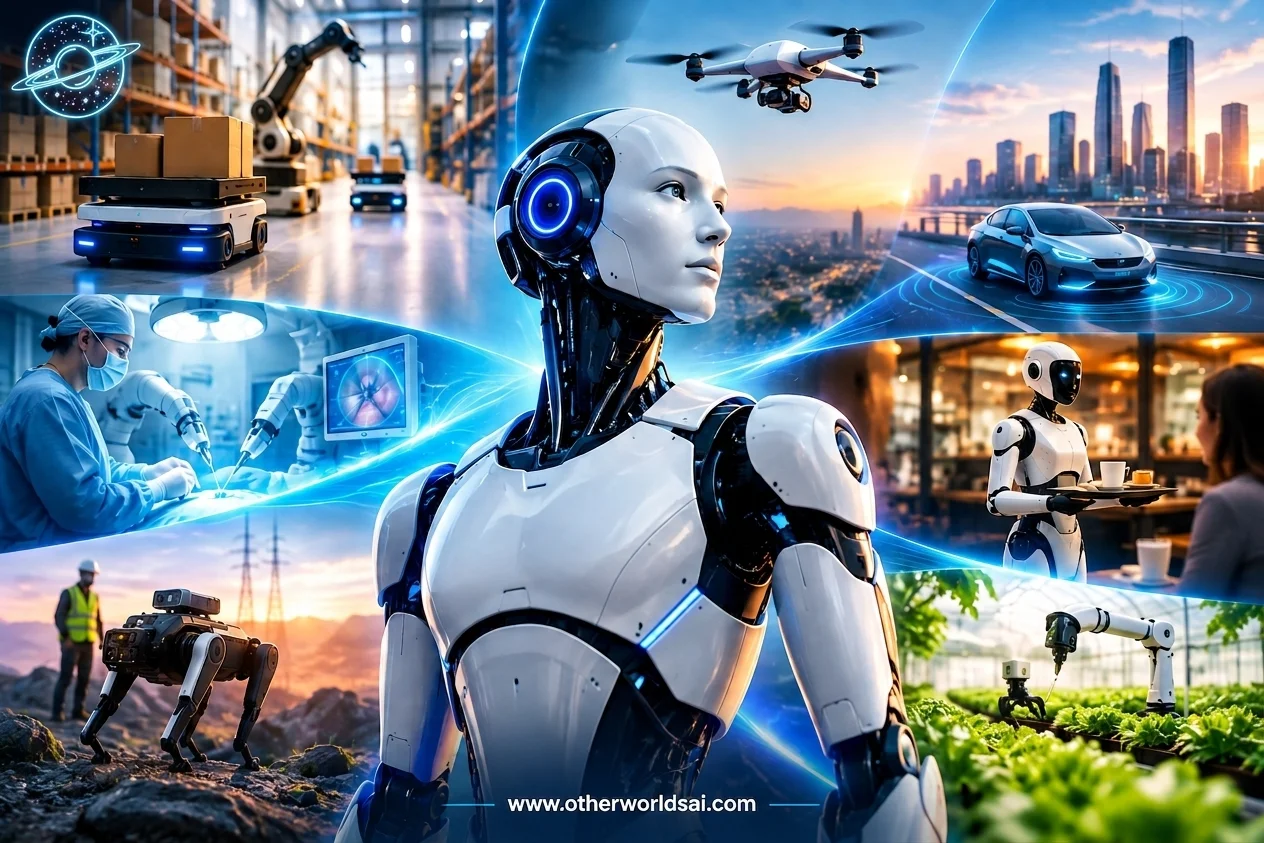
From autonomous vehicles and warehouse robots to AI-powered drones, robotic surgery systems, and humanoid robots, Physical AI is rapidly moving from research laboratories into real-world environments.
This shift represents one of the most important developments in the future of artificial intelligence: machines are no longer simply following instructions. They are increasingly able to see, understand, reason, learn, adapt, and act.
For businesses, this could transform manufacturing, logistics, healthcare, transportation, construction, energy, retail, and many other industries.
For technology companies such as OtherworldsAI, the rise of Physical AI also highlights an important opportunity: the future of AI will increasingly combine intelligent software agents with physical machines.
What Is Physical AI?
Physical AI refers to artificial intelligence systems that allow machines to perceive, understand, reason about, and interact with the physical world in real time.
Traditional industrial robots generally perform predefined tasks. They operate within carefully controlled environments and follow programmed instructions.
Physical AI takes a different approach.
An AI-powered robot can use cameras, sensors, spatial computing, onboard processors, machine learning, and AI reasoning to understand its surroundings and respond to changing conditions.
A robot may recognize an object, determine how to pick it up, navigate around an obstacle, change its route, or learn from previous experiences.
That ability to connect digital intelligence with physical action is what makes Physical AI so significant.
In practical terms, Physical AI combines several technologies, including:
- Artificial intelligence.
- Robotics.
- Computer vision.
- Machine learning.
- Sensor technology.
- Spatial computing.
- Edge AI.
- Digital twins.
- Synthetic data.
- Reinforcement learning.
- Imitation learning.
- AI agents.
- Autonomous systems.
Together, these technologies are creating a new generation of adaptive and intelligent machines.
From Traditional Automation to Intelligent Robotics:
Automation has existed for decades. Factory robots have been welding, painting, assembling, and moving products for years. But traditional automation has an important limitation: it works best when the environment is predictable.
Physical AI changes that equation.
AI-powered machines can process information from their environment and make decisions based on what they see and sense.
Consider a warehouse robot. Instead of simply following a fixed route, an intelligent robot can potentially recognize obstacles, respond to changing inventory conditions, coordinate with other machines, and adjust its behavior. The same concept applies to autonomous vehicles, drones, medical robots, and industrial machinery.
This is why the evolution of robotics is increasingly moving from rule-based automation toward AI-driven autonomy.
The Technologies Powering Physical AI:
The rapid development of Physical AI is not being driven by a single breakthrough. Instead, several technologies are converging.
Vision-Language-Action Models:
One of the most important developments is the emergence of vision-language-action (VLA) models.
These systems combine computer vision, natural language understanding, and motor control. Instead of simply recognizing an object, an AI system can connect what it sees with what it has been instructed to do.
For example, a robot could receive a natural-language instruction, analyze its surroundings, identify the relevant object, and determine the physical actions required to complete the task.
This represents a major step toward general-purpose AI robotics.
Edge AI and Onboard Computing:
Physical AI often requires decisions to happen immediately.
A robot navigating a warehouse cannot always wait for a remote cloud server to process every movement. A vehicle approaching an obstacle cannot afford significant latency.
That is why edge AI and onboard computing are becoming critical.
Specialized processors and neural processing units can allow robots to process sensor information locally and make decisions with very low latency.
This can be particularly important for:
-
Autonomous vehicles.
-
Industrial robots.
-
Drones.
-
Medical robotics.
-
Remote operations.
-
Safety-critical applications.
The result is a shift toward machines that can operate with greater independence from centralized cloud infrastructure.
Computer Vision and Sensors:
Robots need to understand the world before they can act within it.
Computer vision provides machines with the ability to interpret visual information, while sensors can capture sound, temperature, light, movement, pressure, and touch. These technologies effectively provide machines with a digital equivalent of sight and other forms of perception.
Spatial Computing:
Understanding three-dimensional space is another essential component of Physical AI. Robots must know where they are, where objects are located, how those objects relate to one another, and how they can move safely through an environment.
Spatial computing therefore plays an important role in navigation, manipulation, autonomous vehicles, smart factories, and humanoid robotics.
Reinforcement and Imitation Learning:
AI robots can also learn through reinforcement learning and imitation learning. Reinforcement learning allows a robot to improve behavior through rewards and penalties. Imitation learning allows robots to learn from demonstrations performed by humans or expert systems.
Much of this learning can occur in simulation before a robot is introduced to the physical environment.
This creates the possibility of a continuous learning cycle:
Simulation → Training → Real-world deployment → Data collection → Improvement → Retraining
That feedback loop could become one of the foundations of advanced AI robotics.
Why Physical AI Is Becoming Commercially Viable:
Technology is only valuable when it can solve real business problems economically.
The economics surrounding robotics are beginning to improve.
Advanced manufacturing capabilities make it increasingly possible to produce sophisticated robotic systems at enterprise scale. At the same time, component commoditization and open-source technologies are lowering some barriers to entry.
Robotics hardware remains expensive compared with conventional automation because advanced AI processors, sensors, actuators, batteries, and computing systems are required. However, declining technology costs combined with labor shortages and demand for greater efficiency are creating compelling business cases.
This is particularly visible in warehousing and logistics.
Warehousing and Logistics: The Physical AI Proving Ground:
Warehouses provide an ideal environment for intelligent robotics because many operations are repetitive but not completely predictable.
-
AI robots can potentially.
-
Move inventory.
-
Scan products.
-
Navigate warehouse aisles.
-
Transport totes.
-
Sort packages.
-
Assist workers.
-
Coordinate with other robots.
-
Optimize warehouse movement.
Large-scale deployments are already demonstrating how AI can coordinate enormous fleets of machines.
The next stage will likely involve robots becoming more autonomous, adaptable, and capable of performing increasingly complex tasks.
For logistics companies, the combination of AI agents, autonomous robots, computer vision, and fleet management software could dramatically change how warehouses operate.
Physical AI Is Expanding Beyond Warehouses:
Although logistics and manufacturing are early adopters, Physical AI is not limited to industrial environments.
Its applications are expanding across industries.
Healthcare and Medical Robotics:
Healthcare faces significant staffing and operational challenges.
AI-powered robotic systems could assist with surgery, imaging, rehabilitation, patient support, and other activities.
The long-term objective is not necessarily to replace healthcare professionals. Instead, intelligent machines can potentially perform repetitive, physically demanding, or highly precise tasks while humans remain responsible for complex decisions and patient relationships.

Meta's Next Big Bet: This New App Lets You Build Games Simply by Typing a Prompt
Energy and Utilities:
Energy infrastructure can contain dangerous environments involving high voltage, gas pipelines, remote equipment, and difficult terrain.
AI drones and robotic systems can inspect infrastructure while reducing the need to expose workers to hazardous conditions.
This represents one of the strongest use cases for Physical AI:sending intelligent machines into environments where human safety is at risk.
Smart Cities:
AI-powered drones and autonomous vehicles can assist cities with infrastructure inspections, transportation, public safety, and accessibility.
Instead of sending teams to inspect every bridge, road, or infrastructure asset manually, autonomous systems can collect data continuously and help identify potential problems.
Restaurants and Retail:
Labor shortages are also encouraging experimentation with robotic systems in restaurants and retail environments.
Robots can potentially assist with food preparation, delivery, customer service, inventory, cleaning, and other repetitive operations.
The broader trend is clear: Physical AI is moving into environments where humans and machines must work together.
The Humanoid Robot Revolution:
Among all forms of robotics, humanoid robots have attracted perhaps the greatest public attention.
There is a practical reason for this.
Human environments were designed for human bodies.
Our buildings contain doors, stairs, shelves, tools, workstations, kitchens, warehouses, and vehicles designed around human dimensions.
A humanoid robot could potentially operate within these existing environments without requiring organizations to completely redesign their infrastructure.
Support our research
Independent analysis fueled by you.
That makes humanoid robotics particularly interesting for applications involving:
- Warehouses
- Manufacturing
- Logistics
- Healthcare
- Construction
- Hospitality
- Retail
- Home assistance
Humanoid robots are still at an early stage, but their capabilities are advancing quickly.
Why Agentic AI Could Transform Humanoid Robots:
The most interesting development may not be humanoid hardware itself.
It could be the combination of humanoid robots and agentic AI.
Today's AI agents can reason through tasks, use software tools, plan multiple steps, and adapt to changing objectives.
Imagine putting that type of intelligence inside a physical robot.
Instead of simply programming a robot to perform one task, an agentic AI robot could potentially:
-
Understand an objective.
-
Break the objective into smaller tasks.
-
Observe the environment.
-
Select an appropriate action.
-
Execute the task.
-
Detect failures.
-
Adjust its strategy.
-
Complete the objective.
-
Learn from the experience.
That would represent a fundamental change in robotics.
The robot would no longer simply be an automated machine. It would become an AI-powered autonomous agent capable of interacting with the physical world.
The Challenges Standing Between Physical AI and Mass Adoption:
Despite the excitement surrounding Physical AI, significant challenges remain.
The Simulation-to-Reality Gap
Robots can learn in simulations, but the physical world is unpredictable.
Objects have different textures. Floors have different levels of friction. Lighting changes.
People move unexpectedly. Equipment behaves differently from simulations.
A robot that performs perfectly in a virtual environment may behave differently when placed in a real warehouse or hospital.
Closing this sim-to-real gap remains one of the major research challenges in robotics.
Real-Time AI Processing:
Humans can tolerate a short delay when interacting with software.
Robots cannot always do so.
A delay of even a second can become a serious problem when a robot is walking, carrying an object, driving, or operating near humans.
Consequently, low-latency AI inference, edge computing, specialized AI chips, and efficient robotics models will remain essential.
Safety and Trust:
Physical AI creates a unique safety problem.
An incorrect answer from a chatbot may be inconvenient. An incorrect decision by a physical robot can cause damage or injury.
This makes trustworthy AI, human oversight, safety testing, monitoring, and risk management critical.
Human-in-the-loop systems are likely to remain important, particularly for high-risk applications.
Cybersecurity:
Connected robots create a bridge between digital networks and physical environments. A compromised robot fleet could potentially cause operational disruption, unauthorized access, data exposure, or physical damage.
Therefore, AI cybersecurity and robotics security must become integral parts of Physical AI deployments.
Data Management:
Advanced robots generate enormous quantities of information from cameras, sensors, mapping systems, and environmental models.
Organizations need secure infrastructure capable of storing, processing, and learning from this data.
Digital twins can also play an important role by creating virtual representations of physical environments for testing, optimization, and AI training.
Human Acceptance:
Perhaps the most complicated challenge is human acceptance.
Workers may be comfortable with predictable industrial robots. They may feel differently about machines that learn, adapt, and make autonomous decisions.
The successful future of Physical AI will therefore require more than better hardware.
It will require human-centered AI design, transparency, safety, training, and collaboration between people and machines.
The Future of Physical AI:
Physical AI is approaching an important inflection point.
The technology is progressing because multiple developments are converging at the same time: AI agents + robotics + computer vision + edge computing + simulation + synthetic data + sensors + autonomous systems.
This convergence could eventually create machines capable of operating across a wide range of environments.
Move Over Nvidia: Anthropic and Samsung Team Up to Break the AI Chip Monopoly
Warehouses may be an early proving ground, but the technology could ultimately extend into hospitals, factories, farms, construction sites, transportation networks, energy infrastructure, retail stores, and homes.
The most transformative stage may come when robots can move between different environments without requiring extensive reprogramming.
What This Means for Businesses:
For enterprises, the emergence of Physical AI should not be viewed simply as a robotics trend.
It is part of a much larger transition toward intelligent autonomous systems.
Companies should begin asking:
-
Which physical processes are repetitive?
-
Which operations are dangerous for employees?
-
Where could computer vision improve efficiency?
-
Which workflows generate valuable sensor data?
-
Could autonomous systems reduce operational costs?
-
Where could AI agents coordinate physical operations?
-
What infrastructure will be required to deploy AI safely?
-
How should robotics data be protected?
Businesses that begin experimenting early may have an advantage as Physical AI becomes more commercially mature.
OtherworldsAI and the Next Generation of AI:
The evolution from traditional automation to intelligent autonomous machines reflects a broader transformation in artificial intelligence.
At OtherworldsAI, we see AI not simply as software that answers questions, but as technology capable of reasoning, taking action, connecting systems, and supporting real-world business operations.
The same principles behind intelligent AI agents can increasingly extend into robotics, autonomous systems, industrial automation, smart infrastructure, and physical AI.
The future will likely not be defined by humans versus robots.
It will be defined by humans working with increasingly intelligent machines.
Physical AI is bringing artificial intelligence out of the screen and into the real world.
Humanoid robots may eventually become one of its most visible forms, but the larger opportunity is much broader: a world where AI can perceive its environment, reason about complex situations, take action, and continuously learn.
The journey from prototype to production has already begun.
And the next generation of AI may not just talk to us.
It may move, work, build, inspect, assist, and act alongside us.