
The warehouse of the future is no longer just automated—it is becoming intelligent, adaptive, and increasingly capable of building its own digital tools.
For years, warehouses and distribution centers have relied on large enterprise systems to manage inventory, labor, transportation, machinery, orders, and shipments. These platforms are essential, but they can also be difficult and expensive to customize.
When something falls outside the capabilities of the existing system, warehouse managers have traditionally relied on spreadsheets, manually maintained reports, business intelligence dashboards, or informal processes developed by experienced employees.
That model is beginning to change.
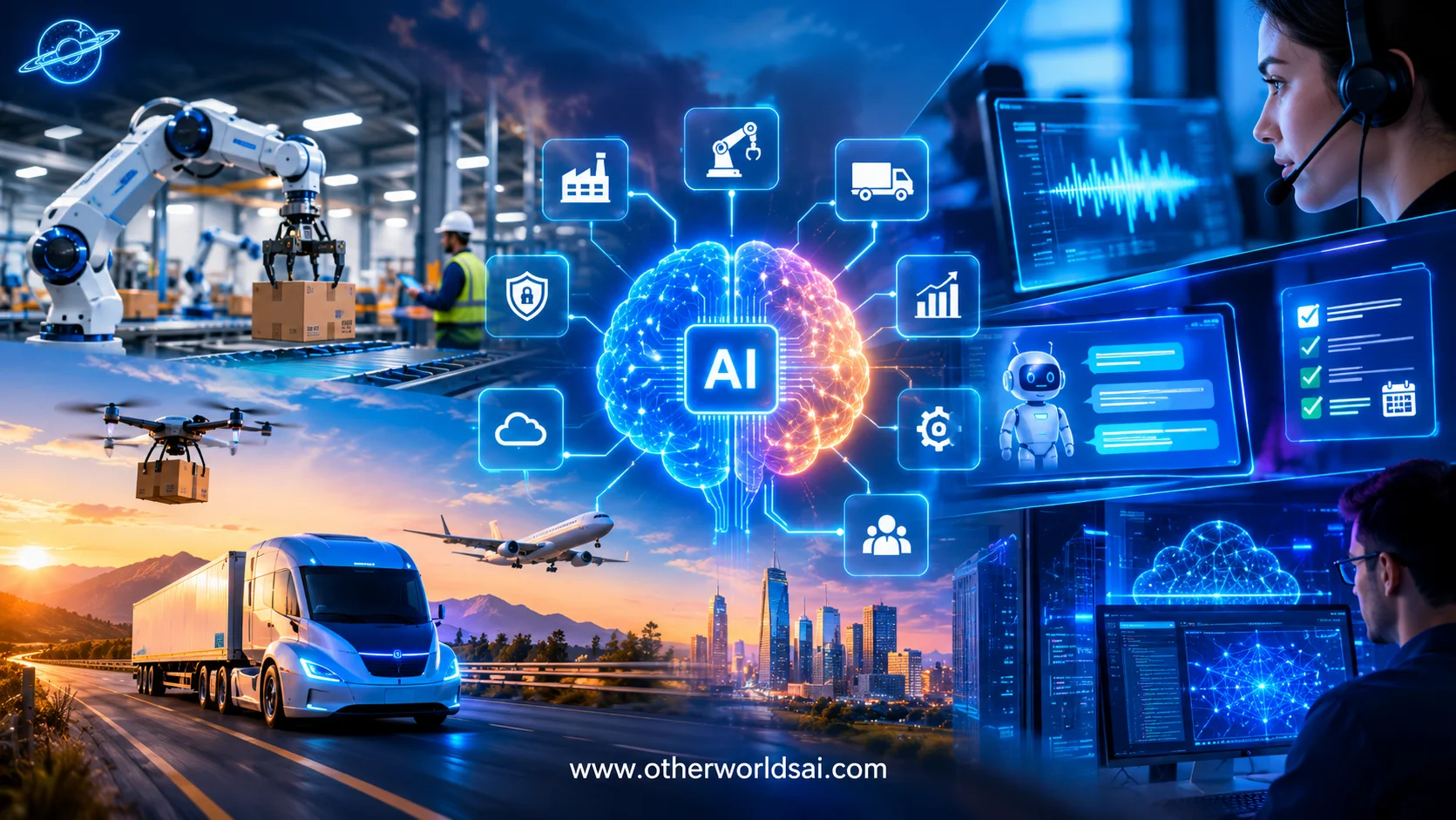
The combination of artificial intelligence (AI), generative AI, optimization algorithms, AI agents, warehouse robotics, and real-time operational data is creating a new generation of intelligent warehouses.
A recent example comes from AutoScheduler, which has introduced an AI-powered Warehouse App Builder that allows logistics teams to create custom applications directly from live warehouse data. At the same time, Gartner has identified four interconnected AI trends that are pushing warehouse automation beyond basic robotics toward more intelligent and adaptive operations.
Together, these developments point toward a significant shift: warehouse employees are increasingly becoming creators and supervisors of AI-powered operational tools rather than simply users of fixed enterprise software.
From Spreadsheets to AI-Powered Warehouse Applications:
Traditional warehouse management systems (WMS) and enterprise resource planning (ERP) platforms perform critical functions, but changing them can take weeks or months. That creates an uncomfortable gap.
A warehouse manager might identify a problem today, but solving it through traditional enterprise software development could require an IT request, development resources, testing, approvals, deployment, and eventually a software release.
In the meantime, operations continue.
This is where AutoScheduler's new Warehouse App Builder is designed to make a difference. The platform allows warehouse and logistics professionals to describe operational requirements in natural language and create targeted applications using live facility data. Instead of asking:
"Can IT build this for us?"
the workflow increasingly becomes:
"What operational problem do we need to solve, and what AI-powered application can we build around it?"
According to AutoScheduler CEO Keith Moore, warehouses often fill the gaps between major enterprise systems with spreadsheets, business intelligence tools, internally developed software, and what he described as "tribal knowledge."
The new approach aims to put those problem-solving capabilities directly into the hands of people working on warehouse operations.
The Hidden Advantage: An Operational Semantic Layer:
One of the most important aspects of this approach is not simply the use of generative AI.
It is understanding warehouse data correctly.
A general-purpose large language model does not automatically understand the relationship between a warehouse management system, labor-management software, yard systems, inventory records, and automated machinery.
AutoScheduler's platform uses an operational semantic layer developed from years of distribution operations.
This layer provides context about how different warehouse systems and data points relate to one another.
That distinction matters.
A generic AI model might understand the meaning of "replenishment" in a general sense.
An operational AI platform needs to understand what replenishment means inside a particular warehouse environment, how inventory levels relate to orders, how labor availability affects execution, and how a decision can ultimately be translated into an operational action.
The combination of semantic data models, optimization algorithms, warehouse management systems, and AI therefore becomes much more powerful than simply adding a chatbot to existing warehouse software.
AI Can Turn Natural Language Into Operational Tools:
The emerging warehouse AI model is moving beyond question-and-answer systems.
Users can increasingly describe what they want in ordinary language, while AI translates those requirements into dashboards, trackers, workflows, alerts, and operational applications.
Early AutoScheduler deployments have reportedly included applications for:
- Wave sequencing
- Replenishment monitoring
- Cross-dock allocation
- Dock-door schedule compliance
- On-time-in-full (OTIF) performance
- Production scheduling
- Warehouse performance monitoring
- Inventory optimization
- Operational exception tracking
This represents an important change in how warehouse software can be developed.
Instead of building one massive application that attempts to solve every possible operational scenario, companies can create smaller AI-powered applications designed around specific problems.
That could make warehouse technology more flexible and responsive.
Why Warehouse AI Is Becoming a Business Necessity:
The movement toward intelligent warehouses is not happening simply because AI is fashionable.
Logistics companies face several structural challenges.
Labor shortages:
Distribution centers continue to face pressure to maintain throughput despite difficulties recruiting and retaining workers.
Automation and AI can help companies make better use of the workforce they already have. AI-powered labor forecasting can help managers anticipate staffing requirements, while intelligent task allocation can match available workers with operational priorities.
Increasing operational complexity:
Modern supply chains are becoming more interconnected.
A delay from one supplier can affect inventory availability. A change in order volumes can alter labor requirements. A congested dock can disrupt transportation schedules and warehouse throughput.
Static planning tools struggle when conditions change continuously.
AI systems can continuously analyze operational data and adjust recommendations as circumstances evolve.
Pressure to reduce costs:
Warehouse operators need to improve productivity while controlling labor, inventory, energy, transportation, and equipment costs.
This is where warehouse optimization software can play a major role.
Optimization algorithms can evaluate thousands of possible operational decisions and identify combinations that may be difficult for human planners to calculate manually.
Gartner's Four AI Tiers Are Changing Warehouse Automation:
The evolution is not limited to AI-powered applications.
Gartner's analysis describes four interconnected AI trends that are helping move warehouse automation from basic automation toward more intelligent operations.
These trends can broadly be understood as:
- Advanced optimization and decision-making
- Generative AI for operational knowledge
- Semi-autonomous AI agents
- Physical AI and warehouse robotics
Together, these technologies create a progression from software that recommends decisions to systems that can increasingly participate in executing them.
1. Advanced Optimization and Generative Planning:
Traditional warehouse optimization relied heavily on predefined rules, spreadsheets, heuristics, and relatively static models. Modern optimization systems are becoming considerably more dynamic.
They can use live operational data to support decisions involving:
- Demand forecasting
- Labor planning
- Inventory allocation
- Warehouse slotting
- Travel routing
- Order sequencing
- Equipment utilization
For example, if order volumes suddenly change during a shift, an AI-powered optimization engine can recalculate operational requirements rather than relying on a plan created hours earlier.
This creates a more responsive warehouse environment.
The important point is that sophisticated mathematical optimization does not necessarily replace human decision-making.

Meta's Next Big Bet: This New App Lets You Build Games Simply by Typing a Prompt
Instead, it provides managers with a continuously updated picture of what is happening and what actions could improve the situation.
2. Generative AI Brings Warehouse Knowledge Into the Workflow:
Generative AI introduces another capability: turning large quantities of unstructured information into useful operational guidance.
Warehouses produce enormous amounts of information beyond structured inventory data.
There are:
- Maintenance records
- Incident reports
- Supplier communications
- Delivery documents
- Equipment manuals
- Employee instructions
- Standard operating procedures
- Operational tickets
Generative AI can help transform this information into practical guidance.
Imagine a conveyor system experiencing an unexpected fault.
Instead of a technician searching through multiple documents to identify the appropriate procedure, an AI assistant could retrieve relevant maintenance history and provide a context-specific troubleshooting sequence.
Similarly, when a supplier delay changes a production schedule, AI could help generate updated operational instructions for affected teams.
This is where generative AI in logistics becomes more than a content-generation technology.
It becomes an operational interface.
3. AI Agents Are Moving From Recommendations to Actions:
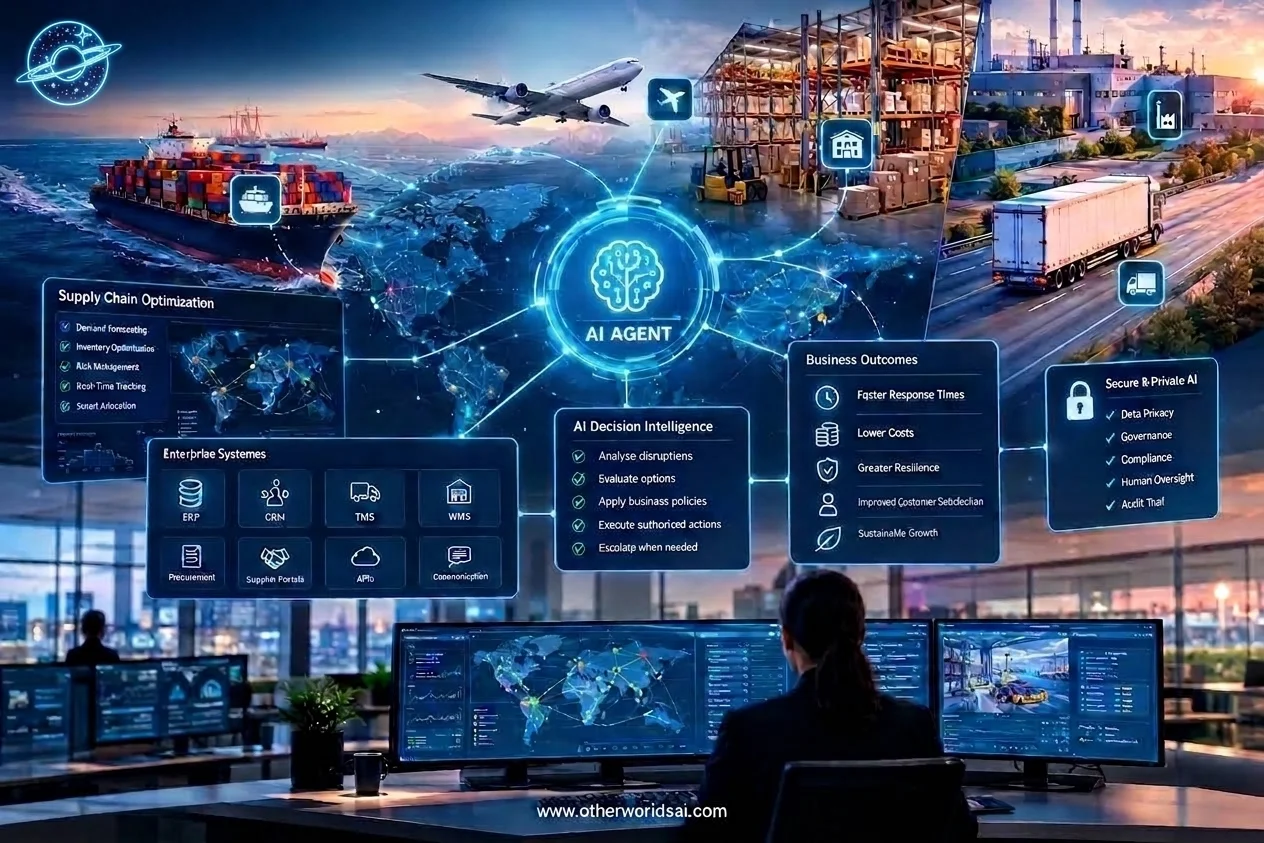
The next stage involves AI agents for supply chain and warehouse operations.
Support our research
Independent analysis fueled by you.
An AI agent can monitor conditions, evaluate options, and recommend or initiate actions according to predefined permissions.
For example, an agent could monitor active warehouse queues and identify an emerging bottleneck.
It might recommend:
- Reassigning picking tasks
- Changing the sequence of orders
- Moving equipment to another area
- Adjusting loading priorities
- Escalating a delayed shipment
Human supervisors can retain control over high-impact decisions while AI handles monitoring and routine optimization.
This creates a human-in-the-loop AI model.
The goal is not necessarily to remove people from warehouse operations.
Instead, AI can take responsibility for continuous monitoring and complex calculations while humans remain responsible for judgment, exceptions, safety, and accountability.
4. Physical AI and Warehouse Robotics:
The fourth stage brings intelligence into the physical warehouse.
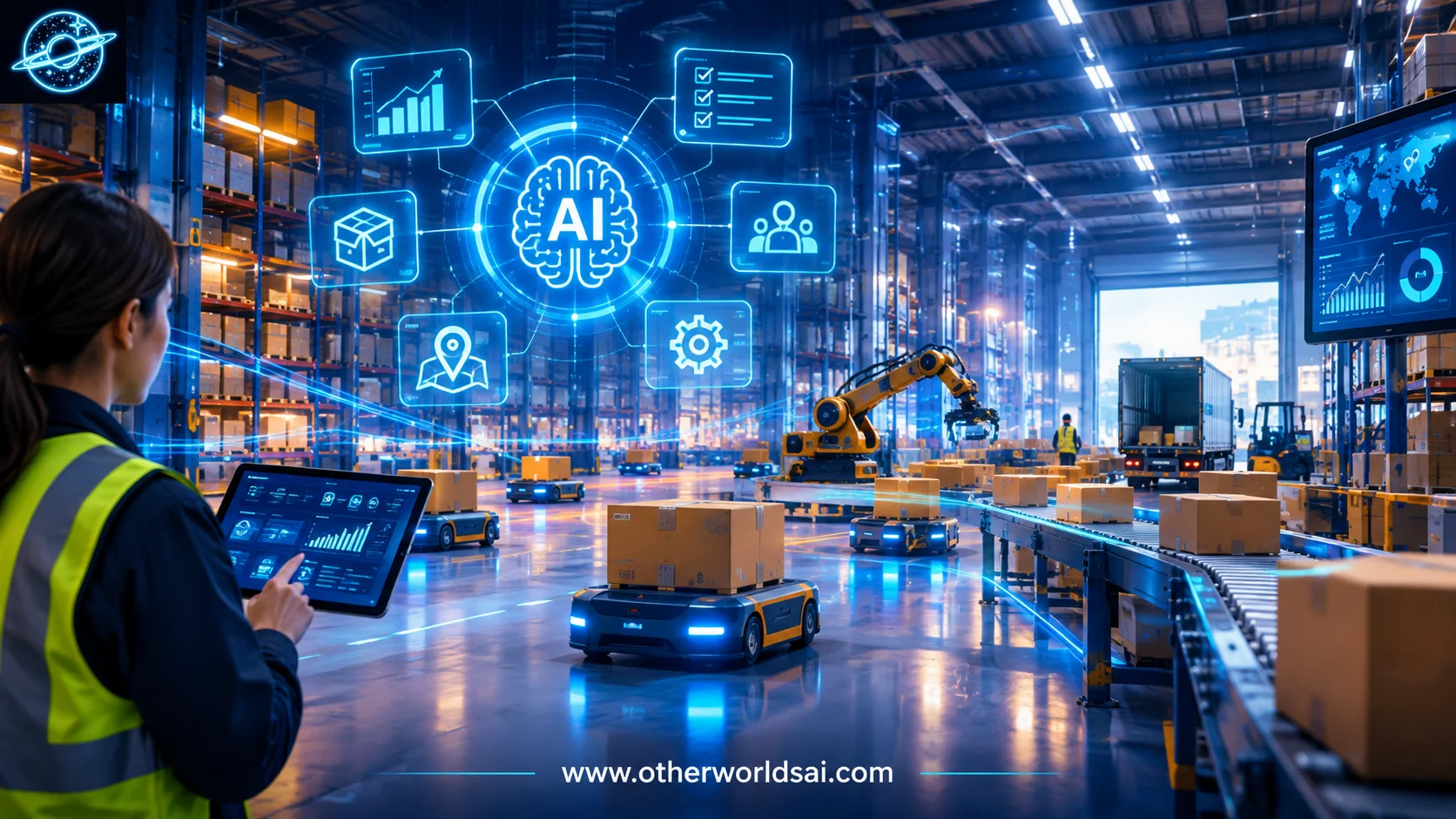
Robotics and autonomous machines are already being used for:
- Picking
- Packing
- Sorting
- Pallet movement
- Material handling
- Loading operations
When machine learning, computer vision, spatial sensors, and robotics are combined, these systems can become increasingly adaptive.
This is sometimes described as Physical AI—AI that interacts with the physical world rather than operating exclusively inside software.
For logistics companies, the potential is significant.
A warehouse could eventually combine intelligent planning software, AI agents, autonomous mobile robots, computer vision, and human workers into a coordinated operational system.
The Real Opportunity Is Connecting Everything:
The most interesting development may not be any single AI technology.
It is the integration of multiple technologies.
Consider a future warehouse scenario.
An AI system detects an increase in customer orders.
The optimization engine recalculates inventory and labor requirements.
An AI agent identifies that additional picking capacity is required.
Warehouse robots are redirected toward the highest-priority zones.
A supervisor receives an updated operational recommendation.
Generative AI produces revised instructions for affected employees.
The warehouse management system receives the approved changes.
All of this can potentially happen within the same operational ecosystem.
That is fundamentally different from simply installing a chatbot inside a warehouse.
Why Data Infrastructure Matters More Than the AI Model:
One of the biggest lessons from these developments is that AI quality depends heavily on data quality and operational context.
A warehouse may have enormous quantities of data, but that does not automatically make the data useful for AI.
Information can be distributed across:
- WMS platforms
- ERP systems
- Transportation management systems
- Labor management systems
- Yard management systems
- IoT sensors
- Robotics platforms
- Maintenance databases
Connecting these systems and establishing a shared understanding of the information is critical.
This is why semantic layers, unified data models, APIs, and real-time integrations are becoming increasingly important components of enterprise AI infrastructure.
From AI Experiments to Production Systems:
Another important change is that warehouse AI is moving beyond experimentation. Companies are increasingly looking for measurable operational outcomes rather than impressive demonstrations.

Move Over Nvidia: Anthropic and Samsung Team Up to Break the AI Chip Monopoly
AutoScheduler says one early application was created in less than 15 minutes during an initial workshop. In another deployment, a facility planner independently developed a replenishment tracking application and reported measurable operational improvements within two weeks.
These examples illustrate an important principle:
The value of enterprise AI is ultimately measured by what it changes operationally.
That could mean:
- Higher warehouse throughput
- Better inventory utilization
- Reduced labor costs
- Faster decision-making
- Improved order accuracy
- Better dock utilization
- Reduced equipment downtime
- Improved OTIF performance
- Fewer operational bottlenecks
The AI itself is not the final product. The operational improvement is.
What This Means for the Future of Logistics:
The warehouse software market is moving toward a model where applications are increasingly configurable, data-driven, and AI-assisted.
Instead of waiting for vendors to release every new feature, logistics organizations may increasingly build specialized applications around their own operational requirements.
At the same time, AI agents and physical automation will expand the ability of warehouses to respond to changing conditions in real time.
But this transition should be managed carefully.
Warehouse leaders need clear visibility into automated decisions. Employees need to understand how AI recommendations are generated. Human override mechanisms remain important, particularly for safety-critical or high-value operational decisions.
The most successful implementations are therefore likely to combine AI automation with human oversight, rather than treating AI as a replacement for operational expertise.
The New Warehouse Operating Model:
The warehouse of the future is unlikely to be a building filled exclusively with robots. It will be a connected ecosystem in which:
- AI understands the data.
- Optimization engines calculate the best available options.
- AI agents monitor workflows and coordinate actions.
- Robots execute physical tasks.
- Human supervisors provide judgment, oversight, and accountability.
And increasingly, warehouse employees themselves may be able to create the digital tools they need.
That is perhaps the most significant development represented by AutoScheduler's Warehouse App Builder.
The next generation of warehouse technology may not simply give businesses better software. It may give the people running warehouses the ability to build the software they need—directly on top of their operational data.
For logistics companies facing labor shortages, rising complexity, demanding customers, and pressure for greater efficiency, this shift toward AI-powered warehouse automation, intelligent supply chains, generative AI, AI agents, warehouse robotics, and real-time optimization could become one of the defining technology trends of the next decade. www.otherworldsai.com