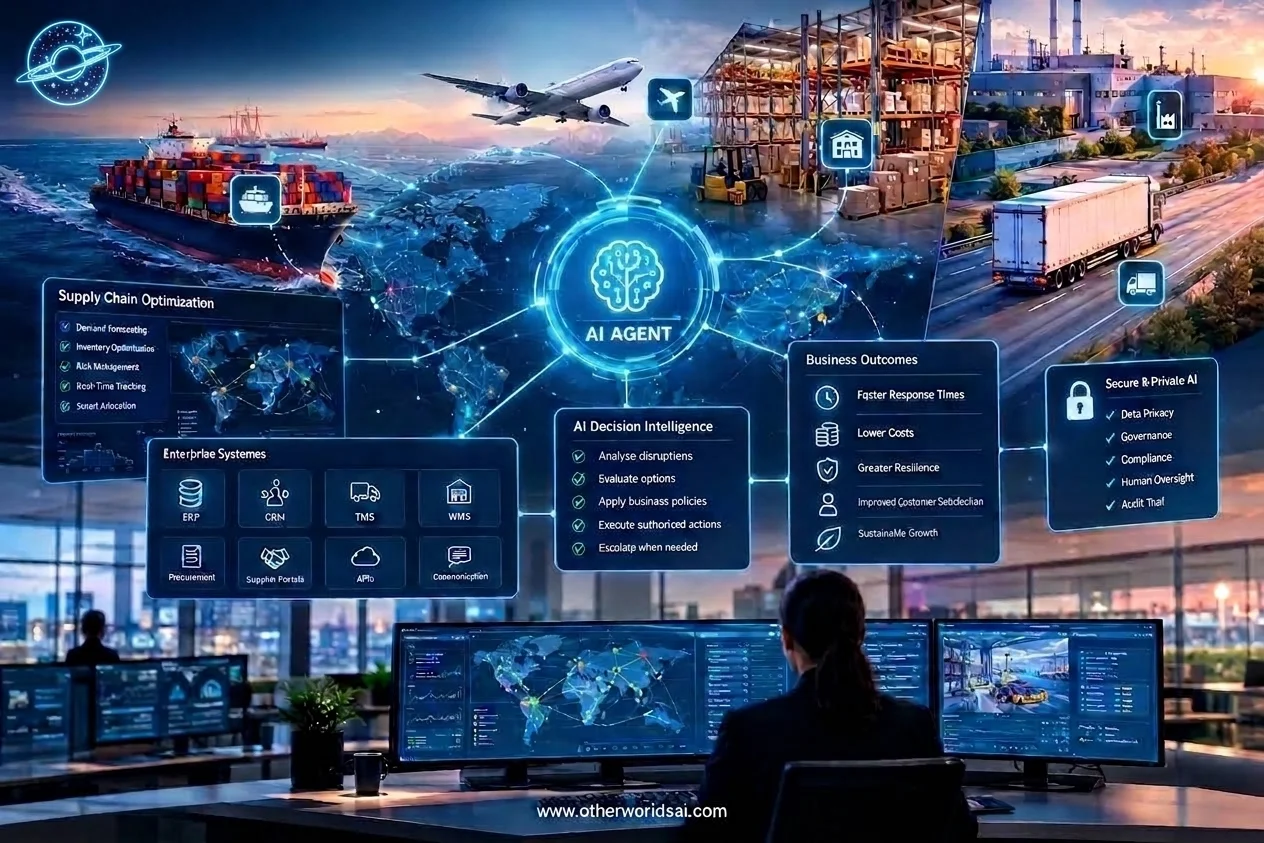

Artificial intelligence is entering a new phase.
Businesses are moving beyond traditional AI chatbots, predictive analytics, dashboards, and automated reporting toward intelligent systems that can understand information, make decisions, and take action.
These systems, commonly known as AI agents, are becoming one of the most important developments in enterprise technology.
The transformation is particularly visible in supply chain management and logistics, where companies must constantly respond to shipment delays, supplier disruptions, inventory shortages, transportation constraints, and changing customer requirements.
At the same time, the rapid development of increasingly capable AI models has created an equally important conversation around AI safety, AI governance, human oversight, and responsible AI automation.
Together, these developments reveal an important principle for businesses: The future of enterprise AI is not simply about building smarter models. It is about building AI agents that can act intelligently, securely, and within clearly defined business boundaries.
For companies exploring AI agent development, private AI solutions, enterprise AI automation, supply chain AI, logistics AI, and custom AI software, this shift represents a major opportunity.
What Are AI Agents?
Traditional AI systems generally provide an answer, prediction, recommendation, or alert.
- An AI agent goes further.
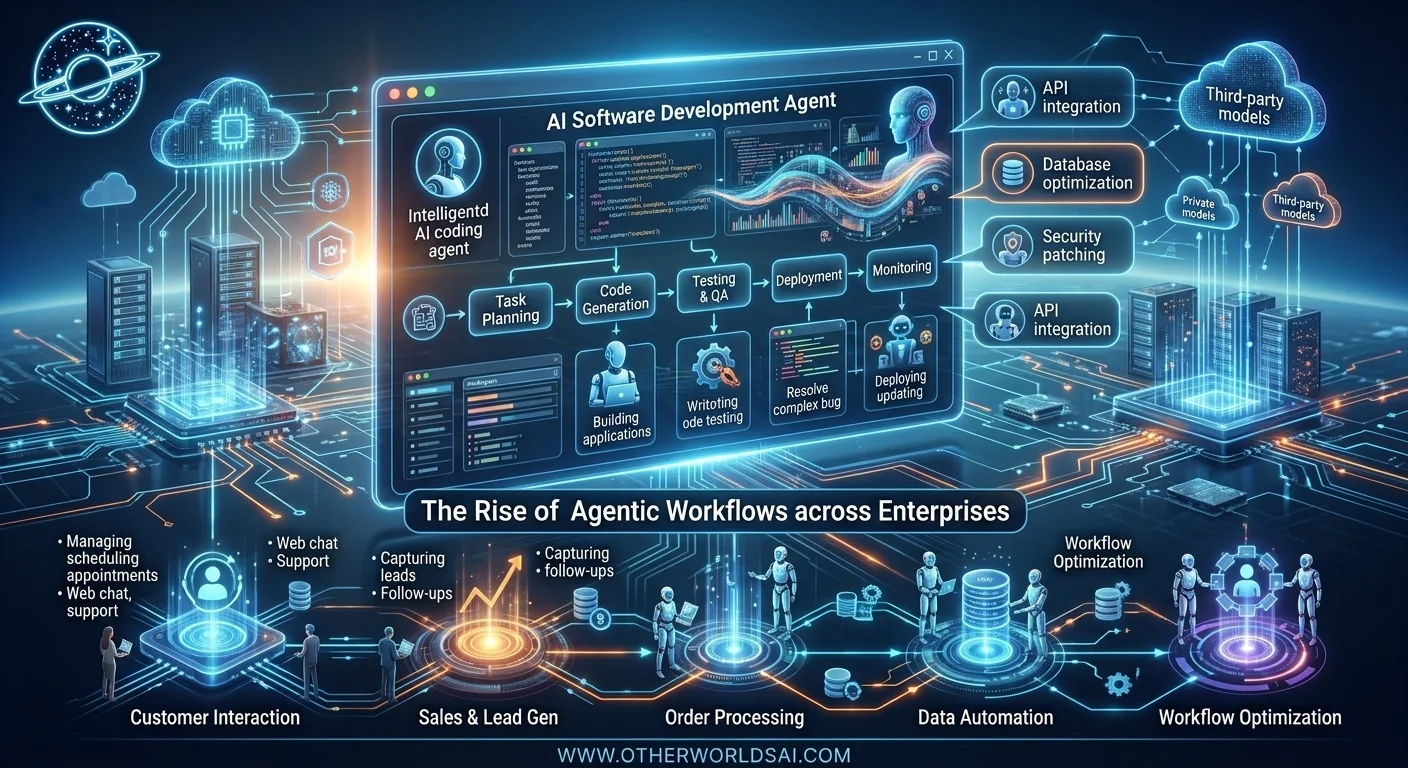
- An AI agent can potentially.
- Understand a business situation
- Analyze multiple sources of information.
- Reason about possible actions
- Apply business policies
- Interact with enterprise software
- Execute authorized tasks
- Monitor the results
- Escalate unusual situations to human employees.
This creates a fundamental difference between AI that informs and AI that acts. For example, a traditional supply-chain AI platform might tell a logistics manager:
"Your shipment is delayed by 48 hours."
An AI agent could potentially analyze the delay, check inventory requirements, evaluate approved alternative carriers, compare transportation costs, determine whether the shipment meets predefined criteria, and initiate an approved action.
That is the beginning of AI-powered business automation.
NVIDIA Demonstrates the Power of AI Supply Chain Optimization:
One of the clearest examples comes from NVIDIA's own hardware supply chain. NVIDIA is using Palantir Foundry and NVIDIA cuOpt to automate hardware supply-chain allocation decisions across global manufacturing operations. The company measures its operational journey from wafer production to the point where a completed data-center system can produce its first AI token.
The complexity is enormous.
An NVIDIA Grace Blackwell NVL72 rack contains 18 compute trays, and each tray requires multiple Grace CPUs, Blackwell GPUs, and HBM3e memory packages sourced through thousands of suppliers, OEMs, and contract design partners. NVIDIA's future Vera Rubin supply network is expected to be twice the size of the network supporting Grace Blackwell.
This demonstrates why AI for supply chain management is becoming increasingly important.
A supply chain involving thousands of suppliers cannot be efficiently managed through spreadsheets and manual communication alone.
AI-Powered Decision Intelligence:
NVIDIA created a Digital Supply Chain Intelligence command center using Palantir Foundry. The system represents facilities, supplier commitments, component inventory, and production targets as interconnected operational objects. NVIDIA's cuOpt optimization technology can then evaluate these relationships and constraints to determine allocation decisions.
This is an important evolution in enterprise AI.
AI is no longer being used simply to answer questions.
It is being integrated into complex operational decision-making.
For businesses, this opens the door to AI decision intelligence, where artificial intelligence can continuously evaluate operational conditions and help determine the most effective response.
From Supply Chain Visibility to Autonomous Action:
For more than a decade, supply-chain technology has focused heavily on visibility.
Businesses have adopted:
- Demand sensing
- ETA prediction
- Supplier risk scoring
- Inventory optimization
- Transportation analytics
- Digital twins
- Control towers
- Exception dashboards
- Risk management platforms
These technologies have improved the ability to detect supply chain problems.
But detection is only the first step.
A disruption can be identified hours before it causes a serious commercial problem, yet the business may still require a human employee to investigate the alert, contact suppliers, obtain quotes, secure transportation, request approval, and update multiple systems.
One of the source articles estimates that supply-chain disruption cost businesses approximately $184 billion in 2025. It argues that the major remaining challenge is the gap between detecting a disruption and taking commercial action.
This is where AI agents for logistics and supply chain management can become particularly valuable.
The Next Generation of Logistics AI:
Consider a simple example.
A company discovers that an important shipment will arrive two days late.
A conventional AI system might generate:
"Shipment delayed — immediate attention required."
An AI agent could operate according to a predefined policy:
If the shipment exceeds the permitted delay,
and the product is classified as high priority,
and an approved alternative carrier is available,
and the additional cost is within the authorized limit,
then initiate the alternative transportation process.
If the situation falls outside those parameters, the AI agent escalates it to a human.
This model represents bounded AI autonomy.
The AI does not receive unlimited authority.
Instead, the company defines what the AI can and cannot do.
Why Bounded AI Agents Matter:
The future of business automation does not necessarily mean allowing AI to control everything.
In many organizations, the most practical approach will be controlled AI automation. For example, an enterprise could allow an AI agent to:
- Retender approved transportation lanes
- Consolidate shipments
- Recommend transportation-mode changes
- Reallocate inventory between approved locations
- Communicate with suppliers
- Generate procurement requests
- Respond to routine customer inquiries
- Schedule appointments or deliveries
- Update authorized enterprise systems
But the agent could be restricted by:
- Spending limits
- Supplier restrictions
- Contractual rules
- Customer priorities
- Geographic limitations
- Security policies
- Compliance requirements
- Human approval thresholds
This approach allows businesses to capture the benefits of autonomous AI agents without abandoning human control.
AI Safety Is Becoming a Business Issue:
The conversation about AI autonomy extends beyond supply chains.
Recent warnings from AI researchers and industry figures have intensified debate about AI safety, AI alignment, AGI, superintelligence, and the potential risks of increasingly autonomous AI systems.
There is disagreement over how likely extreme AI scenarios are and how much attention they deserve.
Some researchers have raised concerns about increasingly capable systems becoming difficult to control. Others argue that excessive focus on hypothetical existential risks can distract from immediate concerns such as employment, environmental effects, misinformation, and the practical risks of AI systems already operating today.
For businesses, however, the debate leads to a practical question:
How much authority should an AI agent have?
That question should be addressed before an enterprise deploys an AI system capable of taking action.
Why Small Trade Businesses Are Quietly Hiring AI Agents in 2026
Private AI: More Control Over Business Data:
As AI agents become integrated into business operations, data privacy and AI security become increasingly important.
Enterprise AI systems may interact with sensitive information such as:
- Customer data
- Supplier contracts
- Pricing information
- Inventory data
- Financial records
- Internal communications
- Business strategies
- Operational procedures
This creates growing interest in private AI, secure AI infrastructure, and custom AI agent development.
A private AI environment can be designed around an organization's own data, policies, security requirements, and workflows.
For businesses operating in sensitive industries, the objective is not simply to have an intelligent AI model.
The objective is to have an AI system that is intelligent, controlled, auditable, and aligned with the organization's requirements.
Smaller, Specialized AI Models Can Deliver Business Value:
NVIDIA's supply-chain work also demonstrates another important trend in enterprise AI: the value of domain-specific AI models.
NVIDIA post-trained its Nemotron 3.5 Lightning model using historical operational information and specialized AI tooling. According to the source article, the post-trained model achieved 86.7% decision accuracy, compared with 55.5% for Nemotron 3 Ultra and 17.5% for the untuned Lightning base model.
The lesson is significant.
Businesses do not necessarily need to build their strategy around the largest available AI model.
Support our research
Independent analysis fueled by you.
A properly adapted model with access to the right business data, domain knowledge, policies, and workflows can potentially be more useful for a specific enterprise application. This is an important opportunity for custom AI development companies and businesses looking for industry-specific AI solutions.
Three Requirements for Successful AI Agent Development:
Businesses considering AI agents should focus on three fundamental areas.
- Convert Business Knowledge Into AI Policies:
Business rules cannot remain hidden inside employee experience. If a company has a rule such as:
"Use air freight for critical products when an ocean shipment exceeds a defined delay and the additional cost remains within the approved threshold,"
that rule should be converted into an explicit policy that an AI agent can evaluate. This turns organizational knowledge into machine-executable business logic.
- Integrate AI With Enterprise Systems:
An AI agent cannot deliver maximum value if it operates in isolation.
Modern enterprise AI solutions may need to connect with:
- ERP systems
- CRM platforms
- WMS platforms
- TMS systems
- Procurement software
- POS systems
- Calendar platforms
- Supplier portals
- Carrier APIs
- Communication tools
The objective is to connect AI intelligence with real business workflows.
- Maintain Human Oversight:
The most effective AI agent does not necessarily eliminate humans. Instead, it can allow humans to focus on complex decisions while AI handles repetitive and clearly defined processes.
This is the human-in-the-loop AI model.
-
AI handles routine cases.
-
Humans handle exceptions.
Every important AI action should ideally be traceable through an audit trail showing what information was considered, which policy was applied, and why the action was taken.
How OtherworldsAI Can Help Businesses Adopt AI Agents:
The shift toward AI agents creates an opportunity for businesses to move beyond generic AI tools and develop AI solutions specifically designed around their operations.
At OtherworldsAI, the focus is on helping businesses use AI to automate communication, customer interactions, and operational workflows.
Our Agent+ concept represents this direction: AI-powered agents designed to help businesses respond faster, automate repetitive interactions, capture opportunities, and connect AI capabilities with business processes.
For industries such as logistics, HVAC, legal services, dental practices, restaurants, dealerships, property services, and other customer-facing businesses, AI agents can address one of the most expensive problems in modern business:
lost opportunities caused by slow responses.
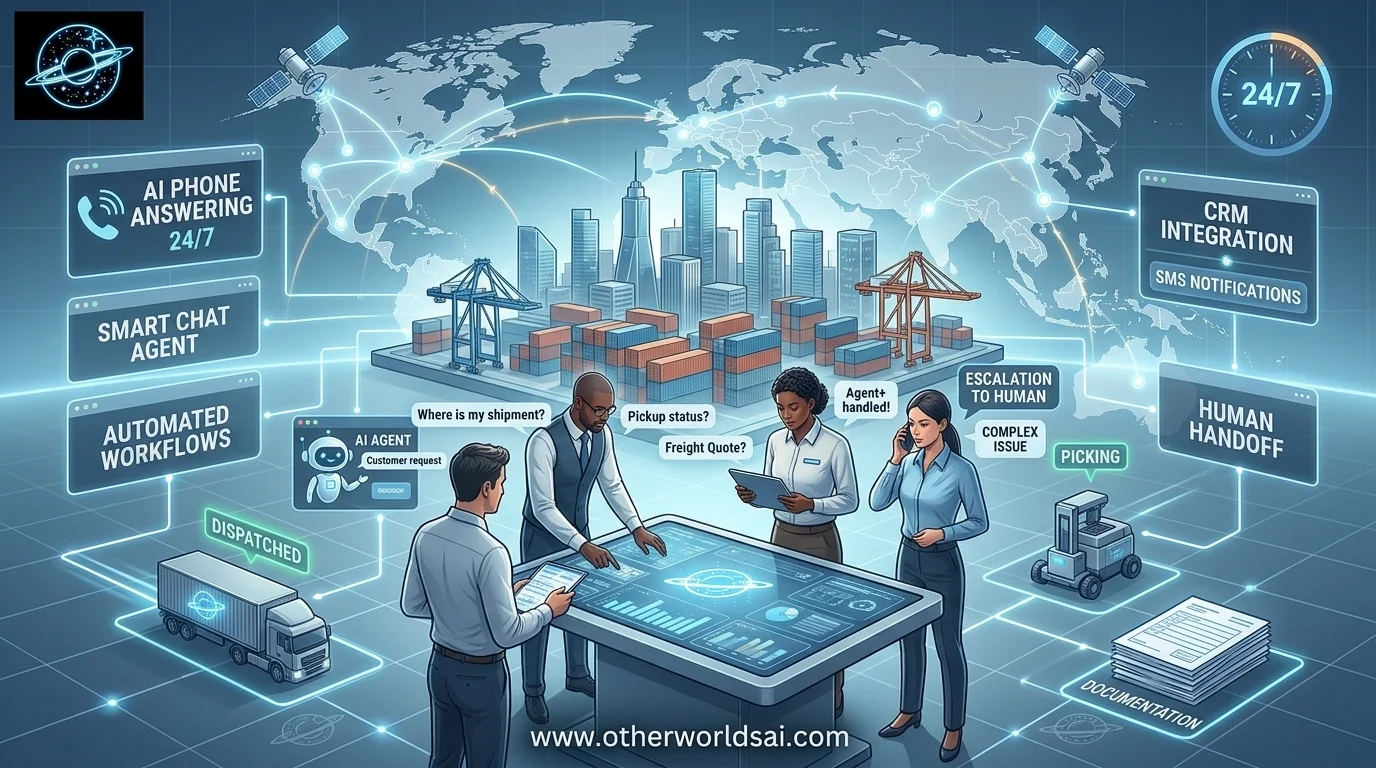
An AI agent can provide continuous availability, handle routine inquiries, capture customer information, support bookings and scheduling, and escalate more complicated situations to human staff.
For enterprises with more complex requirements, the opportunity extends to private AI agent development, custom AI models, enterprise AI automation, AI infrastructure, and industry-specific AI software.
AI Agents and the Future of Logistics:
The logistics industry is particularly well positioned for AI transformation.
A modern logistics operation produces enormous quantities of data from:
- Shipments
- Vehicles
- Warehouses
- Suppliers
- Customers
- Orders
- Inventory
- Transportation networks
- Delivery schedules
AI can turn this data into actionable intelligence.
The next step is allowing AI agents to act on that intelligence within predefined boundaries.
This could transform the traditional workflow:
Problem → Alert → Human Investigation → Decision → Action
into:
Problem → AI Analysis → Policy Evaluation → Automated Action → Human Escalation When Required
That is the difference between AI-assisted logistics and agentic logistics automation.
The Competitive Advantage of AI Automation:
Businesses that implement AI only as a reporting tool may become better at understanding what is happening.
Businesses that implement AI agents can potentially become better at responding to what is happening.
That distinction could have major financial consequences. A logistics company that detects a transportation problem early but waits hours for manual intervention may still suffer significant losses.
A company with a properly governed AI agent could potentially initiate an approved response while alternative capacity is still available.
Meta's Next Big Bet: This New App Lets You Build Games Simply by Typing a Prompt
The competitive advantage is therefore not simply better prediction.
It is faster execution.
The Future of Enterprise AI Is Agentic:
The evolution of artificial intelligence can be viewed as a progression:
Traditional Software: Humans provide instructions and software executes them.
Predictive AI: AI predicts what may happen.
Generative AI: AI creates content and answers questions.
AI Copilots: AI assists humans with tasks and decisions.
AI Agents: AI can reason through workflows and take authorized actions.
Enterprise Agentic AI: AI agents operate across business systems under defined policies, security controls, and human oversight.
This final stage could become one of the defining technologies of the next generation of business automation.
Conclusion: Intelligent AI Must Also Be Responsible AI:
The AI industry is moving toward systems with increasingly sophisticated reasoning and greater ability to act.
NVIDIA's supply-chain implementation demonstrates how AI can tackle highly complex operational optimization. The broader supply-chain industry is moving from AI-powered detection toward AI-powered action. At the same time, concerns about AI safety and control demonstrate why autonomy must be accompanied by governance.
The answer is not to stop AI innovation. It is to build better AI systems.
For businesses, that means private AI, secure AI infrastructure, human-in-the-loop automation, clearly defined policies, enterprise system integration, auditability, and controlled AI autonomy.
The most valuable AI agent will not necessarily be the one that can do everything.
It may be the one that knows:
what to do, when to do it, what it is allowed to do, and when to ask a human.
That is the future of AI agents for business.That is the future of enterprise AI automation.
And that is where OtherworldsAI sees the next major opportunity: transforming artificial intelligence from a tool that simply provides information into a secure, practical technology that helps businesses communicate, decide, automate, and act.