
Why Multi-Agent AI Systems Are Taking Over Supply Chain Execution:
For years, logistics leaders have faced a fundamental problem: standard predictive dashboards don't solve bottlenecks—they just give human planners more work to review.
When a carrier misses an ETA, a dock gets jammed, or a storm hits a key transit lane, legacy tools display recommendations while human teams scramble to clear every micro-action manually. In complex enterprise networks, that manual approval loop creates critical delays. Enter multi-agent AI systems.
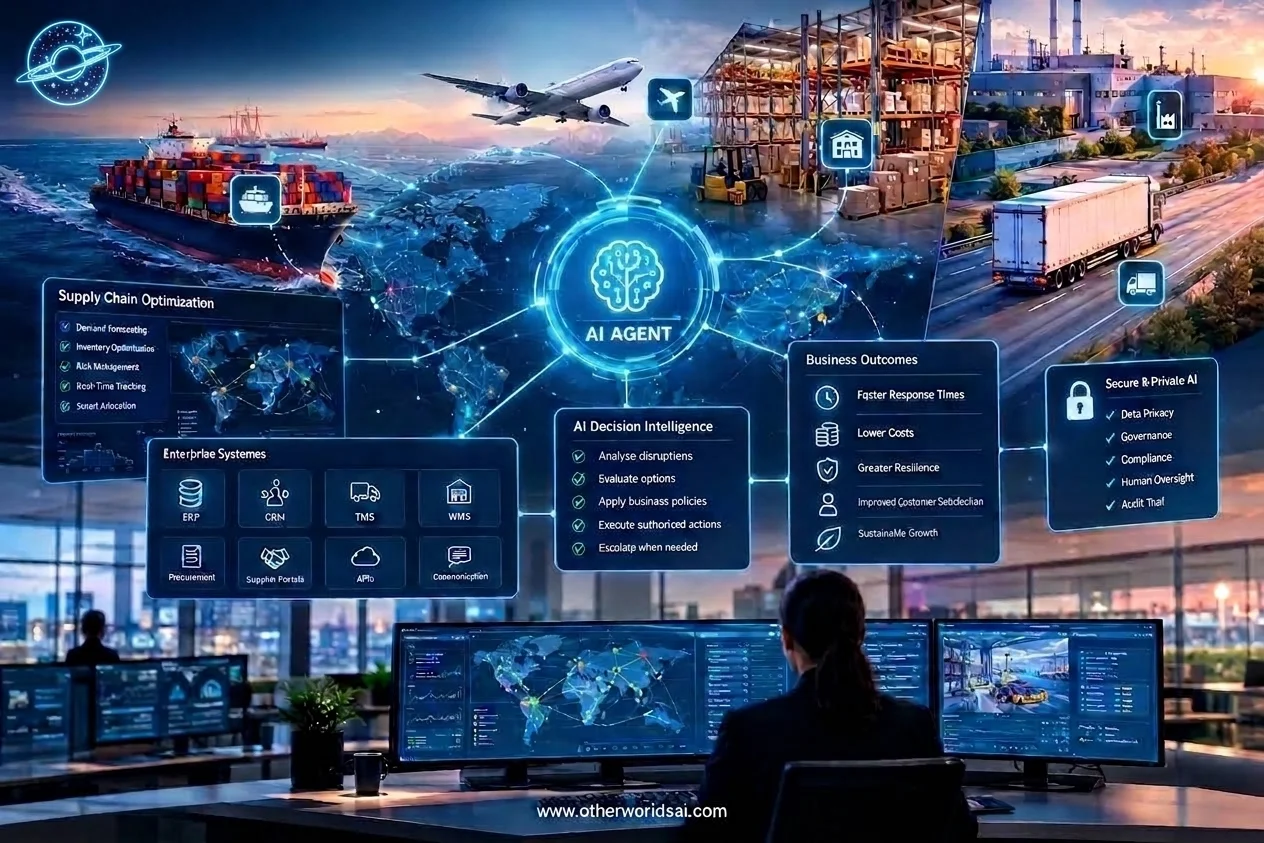
Instead of relying on human approval for every routing tweak, autonomous multi-agent networks operate directly inside Enterprise Resource Planning (ERP) and Warehouse Management Systems (WMS). By ingesting real-time telemetry from carrier ETAs, yard cameras, and WMS event streams, these specialized AI agents execute rerouting, rebalance safety stock, and reallocate dock doors autonomously within pre-configured boundaries.
At Otherworlds AI, we build private, secure, agentic AI architectures that convert static data into autonomous, real-time execution—without sending your proprietary logistics data to public frontier AI models or compromising IP ownership.
Otherworlds AI:
Here is how multi-agent AI is reshaping supply chain execution, real-world case studies proving its ROI, and the operational guardrails required to run autonomous systems safely. Proven Results: Live Multi-Agent AI Deployments in Action The transition from static analytics to autonomous execution is already generating measurable performance leaps across global logistics and manufacturing networks.
MULTI-AGENT AI PERFORMANCE BENCHMARKS:
Metric Impact / Operational Result
- Decision Speed: 3x faster fulfillment decision-making
- Disruption Response: 4x faster incident mitigation
- Delivery Accuracy: +30% increase across global markets
- Risk Assessment: 85% predictive accuracy
- Supplier Threat Detection: Detected 48 hours faster than manual teams
- On-Time Delivery: Increased from 82% to 94%
- Lenovo’s Global iChain Infrastructure:
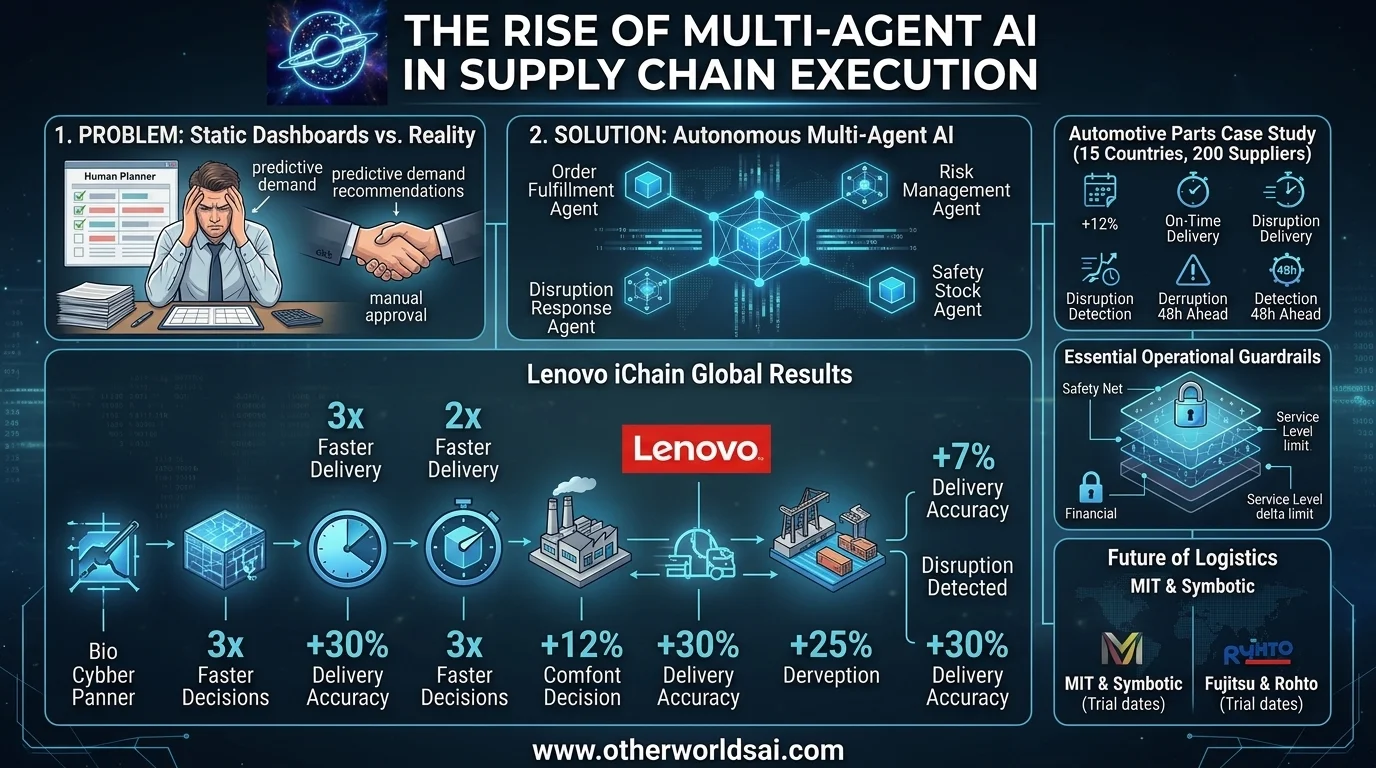
Global tech leader Lenovo deployed a multi-agent system across its iChain network, spanning 180 markets, over 30 factories, and 100 logistics centers. By linking dedicated Order Fulfillment Agents and Risk Management Agents directly to existing transactional databases, Lenovo achieved:
- 3x faster order fulfillment decision-making.
- 4x faster disruption response times.
- 85% accuracy in predictive risk assessment.
- 30% improvement in overall delivery accuracy.
- Multi-Country Automotive Component Manufacturing.
A mid-size automotive parts manufacturer documented by Simor Consulting rolled out five specialized agents across 15 countries and 200 suppliers during an 18-month production run.
The system drove on-time deliveries from 82% up to 94%.
Crucially, the manufacturer's disruption agent detected supply threats 48 hours ahead of manual monitoring teams. While communication agents interacted smoothly with established suppliers, dialogue initially stalled with unfamiliar vendors until the software cataloged their specific reply patterns—underscoring the value of agentic learning in real-world environments.
- Inter-Enterprise Routing (Fujitsu & Rohto Pharmaceutical)
In a virtual-network trial targeting inter-enterprise transport, Fujitsu and Rohto Pharmaceutical recorded transport cost reductions of up to 30%. Based on these initial gains, both organizations scheduled an expanded trial on Rohto’s live physical supply chain running between January 2026 and March 2027.
Single-Task Automation vs. Multi-Agent Orchestration:
Traditional supply chain automation applies narrow AI to single tasks—like forecasting demand or tracking individual shipments. Multi-agent AI platforms coordinate multiple independent operational domains simultaneously under a unified architecture.
Meta's Next Big Bet: This New App Lets You Build Games Simply by Typing a Prompt
Industrial manufacturers Kohler and Belden established this foundation using enterprise data platforms:
-
Kohler deployed a multi-agent supervisor coordinating real-time demand, inventory rebalancing, and planning schedules in parallel.
-
Belden engineered a multi-tier supplier graph using task-specific agents that detect transport incidents and execute master-data correction dynamically.
Beyond enterprise software, autonomous AI is also advancing in warehouse logistics. Joint research by MIT and Symbotic demonstrated a 25% throughput increase using multi-robot path coordination inside simulated e-commerce facilities. Meanwhile, NVIDIA released its Multi-Agent Intelligent Warehouse reference architecture to solve complex cross-fleet coordination.
While hardware operations on the warehouse floor still maintain boundaries between physical robotics and transaction execution, multi-agent AI software handles the high-velocity transactional logic powering the network.
Support our research
Independent analysis fueled by you.
Operational Guardrails: Safe Execution with Private AI Architecture:
Allowing AI agents to make direct database writes requires rigid, enterprise-grade guardrails. Unchecked agents can compound operational errors across integrated purchasing, warehousing, and shipping systems.
To implement supervised autonomy safely, enterprises should configure hard financial and operational tripwires:
-
Transport Rerouting Cost Ceilings: Autonomous freight rerouting scripts operate only within strict, pre-approved cost thresholds and Service Level Agreement (SLA) tolerances.
-
Financial Authorization Triggers: Any inventory rebalancing action exceeding a designated monetary limit or volume percentage pauses automatically for human planner authorization.
-
Draft-Mode Supplier Communication: External communication agents are restricted to draft modes when interacting with unvetted vendor accounts until accuracy benchmarks are satisfied.
The Otherworlds AI Advantage: Private Infrastructure & 100% IP Ownership:
At Otherworlds AI, we build private agentic architectures designed specifically for complex enterprise workflows where data security, privacy, and speed are critical:
- 100% Asset Ownership: We build proprietary models on your dedicated Virtual Private Cloud (VPC) or on-premise infrastructure. You own 100% of the intellectual property, code, and model weights.
-
Zero Third-Party Model Exposure: Your supply chain telemetry, supplier pricing, and operational data never leak to third-party frontier LLM providers or public APIs. Otherworlds AI
-
Production-Grade Governance: Built-in observable guardrails, audit logging, and human-in-the-loop (HITL) fallback modes ensure full transparency across every multi-agent action.
Ready to Transition from Predictive Dashboards to Private Agentic Execution?
The future of global supply chain management isn't another analytics dashboard—it's autonomous multi-agent execution backed by private, enterprise-grade AI.

Move Over Nvidia: Anthropic and Samsung Team Up to Break the AI Chip Monopoly
Whether you need to automate multi-tier inventory rebalancing, accelerate incident response, or build real-time carrier orchestration, Otherworlds AI delivers custom AI solutions engineered to protect your data and maximize operational performance.
Otherworlds AI
Explore Private AI Solutions at Otherworlds AI or reach out to our team today to request a custom ROI audit for your supply chain operations.