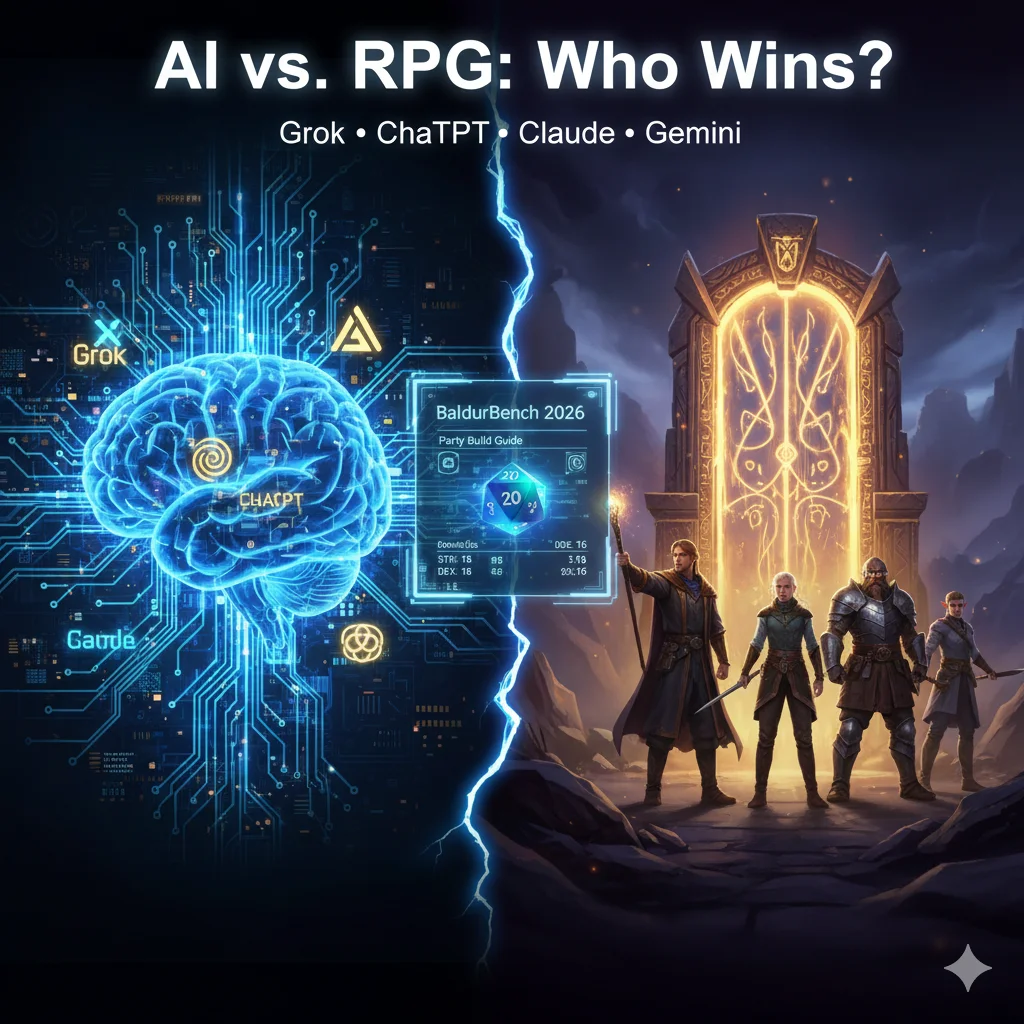

The Baldur’s Gate 3 Benchmark: Why Elon Musk Delayed Grok to Master the Githyanki Creche.
Grok vs. ChatGPT vs. Claude vs. Gemini: Which AI Chatbot Gives the Best Baldur's Gate 3 Advice?
If you've ever searched for a Baldur's Gate 3 party build guide and wondered whether AI chatbots could replace traditional wikis and walkthroughs, you're not alone — and it turns out, at least one tech billionaire has had the same thought.
A recent deep-dive report by Business Insider revealed a fascinating— and somewhat hilarious — behind-the-scenes story from xAI, Elon Musk's artificial intelligence startup. According to sources familiar with the matter, a Grok model release was delayed by several days last year because Musk himself was unhappy with how the chatbot handled detailed questions about the iconic RPG Baldur's Gate. Senior engineers were reportedly pulled off other projects just to improve Grok's in-game knowledge before launch.
Yes, you read that right. High-level AI engineers — the kind of people working on the frontier of machine intelligence — were redirected to help Grok get better at answering video game questions. It's the kind of detail that sounds like satire, but apparently it's very real.
So that naturally raises the question every gamer and AI enthusiast wants answered:Did it work? Is Grok now actually good at Baldur's Gate advice?
The BaldurBench: An AI Chatbot Gaming Showdown:
To find out, a panel of five general Baldur's Gate questions were put to the four major AI models currently dominating the chatbot landscape: Grok (xAI), ChatGPT (OpenAI), Claude (Anthropic), and Gemini (Google). The result? An unofficial but highly entertaining benchmark — dubbed "BaldurBench" — that reveals just as much about each AI's personality as it does about its raw knowledge.
All four models were drawing from similar Baldur's Gate guide sources available on the web, so the core information was largely consistent across responses. The real differences came down to style, tone, and approach — and those differences turned out to be surprisingly distinct.
Grok: Dense, Detailed, and Very Into Tables:
The good news for xAI fans: Grok delivers solid Baldur's Gate advice. The answers were well-informed and genuinely useful for players looking for strategic guidance. Grok clearly understands the game at a mechanical level, referencing concepts that experienced RPG players will immediately recognize.
That said, Grok's responses do lean heavily into gamer jargon — terms like "save-scumming" (repeatedly saving and reloading to get better outcomes) and "DPS" (damage per second) appear frequently, which could be confusing for newcomers. Grok also has a strong affinity for tables and theorycrafting content, making its responses feel more like a Reddit thread from a hardcore min-maxer than a beginner-friendly walkthrough.
Still, considering the reported engineering sprint dedicated specifically to this use case, it's reassuring to know the effort paid off — Grok holds its own confidently against the competition.
ChatGPT: Clean, Structured, and Straight to the Point:
OpenAI's ChatGPT took a characteristically practical approach. Its responses were formatted with bullet points and sentence fragments, prioritizing clarity and scannability over depth or personality. If you want a quick answer you can act on immediately, ChatGPT delivers efficiently.
This approach reflects OpenAI's longstanding emphasis on consumer usability — making AI accessible and digestible for the widest possible audience. ChatGPT won't dazzle you with deep lore analysis, but it will get you the answer you're looking for without wasting your time.
Gemini: Bold, Organized, and Easy on the Eyes:
Google's Gemini took a visually distinct approach to the same questions, bolding key terms and phrases throughout its responses to help readers skim for important information quickly. The formatting felt polished and structured, making Gemini's answers easy to navigate even on longer responses.

Anthropic vs OpenAI: Which AI is Better at Controlling Your Desktop?
Gemini's style suggests Google is prioritizing readability and information hierarchy — perhaps a reflection of its roots in search, where getting users to the right information fast is the core mission.
Claude: The Surprisingly Wholesome Gamer Friend:
And then there's Claude — which took a path nobody expected.
While the other three models focused purely on delivering strategic information, Claude consistently flagged potential story spoilers before diving into gameplay advice. It seemed genuinely concerned about preserving the player's experience of the game, not just answering the question in front of it.
When asked about optimal party compositions — a topic most AI models tackle with optimization charts and damage calculations — Claude closed its response with: "Don't stress too much and just play what sounds fun to you."
It's a response that probably made hardcore theorycrafters roll their eyes, but it's also… kind of refreshing? Claude, made by Anthropic, has built a reputation for being thoughtful and measured in its responses, and that ethos seems to extend even to fantasy RPG advice. Anthropic's focus on enterprise clients may also explain why Claude tends toward a more careful, considered communication style even in casual contexts.
What Does This Tell Us About AI Chatbots in 2024?
The BaldurBench exercise is small-scale and informal— it's not a rigorous academic study. But it does surface something genuinely interesting about how the major AI labs are shaping their models' personalities and priorities.
xAI is willing to delay launches and redirect engineering resources to nail a specific use case — which speaks to a culture of intense, top-down product control. OpenAI prioritizes broad consumer accessibility with clean formatting and digestible answers.
Google's Gemini leans into its strengths in information organization and visual clarity. And Anthropic's Claude seems to genuinely care about the user's holistic experience, even when that means pulling back on the "optimal" answer in favor of the more human one.
None of these models gave dramatically better Baldur's Gate advice than the others. The information was largely the same — what differed was how they communicated it, and what they seemed to value in doing so.
Bottom Line: Which AI Should You Use for Baldur's Gate Help?
-
Use Grok if you're an experienced player who wants detailed, jargon-rich strategic breakdowns and don't mind wading through tables.
-
Use ChatGPT if you want fast, clean, actionable answers without a lot of fluff.
-
Use Gemini if you prefer well-organized responses with clear visual hierarchy.
-
Use Claude if you're a first-time player who wants guidance that respects the journey, not just the destination.
The most important takeaway? After all the reported effort xAI put into making Grok better at Baldur's Gate, it landed right in the same tier as its competitors. Which means the other models were already pretty good — and that the real differentiator between today's top AI chatbots isn't raw knowledge, but the values and communication style baked into each one.
Now if only one of them could help you survive the Githyanki creche on tactician difficulty...
Support our research
Independent analysis fueled by you.