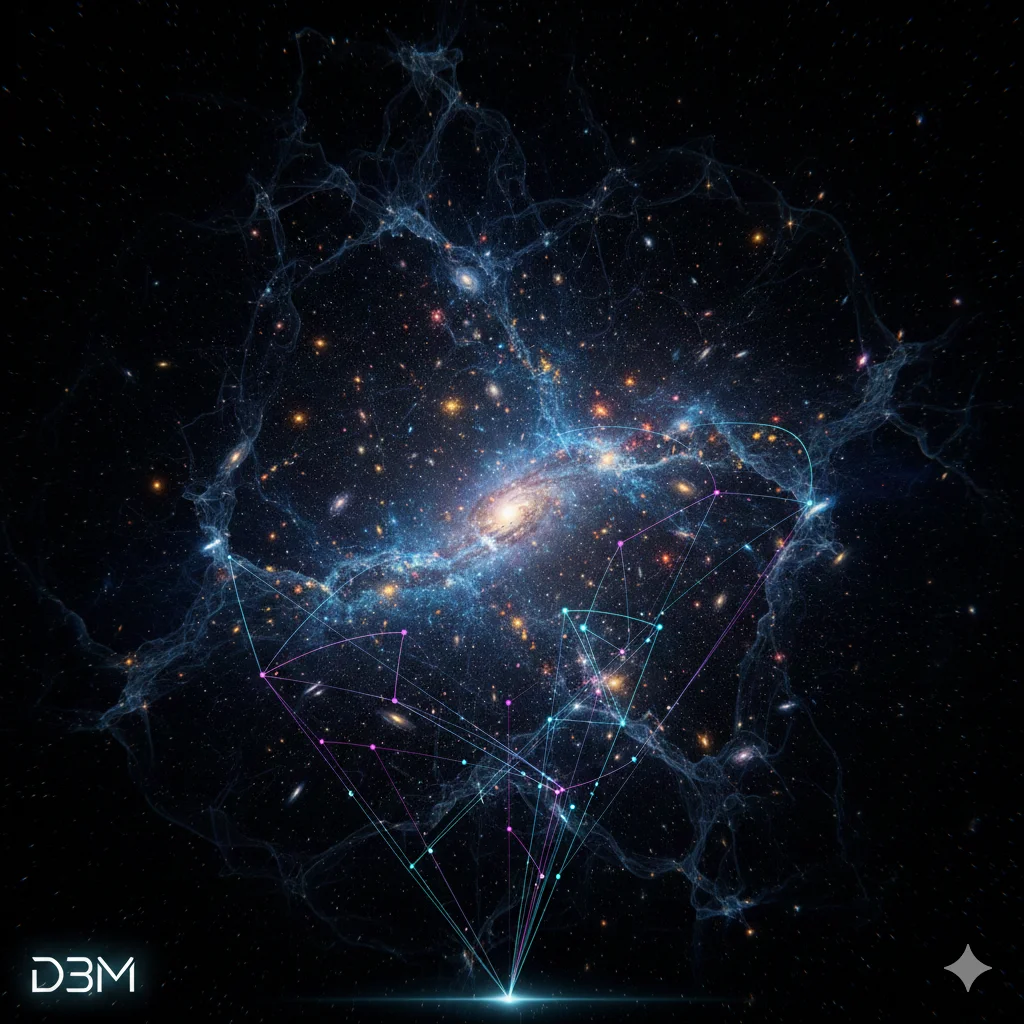

Imagine A stunning, artistic rendering of the cosmic web – a vast network of galaxies and dark matter. It should have a sense of deep space, mystery, and immense scale, perhaps with subtle, futuristic glowing lines indicating data flow or an AI's touch, but keeping the natural beauty of the cosmos at the forefront. The image should evoke wonder and the complexity of the universe being modeled.)
Imagine trying to model 13.8 billion years of cosmic evolution. The birth of stars, the dance of galaxies, the invisible scaffolding of dark matter shaping everything we see. Sounds like a task that would take supercomputers weeks, right?
Well, prepare to have your mind blown. Scientists have just unveiled an AI system, aptly named the Deep Density Displacement Model (D3M), that can do exactly that – in a mere 30 milliseconds. Yes, you read that right. THIRTY MILLISECONDS.
Faster Than Anything We've Ever Seen:
For context, the "gold standard" methods for simulating the universe can take up to 300 hours for a single run. Faster, less accurate methods still take minutes or hours. D3M just breezes past them all, delivering results astonishingly close to the most precise models, but in the blink of an eye.
It's like going from a horse and buggy to a hyperloop in one leap!
The "Elephant" in the Room: AI's Mysterious Intuition:
Here's where it gets truly wild. The team trained D3M on 8,000 simulations, teaching it how gravity sculpts the universe. But when they threw it a curveball – changing fundamental parameters it had never encountered before, like altering the amount of dark matter – D3M didn't just stumble. It adapted. It predicted the outcomes with incredible accuracy.
As astrophysicist Shirley Ho put it, it's "like teaching image recognition software with pictures of cats and dogs, but then it recognises elephants."** Nobody knows how it does this.**
This isn't just about speed; it's about an AI seemingly developing an intuitive understanding of physics that goes beyond its training data. It's like it discovered a shortcut, a deeper truth about the universe, that we haven't quite articulated ourselves.
Why Does This Matter?
Cosmic simulations are vital. They allow us to test theories, understand dark energy, and piece together the history of the cosmos. Until now, the sheer computational cost limited what we could explore. D3M changes everything:

Meta's Next Big Bet: This New App Lets You Build Games Simply by Typing a Prompt
-Unlocking New Discoveries: We can now run thousands, even millions, of simulations with different parameters, opening doors to understanding phenomena like dark energy and dark matter in ways previously impossible.
- A "Black Box" of Wisdom: Scientists are now keen to understand how D3M achieves its magic. Cracking open this "black box" could reveal new mathematical methods or physical insights that could revolutionize astrophysics.
- Beyond the Cosmos: If AI can master something as complex as cosmic evolution, imagine its potential in other fields like climate modeling, material science, or even biological systems.
This isn't just a technological leap; it's a philosophical one. We've created an AI that understands the universe in a way we don't fully grasp. It's a humbling, exhilarating moment in science, reminding us that the universe, and the tools we build to understand it, still hold countless mysteries.
What do you think about D3M? Does it excite you or give you pause? Share your thoughts below!
Support our research
Independent analysis fueled by you.