
19 Models, One Agent: How Perplexity Computer Orchestrates Your Most Complex Tasks:
Perplexity Computer: The AI Agent That Uses 19 Models to Automate Your Workflow.
The AI assistant landscape is shifting fast — and Perplexity AI is placing a bold bet on what comes next. The company has officially launched Perplexity Computer, an advanced agentic AI tool that promises to "unify every current AI capability into a single system." If you've been following the rise of AI agents, multi-model AI systems, and autonomous workflow automation, this launch is one of the most significant developments of 2026 — and it's worth understanding exactly what it means.
What Is Perplexity Computer:
At its core, Perplexity Computer is a cloud-based AI agent designed to independently execute complex, multi-step workflows without constant user input. Unlike traditional AI chatbots that respond to one question at a time, Perplexity Computer operates more like a fully autonomous digital employee — planning tasks, gathering data, and delivering polished, finished outputs entirely on its own.
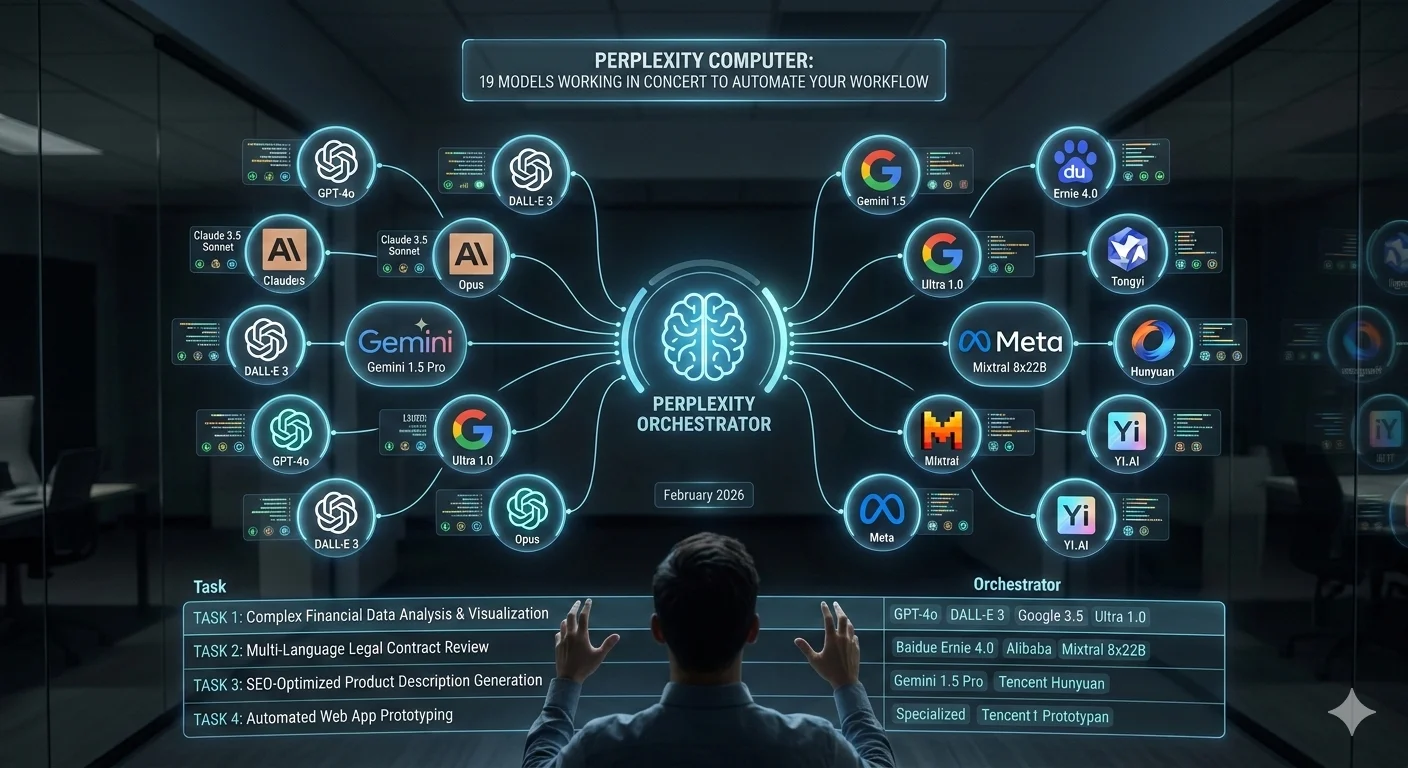
What truly sets it apart in the crowded AI automation tools space is its use of 19 different AI models working in concert. The system automatically selects the best model for each subtask — routing coding-heavy work to a programming-optimized model, while sending marketing copy to one better suited for creative writing. It can even spawn dedicated AI subagents to tackle specific problems within a larger workflow, making it one of the most sophisticated multi-model AI orchestration platforms available today.
Key Features of Perplexity Computer:
-
Multi-model AI orchestration is the heartbeat of this platform. The system dynamically selects from 19 AI models based on task requirements, giving users access to the best available large language model (LLM) for every step of a job — a significant leap beyond single-model tools.
-
Cloud-based execution sets Perplexity Computer apart from many of its rivals. Running entirely in the cloud, this architecture sidesteps many of the security concerns that plague local computer-use AI agents, making it a safer choice for sensitive professional workflows.
-
The Model Council feature brings a genuinely new dimension to AI-assisted decision-making. Users can query multiple AI models simultaneously, enabling side-by-side comparison and collaborative AI reasoning on the same problem — something no single-model tool can offer.
-
Automated subagent creation is where Perplexity Computer starts to feel truly futuristic. For highly complex tasks, the system breaks problems down and assigns specialized subagents, a pattern increasingly seen as the future of AI task automation and enterprise-grade agentic AI frameworks.
-
Rich, publication-ready output formats round out the feature set. From financial analysis to legal summaries, Perplexity Computer can present results as complete websites, interactive data visualizations, or structured reports — making it a powerful engine for AI-powered business intelligence.
What Perplexity Computer Can Actually Do:
According to Perplexity's example workflows, the tool excels in:
-
Data collection and analysis: Gathering statistics, financial figures, and market data from across the web.
-
Legal and compliance research: Synthesizing complex regulatory information into digestible summaries.
-
Content and report generation: Turning raw data into finished deliverables like websites or slide decks.
-
Cost-efficient LLM routing: Leveraging open-source models (including modified Chinese-built LLMs) for cheaper query processing where appropriate.
In practice, Perplexity Computer is built for the kinds of tasks that typically require a team, not just a tool. According to the company's example workflows, it excels at collecting statistics, financial figures, and market data from across the web; synthesizing complex legal and compliance information into digestible summaries; turning raw data into finished deliverables like websites or slide decks; and leveraging cost-efficient open-source models for cheaper query processing where appropriate.
This kind of end-to-end AI workflow automation places Perplexity Computer in direct competition with enterprise heavyweights like Microsoft Copilot, Google Gemini agents, and OpenAI's GPT-4o-based agents — a formidable field, but one where Perplexity believes its multi-model flexibility gives it a genuine edge.
Who Can Access Perplexity Computer:
Access to Perplexity Computer comes at a premium price — it is available exclusively to subscribers of Perplexity Max, the company's top-tier plan priced at $200 per month. That positioning places it firmly in the enterprise AI tools and power-user segment, rather than the mass consumer market that OpenAI's ChatGPT dominates.
The gap in scale between Perplexity and its biggest rival is striking. Perplexity's total user base numbers in the tens of millions, while OpenAI claims a staggering 800 million weekly active users — a reminder that premium positioning and raw user growth are very different games, and Perplexity is clearly choosing to play the former.
The Bigger Picture — Perplexity's Strategic Evolution:
Perplexity's story is one of relentless reinvention. The company first made its name as an AI-powered search engine alternative — a smarter, more conversational take on Google Search that delivered cited, real-time answers using frontier models in a clean, familiar interface.
Competitors, including Google itself, have since overhauled their own products to look more like Perplexity's early vision — a compliment and a competitive threat rolled into one.
Meta's Next Big Bet: This New App Lets You Build Games Simply by Typing a Prompt
Since those early days, the company has made a series of calculated pivots.
It launched Comet, its own AI-native web browser, last summer, with an iOS version expected to arrive next month. It abandoned advertising — one of the first AI companies to try it — late last year, declaring that ads "undermined users' trust in their answers' accuracy." And it is now preparing to host its first developers conference, Ask, on March 11 in San Francisco, signaling a serious push to grow third-party use of its AI API.
Support our research
Independent analysis fueled by you.
Taken together, these moves paint a picture of a company betting heavily on premium subscriptions and deep workflow integration — a fundamentally different business model from the ad-supported, scale-first approach favored by most of its competitors.
Challenges and Controversies:
Not everything has gone smoothly. A planned press demonstration of Perplexity Computer was canceled just hours before the event after engineers discovered flaws in the product — a stumble that raises questions about readiness for a tool promising autonomous execution of complex, high-stakes workflows.
User frustration has also been simmering beneath the surface. The Perplexity subreddit has filled with complaints about new rate limits on free and lower-tier subscription plans. Executives have pushed back firmly — "Any discussions on the free tier being made worse or rate-limited is completely false," one said — but the perception gap between leadership and users remains a friction point the company will need to address.
The unit economics of multi-model querying also remain an open question. Offering simultaneous access to multiple LLMs at flat subscription rates is computationally expensive, and whether the Model Council feature is financially sustainable at scale is something the market will watch closely.
Is Perplexity Computer the Future of AI Agents:
The idea behind Perplexity Computer — a single intelligent orchestration layer routing tasks across the best available AI models — is arguably where all serious AI productivity platforms are headed.The question isn't whether this is the right direction; it's whether Perplexity can execute reliably enough at the price point it's asking users to pay.
If it can deliver on that promise, Perplexity Computer could carve out a defensible and highly profitable niche in the enterprise and power-user segments. If it stumbles, deep-pocketed rivals like Google, Microsoft, and OpenAI are ready to fill the void with their own agentic offerings.
For now, Perplexity Computer stands as one of the most ambitious attempts yet to transform generative AI from a question-answering assistant into a true autonomous digital worker.
Whether it changes how professionals work — or becomes an expensive footnote — will be one of the defining AI stories of 2026.