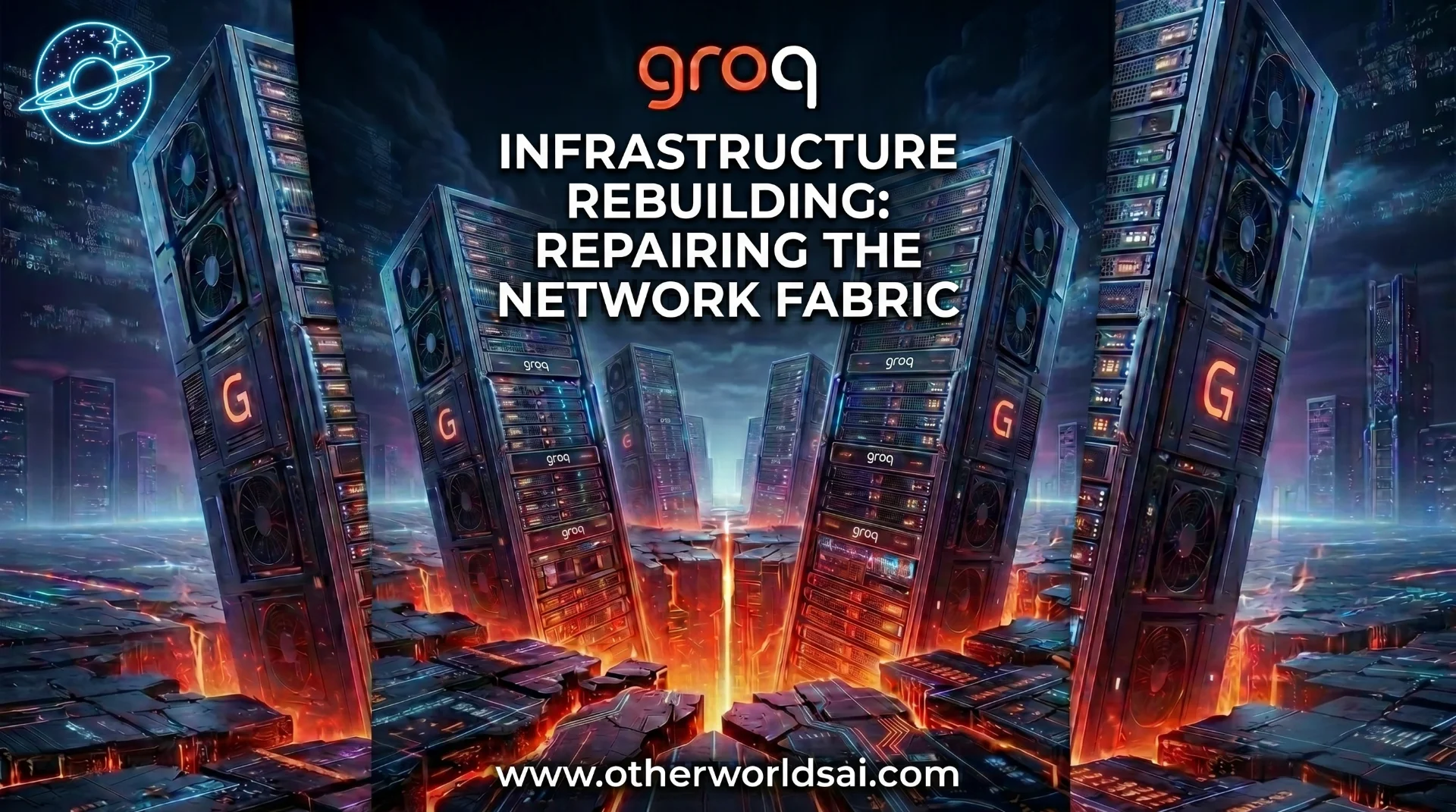

Groq Raises $650M: How AI Chipmakers Survive a Not-Acqui-Hire and What It Means for the AI Inference Market:
When a tech giant buys your IP and poaches your founders, rebuilding isn't just possible — it may be the most valuable thing you can do.
Groq’s Bold $650M Move After Losing Its Core Chip IP to Nvidia :
1: The $650M Reset: Groq's Bold Move After Nvidia's Licensing Deal:
AI inference cloud startup Groq has announced a $650 million funding round, confirming what may be one of the most closely-watched financial stories in the AI chip industry. The round was led by Disruptive — a Dallas-based late-stage investment firm founded by Alex Davis, who also serves as Groq's chairman — alongside Infinitum, a Fort Lauderdale-based hedge fund.
The raise comes roughly six months after Nvidia signed a non-exclusive licensing agreement for Groq's proprietary language processing unit (LPU) technology, simultaneously hiring away founder and CEO Jonathan Ross, president Sunny Madra, and other key employees in what the industry widely characterized as a not-acqui-hire — a deal that stops just short of a full acquisition but achieves similar strategic outcomes.
Groq's last publicly disclosed valuation was $6.9 billion, following a $750 million round in September 2025. The company has not disclosed its current valuation after the new round.
Groq Funding Snapshot: June 2026
New Raise: $650M
Lead Investors: Disruptive & Infinitum
Last Valuation (Sept 2025): $6.9 Billion
Data Centers (Global): 13 Across 4 Regions
Developers on Platform: 5 Million+
2: What Is a Not-Acqui-Hire — and Why Does It Matter for AI?
A not-acqui-hire is a deal structure that has become increasingly common in AI: a larger company pays investors a significant licensing fee for a startup's intellectual property, then simultaneously recruits the startup's most critical technical talent. The result is that the acquiring company gains both the IP and the people who built it — without technically buying the company outright.
In Groq's case, Nvidia paid for rights to the LPU architecture and brought on Jonathan Ross — who had previously helped create Google's Tensor Processing Unit (TPU) — along with other key personnel. Nvidia subsequently launched its own inference hardware cluster based on the technology: the Nvidia Groq 3 LPX, unveiled at its GTC event in March 2026.
For Groq's remaining leadership and investors, the question became: what is the company without its original chip IP and founding team? The answer, it turns out, may be a viable and well-funded AI inference cloud business.
3: Leadership Rebuild: New Executives, New Direction:
Following the departure of its founding leadership team, Groq has moved quickly to recruit experienced executives from across the enterprise AI and cloud infrastructure space.
Doug Wightman, who co-founded Groq with Ross and stayed on after the Nvidia deal, has assumed the role of CEO. Under his leadership, the company is executing a strategic pivot toward its neocloud inference business.
New additions to the executive team include Alan Rice as COO, previously at xAI and Meta, with a career background in the U.S. Navy. Sinclair Schuller joins as CTO — he co-founded Apprenda, an enterprise cloud software company — and Rakesh Malhotra takes the CPO role. Schuller and Malhotra previously collaborated at Nuvalence, a software engineering firm acquired by EY in 2024. Malhotra brings nearly a decade of experience building Microsoft's cloud products.
New Groq Leadership (2026) Role & Background
Doug Wightman (CEO): Co-Founder; former engineering lead
Alan Rice (COO): Ex-xAI, Meta; U.S. Navy veteran
Move Over Nvidia: Anthropic and Samsung Team Up to Break the AI Chip Monopoly
Sinclair Schuller (CTO): Founded Apprenda & Nuvalence
Rakesh Malhotra (CPO): Ex-Microsoft Cloud; co-founder Nuvalence
Support our research
Independent analysis fueled by you.
4: The Pivot to AI Inference Cloud: Groq's New Competitive Angle:
With its LPU chip IP now in Nvidia's hands, Groq has pivoted to emphasize its neocloud inference platform — a business that had been built out under former president Sunny Madra following Groq's acquisition of his AI data analytics company, Definitive Intelligence, in 2024.
The inference cloud operation has scaled significantly: Groq now operates 13 data centers across North America, Europe, the Middle East, and APAC, serving over five million developers and thousands of AI companies. The platform processes trillions of tokens per week.
The AI inference market is experiencing extraordinary demand right now, driven by the surge in enterprise AI deployments and the growing need for cost-effective, high-throughput inference infrastructure. VC investment in inference-focused startups is accelerating — just weeks before Groq's announcement, AI inference startup Baseten was reportedly raising $1.5 billion in a new round.
"Groq now operates 13 global data centers and serves over 5 million developers — processing trillions of tokens each week."
— Groq Company Announcement, June 2026
5: Can Groq Compete Without Its Own Chip? Lessons from Scale AI:
Whether Groq can sustain a competitive edge in inference cloud without proprietary chip IP is the central strategic question facing the company. Nvidia — now licensing the same LPU architecture — has a clear infrastructure advantage. But inference performance depends on more than hardware: data center footprint, developer ecosystem, pricing, and platform integrations all matter.
A precedent worth examining is Scale AI, which survived a similarly disruptive not-acqui-hire: in August 2025, Meta executed a $14.3 billion deal that brought in Scale AI's key talent and IP access. Scale AI CEO Jason Droege told Forbes in May 2026 that the business has rebounded and is on track to generate $1 billion in revenue — a strong signal that these deals don't have to be fatal.
For Groq, the parallel is meaningful. The company has real infrastructure, an established developer base, and now a fresh injection of $650 million to invest in scaling its inference cloud operations, hiring talent, and competing in a market that is growing faster than almost any other segment of enterprise technology.
Not-Acqui-Hire Survivors: Outcome
Scale AI (Meta deal, Aug 2025): On track for $1B revenue — CEO confirmed May 2026
Groq (Nvidia deal, Dec 2025): $650M raised; 13 DCs; 5M+ developers
6: What This Means for Your Business: AI Infrastructure Is Now a Strategic Decision:
Groq's story isn't just about one chipmaker navigating a difficult deal — it's a signal about where the AI industry is heading. The explosive growth of AI inference infrastructure, the surge of VC investment into cloud platforms, and the willingness of companies to rebuild from scratch after losing core IP all point to the same underlying truth: AI adoption at the enterprise level is accelerating, and infrastructure decisions made today will shape competitive advantage for years.
For business owners and operators, the question is no longer whether to integrate AI — it's how to do it effectively without getting left behind by the pace of change. The companies benefiting most from this shift aren't just the hyperscalers and chipmakers. They're the businesses that have deployed AI automation into their daily operations — handling customer interactions, managing workflows, generating insights, and freeing up teams to focus on growth.
That's exactly what the Agent+ Business AI platform from Otherworlds AI is built to deliver. Purpose-built for small and mid-sized enterprises, Agent+ brings enterprise-grade AI automation to businesses that don't have the budget or bandwidth of a Fortune 500 company — but still need to compete like one. From automated client communication to intelligent workflow orchestration, Agent+ puts the same AI infrastructure advantages that are reshaping billion-dollar companies to work for yours.
"The businesses winning in the AI era aren't waiting for the technology to mature. They're deploying it now — and building competitive moats in real time." — Otherworlds AI
Ready to put AI infrastructure to work for your business? Explore Agent+ Business AI at otherworldsai.com
Meta's Next Big Bet: This New App Lets You Build Games Simply by Typing a Prompt
Published June 2026 | Reading time: ~6 min