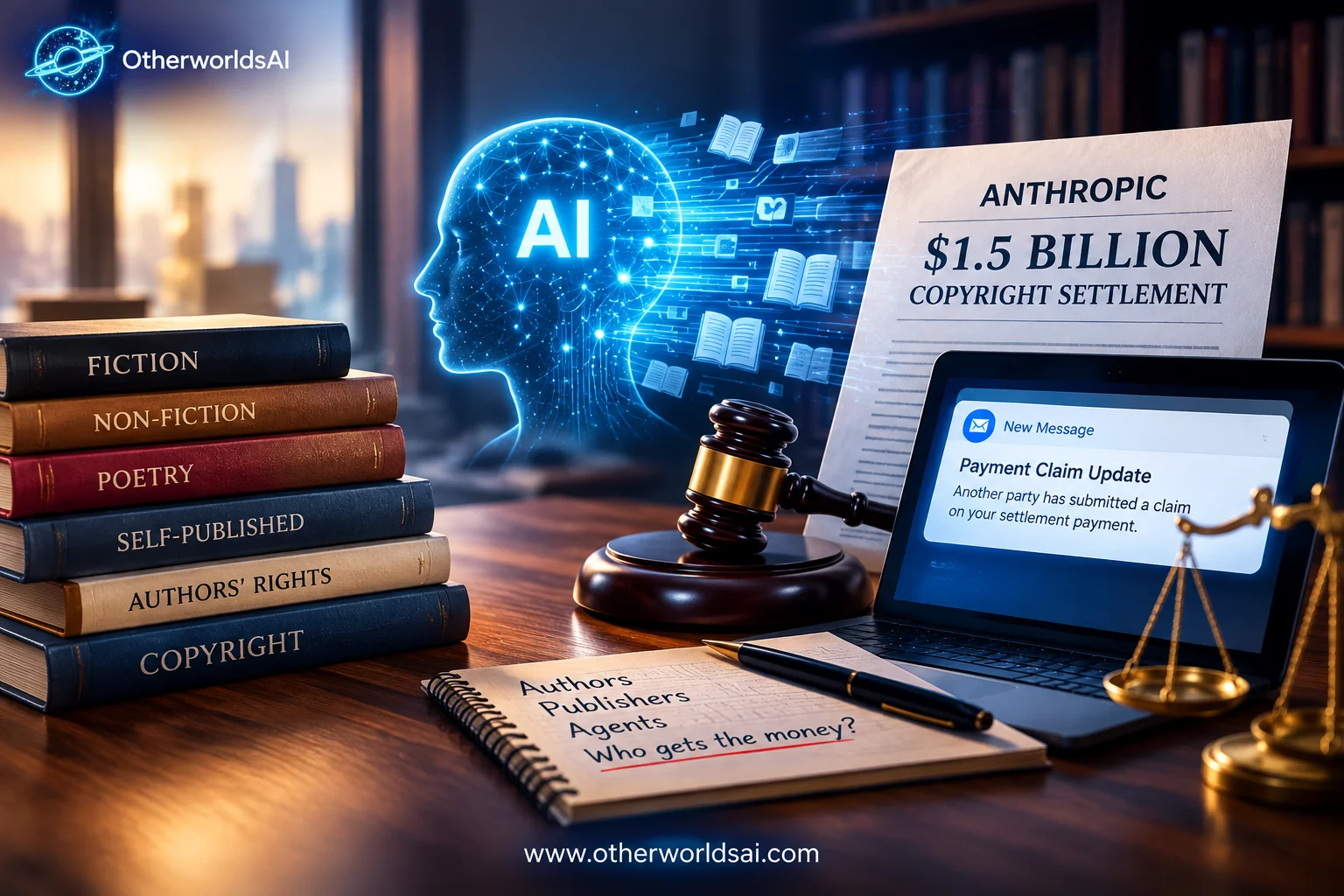

Anthropic’s $1.5 Billion AI Copyright Settlement Sparks New Fight Over Authors’ Money.
Why $3,000 AI Settlement Checks Are Causing Major Drama Between Authors and Publishers.
The debate over AI copyright and artificial intelligence training data is entering a new and unexpected chapter.
After Anthropic agreed to a landmark $1.5 billion copyright settlement with authors whose books were allegedly pirated and used in connection with AI training, many writers expected the process to be relatively straightforward: identify eligible books, submit claims, and receive their share of the settlement.
Instead, some authors say they are discovering that publishers and even literary agents are claiming money that they believe belongs to them.
The dispute is raising broader questions about copyright protection in the age of generative AI, how publishers manage digital rights, and who should benefit when copyrighted books become part of the AI ecosystem.
Anthropic’s $1.5 Billion Copyright Settlement Explained:
The controversy stems from a copyright lawsuit involving Anthropic, the artificial intelligence company behind Claude.
The case focused on how copyrighted books were obtained and used in the development of AI systems.
A major distinction emerged during the legal proceedings. The court determined that training AI models using copyrighted material can qualify as fair use, while obtaining copyrighted books through piracy is a different matter.
Anthropic ultimately agreed to a settlement worth approximately $1.5 billion.
The settlement received final approval in July 2026, clearing the way for payments to eligible authors and other rights holders.
Under the agreement, authors of nearly 500,000 titles may receive approximately $3,000 for each eligible pirated work.
That sounds simple—but the distribution rules have created a new dispute. Who Gets the $3,000 Payment?
The settlement distinguishes between traditionally published and independently published books.
If an eligible book is still under a traditional publishing agreement, the settlement payment is generally divided:
-
50% to the author.
-
50% to the publisher.
For a $3,000 payment, that would mean approximately $1,500 for the author and $1,500 for the publisher.
But the situation changes if the author owns the rights again.
If a book was self-published, or if the publisher previously returned the rights to the author because the book went out of print, the author may be entitled to the full settlement payment.
This is where some writers say the problems began.
Authors Say Publishers Are Claiming Books They No Longer Own.
Several authors have taken to social media to complain that publishers are apparently submitting claims for books where their publishing rights had already reverted to the authors.
Mystery and thriller author April Henry, for example, publicly questioned why HarperCollins had claimed one of her books even though she said the rights had reverted approximately 17 years earlier.
Her experience highlights one of the central problems in the settlement process:
Who actually owned the rights to a book when the relevant AI-related download occurred?
That question is critical because authors may receive significantly more money if they can establish that the publishing rights had already returned to them.
The Rights-Reversion Problem:
One of the most important details for authors involves the settlement's August 10, 2022 download date.
For an author to make a 100% claim on an eligible work, the rights reversion must generally have occurred before August 10, 2022.
That makes old publishing contracts and rights-reversion records extremely important.
Authors who believe a publisher has incorrectly claimed their settlement payment may need to review:
-
Original publishing contracts.
-
Rights-reversion letters.
-
Out-of-print notices.
-
Contract amendments.
-
Copyright ownership records.
-
Publication and termination dates.
-
Settlement claim information.
For writers with books published many years ago, finding these documents may be surprisingly difficult.
Are Publishers Deliberately Taking Authors’ Settlement Money?
That is one of the biggest questions surrounding the controversy.
Victoria Strauss of Writers Beware has reported receiving complaints from authors about incorrect publisher claims.

Move Over Nvidia: Anthropic and Samsung Team Up to Break the AI Chip Monopoly
But Strauss has also cautioned against immediately assuming bad intentions.
Poor recordkeeping could explain some of the errors.
Publishing companies may have decades of contracts, amendments, rights reversions and ownership records stored across different systems. Large-scale settlement processing can also create administrative problems.
The Authors Guild has similarly suggested that the issue may be the result of confusing settlement procedures and outdated rights records, rather than an organized attempt by publishers to take money from authors.
Still, the number and similarity of complaints are attracting attention.
Strauss has argued that repeated reports of the same problems could indicate something broader than ordinary administrative mistakes.
That distinction matters.
Support our research
Independent analysis fueled by you.
If these are isolated errors, they can potentially be corrected.
If the problem is systemic, however, thousands of authors could potentially be affected.
Literary Agents Are Now Part of the Controversy:
Publishers aren't the only organizations facing questions.
Some authors have also reported that literary agencies are submitting claims or seeking a percentage of settlement payments.
That has surprised authors because literary agents generally represent writers in negotiating and selling publishing rights but aren't themselves the copyright owners of the books.
Author Courtney Milan has publicly criticized the idea of agents taking a percentage of the settlement.
The disagreement raises an important question:
Does an agent's contractual commission on publishing income automatically give the agent a right to a copyright settlement?
The answer may depend on the specific agency agreement and the nature of the payment. But authors should not automatically assume that every organization associated with a book is entitled to part of the settlement.
What Authors Should Do If Their Claim Is Wrong:
Authors who receive a settlement notice showing an unexpected publisher or agency allocation should not simply assume the information is correct.
The first step is to carefully examine the settlement claim information and determine who is listed as receiving the payment and why.
Authors should then review their publishing history and establish whether the publisher actually held the relevant rights on the settlement's applicable date.
If the rights had reverted before August 10, 2022, documentation proving that reversion could be extremely important.
Authors can also use the dispute procedures provided by the settlement administrators and seek guidance from organizations such as the Authors Guild when appropriate.
Why This Matters Beyond One Copyright Settlement:
The Anthropic dispute is bigger than a $1.5 billion payment.
It represents one of the first major tests of how the publishing industry handles copyright and generative AI at enormous scale.
Artificial intelligence companies need vast quantities of data to train increasingly sophisticated models. Books, articles, websites, images, music and other creative works can potentially become part of that training ecosystem.
That creates a difficult balance.
AI companies argue that training models requires learning from enormous amounts of information.
Creators argue that their intellectual property should not be used without appropriate legal protection or compensation.
The Anthropic settlement demonstrates that even when a legal dispute reaches a financial resolution, determining who actually owns the rights can be surprisingly complicated.
The Bigger AI Copyright Battle:
The future of AI copyright law is still being written.
Governments, courts, publishers, technology companies and creators are all trying to answer fundamental questions:
-
Can copyrighted material be used to train AI models?
-
When does AI training qualify as fair use?
-
What happens when copyrighted material is obtained illegally?
-
Who should receive compensation when AI companies settle copyright disputes?
How should contracts between authors and publishers apply to AI-generated revenue? These questions will become increasingly important as AI systems become more capable and are integrated into publishing, entertainment, software development, marketing and other creative industries.
Meta's Next Big Bet: This New App Lets You Build Games Simply by Typing a Prompt
The Anthropic settlement could therefore become an important precedent—not necessarily because it resolves every AI copyright question, but because it exposes the complexity of determining ownership and compensation in the digital era.
AI Is Changing Copyright—and Copyright Is Changing AI:
The conflict between authors and publishers illustrates a larger transformation happening across the technology industry.
Generative AI has created enormous opportunities for businesses and consumers, but it has also challenged traditional assumptions about intellectual property, copyright ownership, training data and creative rights.
The Anthropic case shows that resolving a copyright lawsuit is only one part of the problem. The next challenge is figuring out who gets paid.
For authors, publishers and literary agents, that question could determine whether the settlement becomes a meaningful source of compensation—or another complicated battle over ownership.
And for the broader AI industry, the dispute offers an important warning:
The future of artificial intelligence will depend not only on how powerful AI models become, but also on how responsibly the industry handles the rights of the people whose work helps make those systems possible.
OtherworldsAI helps businesses explore practical AI automation and intelligent AI agents designed to improve customer engagement, streamline workflows, and reduce repetitive work. Explore the future of business automation with OtherworldsAI.