
The 4 AI Scenarios Every Business Leader Needs to Plan for Today.
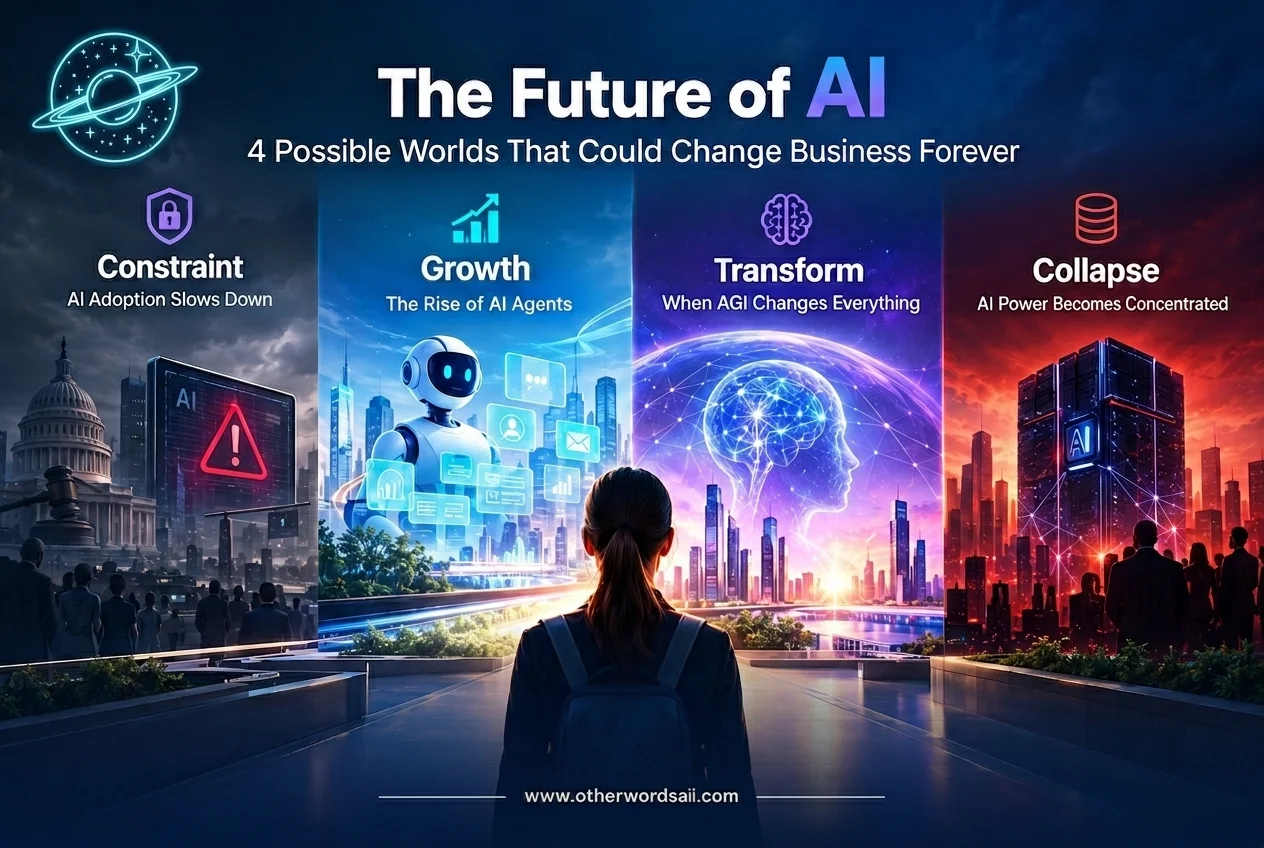
The Future of AI: Four Possible Worlds That Could Change Business Forever.
Artificial intelligence is moving faster than most businesses can adapt. But what happens next? Explore four possible futures of AI—and what companies can do today to prepare for all of them.
Artificial intelligence has moved far beyond being a futuristic technology.
AI is already writing code, generating content, analyzing data, answering customer questions, automating repetitive tasks, and increasingly acting as an AI agent capable of completing multi-step workflows.
For businesses, the question is no longer simply:
“Should we use AI?”
The much bigger question is:
“What happens if AI changes much faster—or much differently—than we expect?”
That is where the future of AI becomes difficult to predict.
Some companies may enter an era of extraordinary productivity. Others may face tighter AI regulation, unexpected failures, workforce disruption, or increasing dependence on a handful of powerful AI providers.
Rather than betting everything on one prediction, it makes more sense to consider several possible futures.
This article explores four scenarios for the future of artificial intelligence:
-
Constraint — AI adoption slows down.
-
Growth — AI agents transform everyday business.
-
Transform — AGI changes the rules.
-
Collapse — AI power becomes dangerously concentrated.
These aren't predictions carved in stone. They are thought experiments designed to help businesses understand the opportunities, risks, and strategic decisions that could shape the next decade.
Why the Future of AI Is So Difficult to Predict:
The AI industry is developing at extraordinary speed.
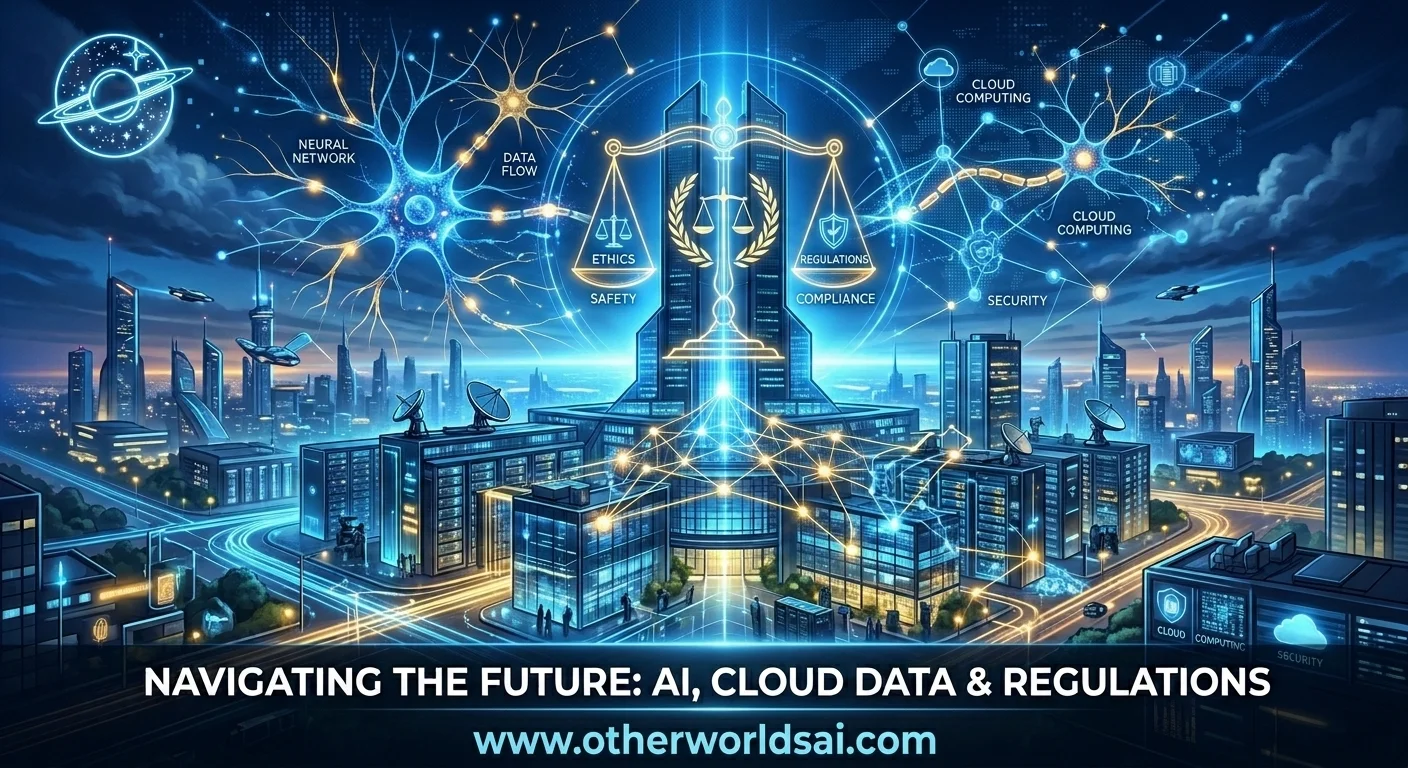
New foundation models, AI agents, robotics systems, enterprise AI platforms, and automation tools are appearing constantly. At the same time, governments are developing new approaches to AI regulation, data privacy, AI safety, and responsible AI. This creates an unusual business environment.
Technology is advancing rapidly, but the rules surrounding that technology are still evolving.
And there is another complication: AI doesn't simply improve existing software. It can change how work itself is performed.
A traditional software application waits for a human to tell it what to do.
An AI agent can potentially understand a goal, plan several steps, use software tools, retrieve information, make decisions, and complete a task with considerably less human intervention.
That shift—from software that assists people to AI systems that perform work—could have enormous consequences for businesses.
The question is: which future will actually emerge?
Future No. 1: Constraint — When AI Adoption Slows Down:
Imagine a future where enthusiasm about artificial intelligence meets reality.
AI systems continue to improve, but several high-profile failures create a wave of skepticism.
Perhaps an AI trading system makes a serious mistake.
Perhaps an AI-powered financial system repeatedly produces unreliable reports.
Perhaps a medical AI system makes a dangerous recommendation.
Or perhaps businesses discover that some forms of AI-generated content simply don't deliver the expected commercial value.
Suddenly, governments, businesses, and consumers start asking harder questions.
-
Who is responsible when an AI system makes a mistake?
-
How much autonomy should an AI agent have?
-
What data should an AI system be allowed to access?
-
Who should be liable for an AI-generated decision?
The result could be significantly stronger AI governance and regulation.
Instead of racing toward maximum automation, companies become more cautious.
AI adoption doesn't disappear. It simply becomes slower and more controlled.
What businesses would need in this AI future:
Companies operating in this environment would need strong:
- AI governance frameworks.
- Risk assessment procedures.
- Human oversight.
- AI testing and validation.
- Data governance.
- Compliance systems.
- Security controls.
- Business continuity plans.
The winners wouldn't necessarily be the companies deploying the most AI.
They would be the companies deploying reliable AI.
Trust could become a competitive advantage.
Businesses that can demonstrate that their AI systems are secure, explainable, auditable, and properly supervised could have an advantage over organizations that simply automate everything as quickly as possible.
Future No. 2: Growth — The Rise of AI Agents:
Now imagine a very different future. AI development continues along its current trajectory.
There is no sudden breakthrough into human-level AGI. Instead, AI models steadily become more capable, reliable, affordable, and specialized.
This may actually be one of the most commercially important possibilities.
Why?
Because businesses don't necessarily need artificial general intelligence to transform their operations.
They need AI that can reliably perform useful work.
By 2030, specialized AI agents could become deeply integrated into departments such as:
- Customer service.
- Sales
- Marketing
- Finance
- Human resources
- Legal operations
- IT support
- Procurement
- Scheduling
- Business intelligence
Instead of asking an employee to manually complete dozens of repetitive tasks, companies could deploy digital workers that handle much of the operational workload.
This could create a new type of organization:
AI-augmented businesses where humans focus on judgment, relationships, creativity, and strategy while AI handles increasingly complex operational work.
AI Agents Could Become the New Digital Workforce:
Consider a customer service department.
Today, a customer may send a message, wait for a response, speak with an employee, receive an answer, and then require additional follow-up.
An AI agent could potentially:
- Understand the customer's request.
- Retrieve relevant information.
- Check the company's systems.
- Determine the appropriate action.
- Complete the transaction.
- Update the CRM.
- Schedule follow-up.
- Notify the customer.
That is more than a chatbot. It is AI-powered workflow automation.
This distinction is important. The next phase of enterprise AI may not simply be about generating text or images.
It may be about executing work.
Future No. 3: Transform — When AGI Changes Everything:
The third scenario is considerably more dramatic.
Artificial general intelligence, or AGI, becomes practical.
Instead of AI systems being highly specialized, advanced AI can reason across a broad range of intellectual tasks and operate across different domains.

Meta's Next Big Bet: This New App Lets You Build Games Simply by Typing a Prompt
In this world, AI becomes much more than another enterprise technology.
It becomes a general-purpose capability.
Imagine enterprise AI platforms capable of handling complex research, software development, financial analysis, strategic planning, customer operations, legal workflows, engineering tasks, and other knowledge-intensive activities.
The organizational consequences could be enormous.
Companies might no longer need large layers of administrative work.
Small teams could operate businesses that previously required hundreds or thousands of employees.
Entrepreneurs could launch companies with dramatically lower operating costs. And existing businesses could redesign their entire operating models around AI.
The Human-AI Collaboration Era:
But the most interesting part of this scenario isn't necessarily replacing humans. It could be augmenting human capabilities.
An AI system might analyze millions of pieces of information while a human makes the final strategic decision.
A product team could use AI to simulate hundreds of product concepts.
A marketing team could have AI analyze customer behavior and develop personalized campaigns. An engineer could work alongside AI systems capable of testing thousands of design alternatives.
The result could be a new model of human-AI collaboration.
Humans provide:
- Judgment
- Creativity
- Leadership
- Ethics
- Context
- Relationships
- Strategic direction
AI provides:
- Computation
- Analysis
- Automation
- Pattern recognition
- Research
- Execution
- Scalability
The companies that learn how to combine these capabilities effectively could gain a significant competitive advantage.
Support our research
Independent analysis fueled by you.
Future No. 4: Collapse — When AI Power Becomes Concentrated:
The fourth scenario is perhaps the most unsettling.
Imagine that a major breakthrough gives one company or a very small group of organizations an overwhelming advantage in artificial intelligence.
Because advanced AI requires enormous amounts of computing power, data, talent, infrastructure, and capital, the advantages could reinforce one another.
- More capable AI attracts more users.
- More users generate more data and revenue.
- More revenue enables more infrastructure.
- More infrastructure enables better AI.
And better AI attracts even more users.
This creates a powerful network effect.
Eventually, AI capabilities could become concentrated in the hands of a very small number of organizations.
Why AI Concentration Could Become a Business Risk:
For companies building their businesses around external AI providers, concentration creates a serious strategic question:
What happens if your entire business depends on someone else's AI infrastructure?
A company could become vulnerable to:
- Pricing changes
- API restrictions
- Service outages
- Model changes
- Data policies
- Regulatory decisions
- Vendor lock-in
- Intellectual-property concerns
This is why AI independence, data ownership, interoperability, and AI infrastructure strategy could become increasingly important.
Businesses shouldn't only ask:
“Which AI model is best today?”
They should also ask:
“How dependent do we want to become on one provider?”
The AI Moat: What Will Protect Businesses?
In an AI-driven economy, competitive advantage may increasingly come from something that could be called an AI moat.
An AI moat can include:
- Proprietary data
- Specialized industry knowledge
- Unique workflows
- Customer relationships
- Proprietary AI models
- Internal automation systems
- Brand trust
- Intellectual property
- Specialized talent
- Deep integration into business operations.
The technology itself may become increasingly accessible.
The real advantage could come from how a company uses AI differently from everyone else.
What Should Businesses Do Now?
Nobody knows exactly which AI future will emerge.
That is precisely why companies shouldn't build their strategy around a single prediction. Instead, businesses should prepare for multiple possibilities.
- Start with practical AI use cases:
Don't adopt AI simply because everyone else is doing it. Identify repetitive, expensive, slow, or error-prone processes where AI can deliver measurable value.
- Move beyond AI chatbots:
Chatbots are only one part of the AI revolution.
Explore AI agents, workflow automation, intelligent customer service, AI-powered sales, automated scheduling, data analysis, and autonomous business processes.
- Build AI governance early:
As AI becomes more powerful, governance becomes more important. Define:
- Who can deploy AI?
- What data can AI access?
- Which decisions require human approval?
- How are AI errors detected?
- How is sensitive information protected?
- How are AI systems monitored?
- Protect your data:
Your data may become one of your company's most valuable AI assets. Companies should understand where their data goes, who can access it, how it is processed, and whether they can maintain control over it.
- Avoid unnecessary vendor lock-in:
Don't assume that today's dominant AI provider will always be the best choice. Where practical, maintain flexibility across models, platforms, infrastructure, and providers.
- Train your workforce:
AI transformation isn't just a technology project. Employees need to understand how to work with AI, supervise AI systems, evaluate AI-generated information, and redesign workflows around automation.
Where Does OtherworldsAI Fit Into This Future?
At OtherworldsAI, we believe the most useful AI isn't necessarily the AI that creates the most headlines.
It's the AI that solves real business problems.
The next generation of business automation will increasingly move from simple software tools toward intelligent AI agents that can understand tasks, interact with systems, communicate with customers, and complete workflows.
That means businesses can begin thinking about AI differently.
Move Over Nvidia: Anthropic and Samsung Team Up to Break the AI Chip Monopoly
Not simply as another software subscription.
But as a digital workforce layer that can operate alongside human employees. For a small business, that could mean an AI agent answering customers around the clock. For a growing company, it could mean automating lead qualification, appointment scheduling, customer follow-up, and internal workflows.
For an enterprise, it could mean building private AI infrastructure, specialized models, and secure AI systems around proprietary data and business processes.
The objective isn't to replace humans simply because automation is possible.
The objective is to remove repetitive work so people can focus on work that actually requires human judgment and creativity.
The Future of AI Will Not Be One Future:
The biggest mistake businesses can make is assuming that the future of artificial intelligence is already predetermined.
It isn't.
- AI could develop gradually.
- It could accelerate dramatically.
- Regulation could slow adoption.
Or technological breakthroughs could concentrate power in the hands of a few companies. The four scenarios explored here—Constraint, Growth, Transform, and Collapse—illustrate how different the next decade could look. The original framework likewise treats these scenarios as strategic possibilities rather than forecasts.
And that's the real lesson. The question isn't:
“Which AI future will happen?”
The better question is:
“How prepared is our business if any of them happens?”
Companies that build adaptable systems, protect their data, develop AI skills, invest in responsible AI governance, and experiment with AI agents today will have more options tomorrow.
The future of AI may be uncertain.
But businesses don't have to be unprepared for it.
The companies that shape their AI strategy today may have a much better chance of shaping the future instead of simply reacting to it.
Final Takeaway:
Artificial intelligence is moving from experimentation into the core of business operations. The next phase will likely be defined by AI agents, enterprise AI, automation, generative AI, AI governance, AGI research, and increasingly sophisticated human-AI collaboration. Whether the future brings steady growth, radical transformation, tighter constraints, or concentrated AI power, one principle remains the same:
Don't wait for the future of AI to arrive. Start preparing for it now.
About OtherworldsAI:
OtherworldsAI helps businesses explore practical AI automation and intelligent AI agents designed to improve customer engagement, streamline workflows, and reduce repetitive work. Explore the future of business automation with OtherworldsAI.