
Treble Raises $18 Million to Build the Simulation Infrastructure Behind Voice AI
Voice AI is moving far beyond simple chatbots and virtual assistants. Today, voice technology is becoming a fundamental interface for customer service, AI agents, smart glasses, headphones, robotics, automobiles, and other intelligent devices.
But as voice-enabled technology becomes more sophisticated, one challenge is becoming increasingly important: how do companies test and improve AI systems that need to understand sound in the real world?
Iceland-based startup Treble believes the answer lies in simulation.
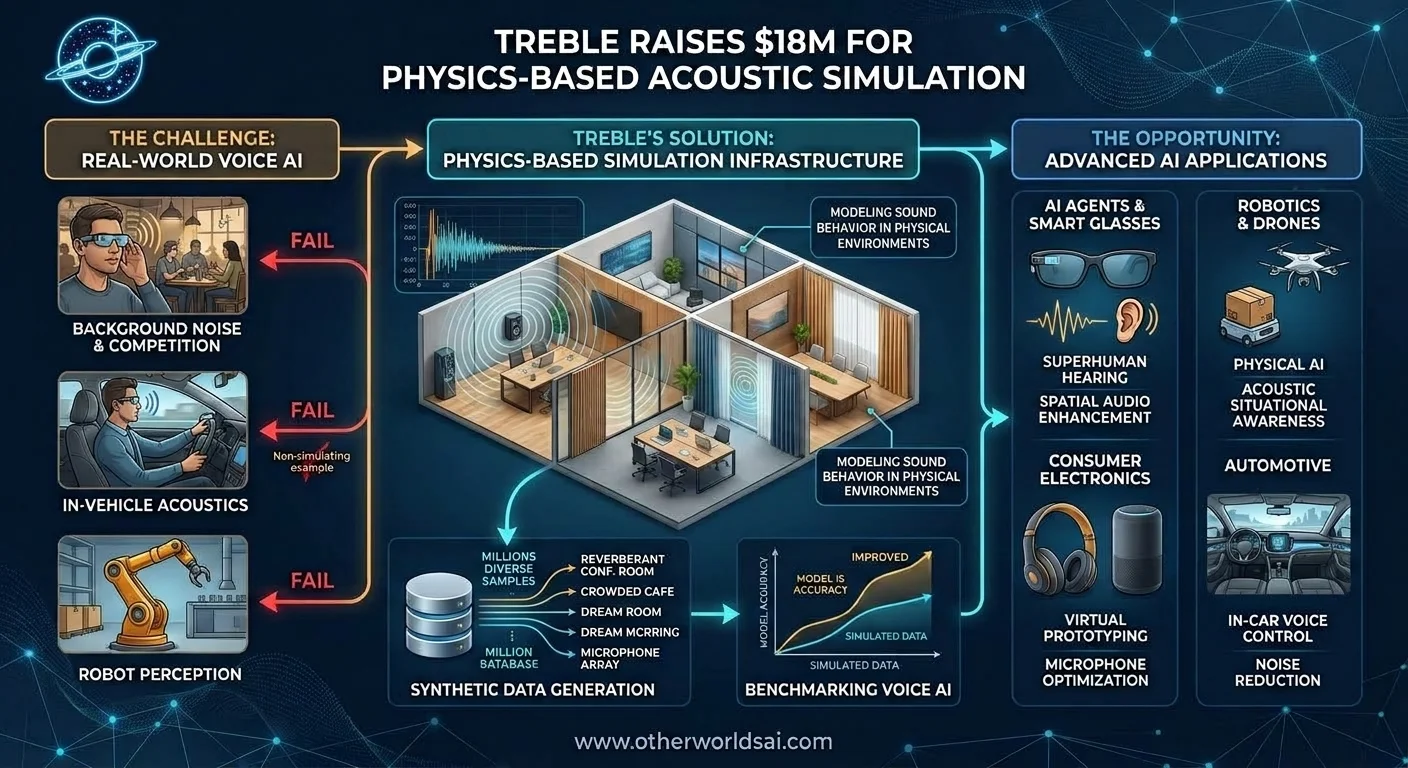
The company has developed an AI-powered acoustic simulation platform designed to help companies generate synthetic audio data, test voice AI models, simulate real-world environments, and improve the performance of hardware that depends on sound.
Treble recently raised $18 million in an extension of its Series A funding, led by Paladin Capital Group, with participation from existing investors including KOMPAS VC, Frumtak Ventures, the European Innovation Council (EIC), and Omega ehf.
The new funding brings Treble's total capital raised to more than $40 million.
For the rapidly expanding Voice AI and physical AI markets, Treble's approach highlights an important trend: the future of artificial intelligence may depend not only on better models, but also on better ways to generate, simulate, and test the data those models need.
Why Voice AI Needs More Than Better Models:
The Voice AI industry is expanding rapidly.
AI companies are developing increasingly capable systems for voice assistants, AI customer service agents, sales automation, meeting transcription, speech recognition, smart glasses, headphones, and conversational AI.
At the same time, hardware companies are building devices where voice is becoming the primary interface.
Smart glasses, AI-powered headphones, smart speakers, robots, vehicles, and drones all need to understand sound in environments that are rarely perfect.
A voice AI model might work extremely well in a quiet office. But what happens when the same system is used in a crowded restaurant, a busy street, an airport, a classroom, or inside a moving vehicle?
Background noise, echoes, distance, room size, speaker position, competing conversations, and other acoustic conditions can dramatically affect performance.
This creates a major requirement for the AI industry: realistic testing environments and high-quality audio data.
That is the problem Treble is attempting to solve.
Treble's Acoustic AI Simulation Platform:
Founded in 2020 by acoustic engineers Finnur Pind and Jesper Pedersen, Treble focuses on physics-based acoustic simulation.
Instead of relying exclusively on recorded audio or information scraped from the internet, the company uses simulation to model how sound behaves in different physical environments. This approach can potentially produce large amounts of synthetic audio data while allowing developers to control the acoustic conditions being tested.
For Voice AI companies, this can be useful for applications such as:
- Speech recognition testing
- Noise suppression
- Speech enhancement
- Voice model training
- Audio AI evaluation
- Acoustic environment simulation
- Synthetic data generation
- Microphone and speaker testing
- AI hardware development
The underlying idea is straightforward: if developers can accurately simulate how sound behaves, they can test AI systems against thousands of different scenarios before deploying them in the real world.
Synthetic Data Could Become a Major AI Advantage:
Synthetic data has become an increasingly important part of AI development.
Large AI models require enormous amounts of training and testing data. But collecting real-world data can be expensive, time-consuming, difficult to scale, and sometimes difficult to reproduce under controlled conditions.
Audio introduces another layer of complexity.
It is not enough to know what someone said. AI systems increasingly need to understand where the sound came from, how far away the speaker is, what background sounds are present, and how the surrounding environment affects the recording.
Physics-based simulation can provide developers with greater control over these variables. For example, a company developing an AI voice assistant could simulate a conversation in a restaurant and alter variables such as:
- Distance between the user and microphone
- Background conversations
- Room dimensions
- Reverberation
- **Speaker location
- Noise levels
- Microphone placement
- Number of simultaneous speakers
This could help AI developers evaluate how a model performs under realistic conditions without having to physically recreate every environment.
Benchmarking Voice AI in Realistic Conditions:
Treble is also working on AI model evaluation and benchmarking.
Earlier in 2026, the company partnered with Hugging Face on a benchmark for speech recognition models designed to evaluate performance across realistic acoustic conditions. This type of benchmarking could become increasingly important as more companies develop speech recognition and Voice AI systems.
Traditional AI benchmarks often focus on standardized datasets. However, real-world voice applications require models to perform reliably when conditions are unpredictable.
A speech recognition model that performs well in a controlled environment may produce very different results when exposed to:
noise + distance + reverberation + multiple speakers + imperfect microphones.
Testing these combinations gives developers a better understanding of how their models may behave outside the laboratory.
AI Hardware Is Becoming an Acoustic Engineering Problem:
Treble's opportunity extends beyond software.
The company also works with headphone, speaker, and consumer electronics manufacturers to help them understand how products will perform acoustically.
Virtual prototyping can allow hardware companies to evaluate potential designs before building and testing large numbers of physical prototypes.

Meta's Next Big Bet: This New App Lets You Build Games Simply by Typing a Prompt
For example, developers can investigate how microphone placement affects voice recognition or how a smart speaker responds to commands depending on its position in a room. This is particularly relevant as AI becomes embedded into consumer devices.
The next generation of AI hardware may include:
- AI smart glasses
- AI headphones
- Smart speakers
- Wearable AI devices
- Voice-controlled vehicles
- Robots
- Drones
- Industrial AI systems
In all of these applications, sound becomes part of the user interface.
Smart Glasses and the Future of Superhuman Hearing:
One of the more interesting areas for Voice AI is wearable technology.
AI-powered smart glasses and headphones could eventually do much more than answer questions. They could help users understand conversations in noisy environments, identify particular sounds, enhance selected voices, or reduce unwanted background noise.
Imagine sitting in a crowded restaurant and asking your wearable device to focus on the person sitting directly across from you.
Or imagine attending a seminar where an AI-enabled headset reduces surrounding noise while enhancing the speaker's voice.
Support our research
Independent analysis fueled by you.
These scenarios demonstrate how AI audio enhancement and spatial sound processing could change the way humans interact with their surroundings.
The concept is sometimes described as enabling forms of "superhuman hearing"—not because the device gives humans biological abilities, but because AI can selectively process and enhance information that would otherwise be difficult to hear.
Voice AI Meets Physical AI:
Perhaps the biggest opportunity for Treble is the convergence between Voice AI and Physical AI.
Physical AI refers to intelligent systems that interact with the physical world. Robotics, autonomous vehicles, drones, industrial machines, and smart devices are all part of this emerging category.
Most discussions about Physical AI focus on vision.
Cameras provide robots and autonomous systems with enormous amounts of visual information. But sound can provide another critical source of information.
A robot could potentially use audio to identify:
- Human speech
- Machinery sounds
- Alarms
- Impacts
- Mechanical problems
- Directional sounds
- Environmental changes
This creates a new opportunity for AI-powered audio perception.
As robotics becomes more advanced, systems may need to combine computer vision, speech recognition, spatial audio, sensor data, and AI reasoning to understand their environments.
Why This Matters for AI Agents:
The development of better acoustic AI also has implications for AI agents.
Modern AI agents are increasingly moving from text-based interfaces toward voice-based interactions.
A voice AI agent handling customer calls, for example, needs more than a powerful language model. It also needs reliable speech recognition, noise handling, speaker separation, low latency, and accurate understanding of conversational context.
This is especially important for businesses deploying AI agents for:
- Customer support
- Sales calls
- Appointment booking
- Lead qualification
- Order management
- Receptionist services
- Technical support
For companies such as Otherworlds AI developing AI agents and intelligent voice interfaces, improvements in speech technology and acoustic simulation could contribute to more reliable real-world deployments.
The quality of an AI agent is ultimately influenced by the entire technology stack—not just the underlying language model.
The Bigger AI Infrastructure Opportunity:
Treble's funding also points toward a broader shift in the AI industry. The AI ecosystem is increasingly developing specialized infrastructure for specific types of intelligence.
Large language models need enormous computing infrastructure.
Computer vision systems need high-quality visual data.
Robotics requires simulation environments and physical-world testing.
Voice AI needs realistic acoustic environments and audio data.
This means AI infrastructure is expanding beyond GPUs and cloud computing.
Simulation platforms, synthetic data generation, benchmarking systems, evaluati on tools, and specialized testing environments could become increasingly important as AI moves from the digital world into physical products.
Treble's investors appear to see this opportunity.

Move Over Nvidia: Anthropic and Samsung Team Up to Break the AI Chip Monopoly
Paladin Capital Group has described the company's technology as an infrastructure layer for systems that increasingly depend on understanding sound, spanning Voice AI, wearables, robotics, and Physical AI.
What Treble's $18 Million Funding Signals:
Treble's latest investment is more than another funding announcement in the crowded AI startup market.
It reflects a growing recognition that the next stage of AI development will require better tools for testing, simulation, evaluation, and synthetic data generation. AI models are becoming increasingly capable. But deploying them in the real world introduces new challenges.
- A voice AI model must understand speech in noisy environments.
- A smart glass must distinguish between relevant and irrelevant sounds.
- A robot must interpret audio while moving through a complex environment.
- A vehicle must process sounds while operating under constantly changing conditions.
These problems cannot always be solved simply by making a larger model. They require better data, better simulations, better benchmarks, and better testing infrastructure.
The Future of AI Is Becoming Multimodal:
The broader direction of the industry is clear: AI is becoming increasingly multimodal. Text, images, video, audio, sensors, and physical-world information are converging into intelligent systems capable of interacting with humans and environments in increasingly natural ways.
Voice will play a major role in that transition.
From AI voice agents and conversational AI to smart glasses, robotics, autonomous systems, and Physical AI, machines will increasingly need to understand the acoustic world around them.
Treble is positioning itself at an important point in this ecosystem by providing the simulation and testing infrastructure needed to develop that capability.
For the AI industry, the lesson is significant: building smarter AI is only part of the challenge. Building the infrastructure that allows AI to learn, simulate, test, and operate reliably in the real world may be just as important.
And as voice becomes a central interface between humans, AI agents, and intelligent machines, acoustic AI simulation could become an increasingly important layer of the global AI infrastructure stack.