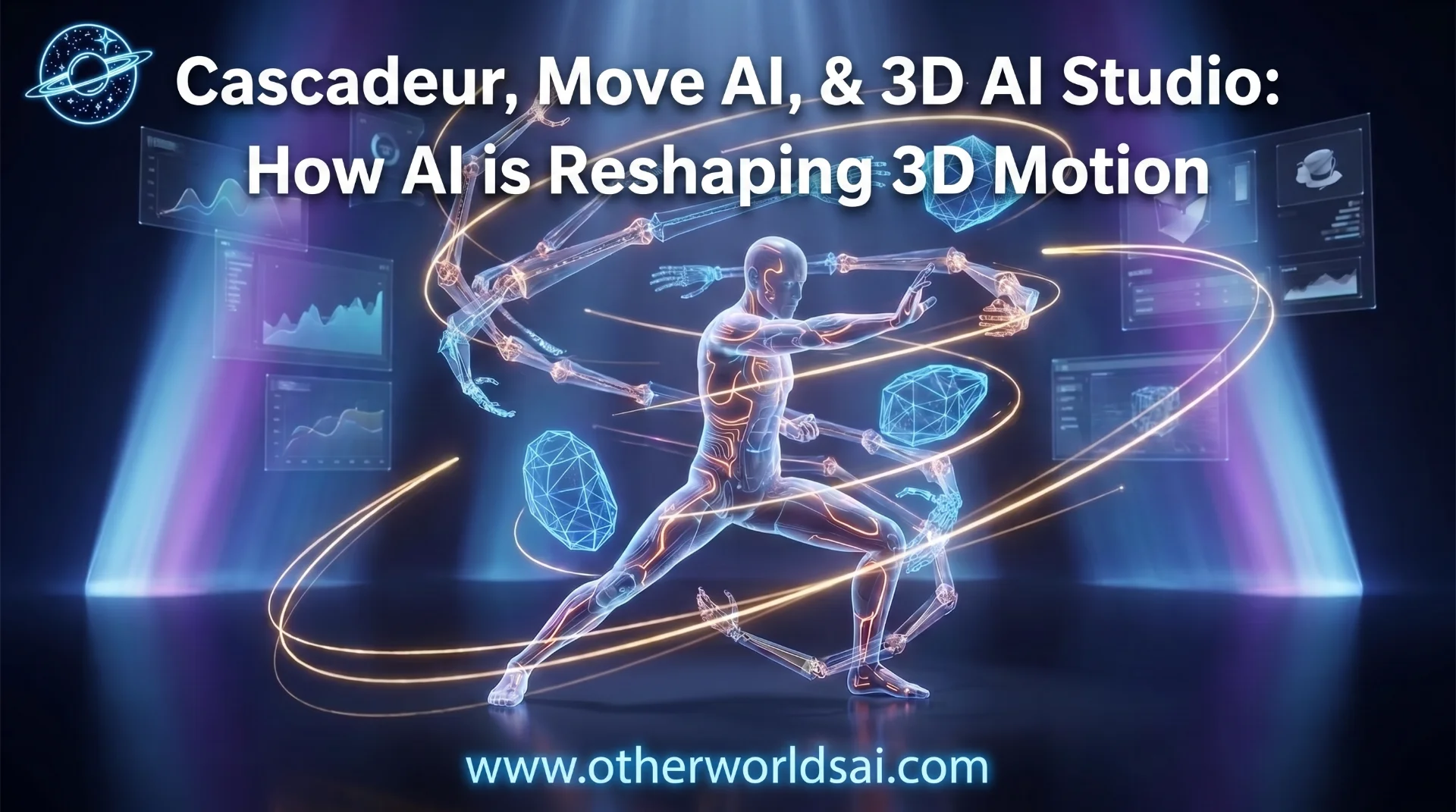

Cascadeur, Move AI, & 3D AI Studio: How AI is Reshaping 3D Motion.
3 New AI Tools Reshaping 3D Animation in 2026.
One by one: what they are, how they work, and what kind of animation each one is built for.
3 Tools: Covered One by One
Weeks → Hours: Typical Pipeline Speedup
Rigging: The Old Bottleneck, Solved
3D animation has always been a craft of patience — rigging skeletons, cleaning up motion capture, keyframing every subtle shift of weight. In 2026, a new wave of AI-powered tools is compressing weeks of that work into hours, without cutting studios out of the creative decisions that actually matter.
At Otherworlds Studios, we’ve been tracking which of these tools are genuinely production-ready versus which are still novelties. Here are three that stand out, one by one — what they are, how they work, and what kind of animation they’re best suited for.
1: Cascadeur — AI-Assisted Keyframe Animation:
What it is: Cascadeur is a standalone animation tool built specifically to solve one of the hardest problems in character animation: physically believable motion. Instead of replacing keyframing, it makes it dramatically faster.
How it works: An animator sets a handful of key poses — say, the start and end of a jump or a punch. Cascadeur’s physics-aware AI then analyzes the character’s rig and automatically generates the in-between motion, adjusting balance, momentum, and secondary movement so the result looks physically grounded rather than floaty.
It can also take reference footage and translate the movement onto a rig, correcting poses automatically so animators only need to nudge one joint — an arm or a leg — and the rest of the body follows naturally, rather than manually adjusting inverse kinematics for every joint in the chain.
What it’s best for: Action-heavy character animation — fight choreography, stunts, falls, sports movement — where physical plausibility is the whole point. It’s less suited to stylized, exaggerated cartoon motion, since its core strength is grounding movement in real physics rather than pushing it into caricature. Think game cinematics, action sequences, and any shot where a character needs to look like they actually have weight.
2: Move AI and DeepMotion — Markerless Motion Capture:
What it is: These two tools represent a category that used to require a dedicated mocap stage, a suit covered in reflective markers, and a team to clean up the data afterward. Now, motion capture can be pulled from ordinary video.
How it works: An actor performs the motion in front of one or more standard cameras — in some cases, even a single smartphone. The AI analyzes the footage frame by frame, estimating the position of the human skeleton in 3D space without any physical markers or specialized suit.
That skeletal data is then mapped onto a 3D character rig, translating the performer’s real movement into the character’s animation. The AI’s own cleanup pass tidies noisy joint data and fills gaps where the camera briefly lost track of a limb, though animators still typically polish the final performance for expressiveness.
What it’s best for: Character performance that needs a human core — dialogue scenes, walk cycles, nuanced acting beats — at a fraction of the cost of a traditional mocap studio. It’s a strong fit for indie and mid-size studios that want performance-driven animation without the capital investment of a mocap volume, and it scales well for capturing large amounts of raw movement data quickly to populate game animation libraries.
3: 3D AI Studio — Text-to-Character, Rigged and Ready:
What it is: Where Cascadeur and mocap tools assume you already have a rigged character, 3D AI Studio starts even earlier in the pipeline — generating the character itself from a text prompt or reference image, and delivering it already rigged and animation-ready.
How it works: A creator types a description (or uploads a concept image), and the AI generates a 3D model of the character. From there, the tool auto-rigs the mesh with a clean skeleton — historically one of the biggest bottlenecks in any pipeline.
The rig is built to be compatible with existing animation libraries, so a freshly generated character can immediately be dropped into a large catalog of pre-made animations rather than requiring custom motion from scratch. The platform also supports pose transfer, letting a creator quickly generate turnarounds and reference poses for a new character.
What it’s best for: Rapid prototyping and populating a scene with secondary or background characters — NPCs, crowd fillers, concept previsualization — where speed matters more than the bespoke detail a hero character would need. AI-generated topology, while improving, still isn’t consistently reliable for characters that need complex facial deformation or close-up performance; most studios currently treat these models as strong starting points or background assets rather than final hero-character meshes.
“The judgment about when a shot is actually done is still very much a human one.”
4: Where This Leaves Studios Like Ours:
None of these tools eliminate the animator — they eliminate the tedious middle steps between a creative decision and seeing it move. Cascadeur speeds up the physics of motion, markerless mocap speeds up capturing a human performance, and generative platforms like 3D AI Studio speed up getting a character into the pipeline in the first place.
The throughline across all three is the same: less time spent on technical setup, more time spent on the actual storytelling and performance choices that separate good animation from great animation.
The honest caveat, echoed across the industry right now, is that AI output in 3D still benefits from a skilled hand at the finish line — cleaning up a mocap pass, refining a generated topology, or pushing a physically “correct” Cascadeur motion into something with real character. The tools are fast. The judgment about when a shot is actually done is still very much a human one.
Bring the Speed. Keep the Craft.
Cascadeur, markerless mocap, and generative rigging are changing how fast a shot can move from idea to animation — but knowing which tool fits which shot, and where a human pass still needs to finish the work, is where a studio earns its keep.
Otherworlds Studios builds character animation and 3D pipelines that use these tools where they help and skip them where they don’t.
If you’re scoping a project and want a pipeline built around the right mix of speed and craft, let’s talk.