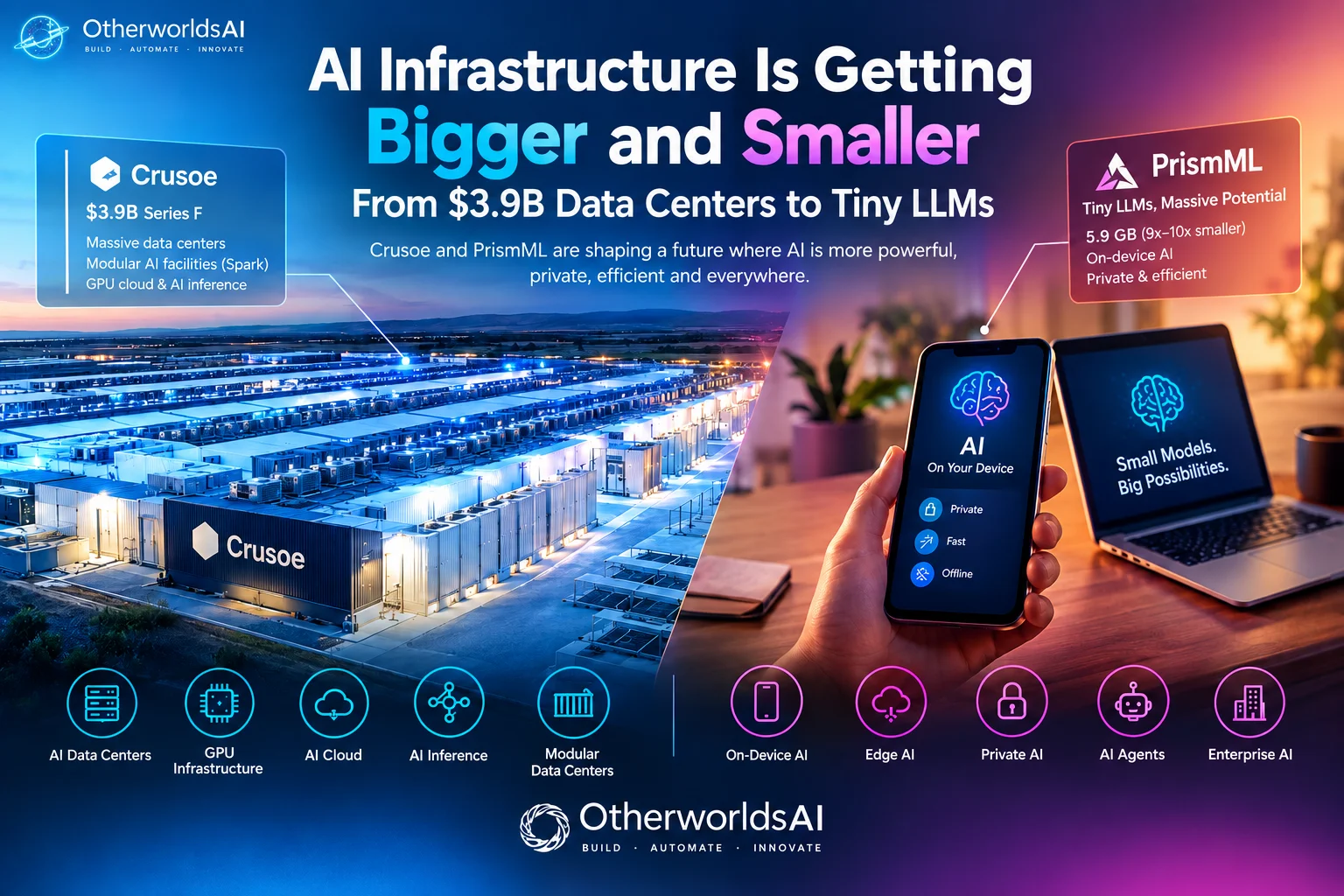

### Artificial intelligence is expanding in two seemingly opposite directions.
On one side, AI infrastructure companies are raising billions of dollars to build enormous data centers packed with GPUs.
On the other, researchers are developing increasingly compact AI models that can run on PCs and potentially smartphones.
These two trends may look contradictory, but they are actually pointing toward the same destination: more accessible, powerful, private, and efficient AI computing.
The latest developments from Crusoe and PrismML offer a clear view of where the AI infrastructure market could be heading. Crusoe has raised $3.9 billion to expand massive AI data center infrastructure and modular computing facilities, while PrismML is working to compress large language models (LLMs) so that sophisticated AI can operate on much smaller devices.
For businesses building the next generation of AI agents, private AI systems, AI applications, and enterprise automation, this combination could be especially important.
Crusoe Raises $3.9 Billion for AI Data Center Infrastructure:
Crusoe, an AI infrastructure and data center developer, has raised $3.9 billion in Series F funding, bringing the company's valuation to approximately $30.9 billion.
**The funding round was co-led by Atreides Management, Mubadala Capital, **and Valor Equity Partners. Other participating investors included Founders Fund, GIC, Nvidia, Qatar Investment Authority, Radical Ventures, and TPG.
The investment reflects the enormous amount of capital now flowing into AI data centers, GPU infrastructure, cloud computing, and AI inference infrastructure.
Crusoe plans to use the new capital to finance existing data center projects while expanding its modular AI infrastructure strategy.
One major project is a large data center site in Abilene, Texas, which is being used by OpenAI. At the same time, Crusoe is developing smaller modular AI facilities known as Spark. These modular data centers are designed to be manufactured at Crusoe's own facilities and transported by truck to locations where they can be connected to significant power sources. That approach could potentially reduce the time and construction workforce required to deploy new computing capacity.
Why Modular Data Centers Matter for AI:
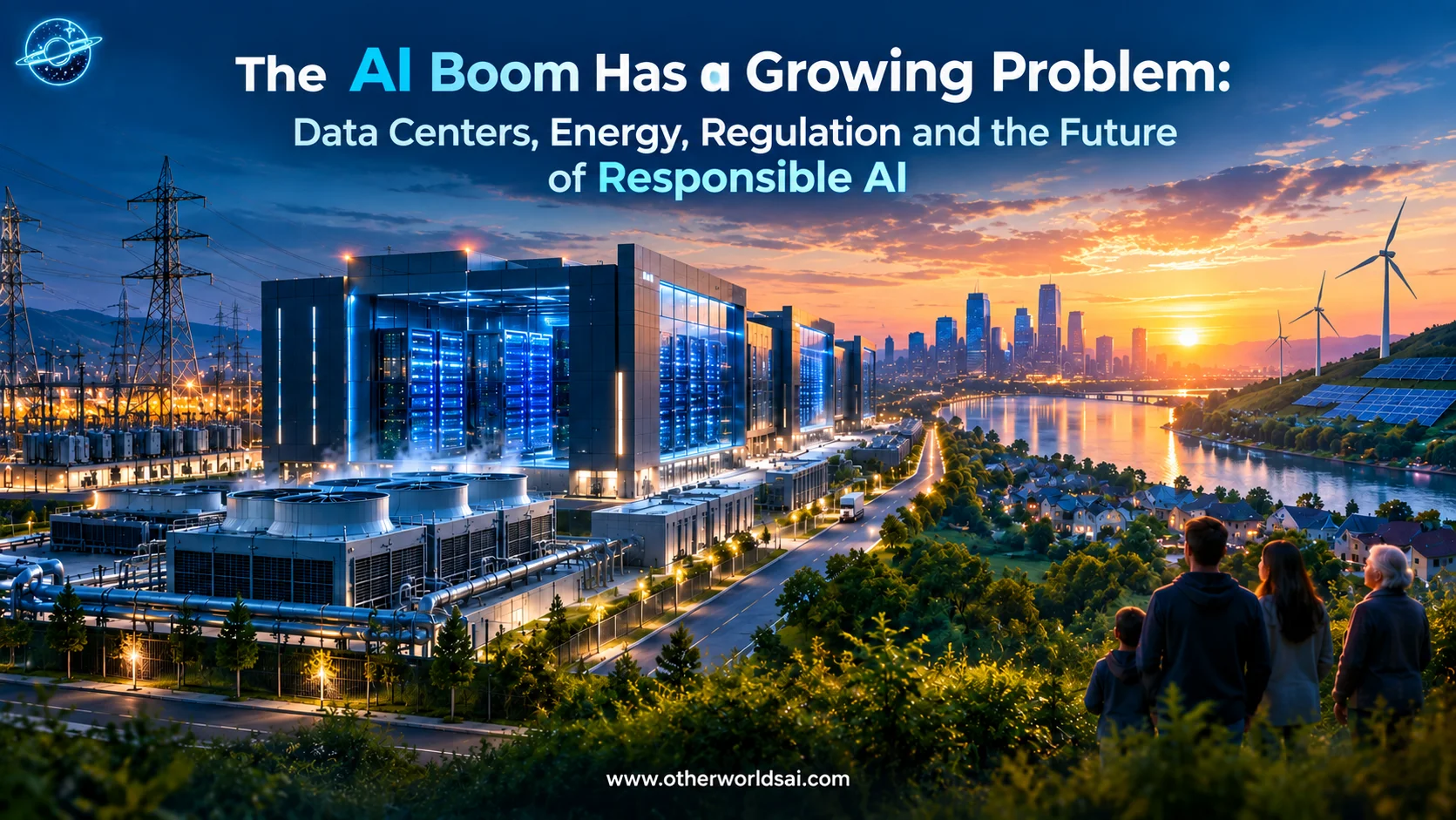
The AI industry has a growing infrastructure problem.
Training and operating advanced AI models requires enormous amounts of computing power. GPUs consume significant electricity, while data centers require land, cooling systems, networking infrastructure, power connections, and specialized construction.
Traditional hyperscale data centers can take years to plan and build.
Modular data centers offer a different approach.
Instead of constructing every facility entirely on-site, companies can manufacture standardized computing infrastructure and deploy it where power and connectivity are available.
For the rapidly expanding AI cloud infrastructure market, this could provide a way to bring GPU capacity online faster.
It could also become relevant as communities and local governments increasingly debate the environmental and infrastructure impact of very large data center projects.
Crusoe's Three-Part AI Infrastructure Business:
Crusoe has built its business around several layers of the AI computing stack.
The company leases data center capacity to customers that provide their own GPUs. It also rents GPUs and sells computing resources for AI inference, the process of running trained AI models to generate responses and perform tasks.
This creates exposure to several of the fastest-growing areas of the AI infrastructure economy:
- AI data centers
- GPU cloud computing
- AI inference
- AI infrastructure-as-a-service
- High-performance computing
- Generative AI infrastructure
- Enterprise AI workloads
- Modular data centers
The company has also reportedly signed a five-year, approximately $13 billion cloud contract with Jane Street, underlining the growing demand for GPU infrastructure from companies outside the traditional technology sector.
Crusoe has reportedly discussed a potential future IPO with investment banks, although an IPO would depend on future company and market decisions.
From Crypto Mining to AI Infrastructure:
Crusoe's transformation is also a reflection of how quickly the computing economy has changed.
Founded in 2018, the company originally focused on cryptocurrency mining powered by otherwise wasted natural-gas energy.
As demand for artificial intelligence computing exploded, Crusoe shifted its focus toward AI infrastructure and GPU computing.
Today,its reported customers include major technology companies such as Meta, Microsoft, and Oracle.
The transition illustrates a broader trend: energy, GPUs, data centers, networking, and AI software are becoming increasingly interconnected.
But while companies like Crusoe are building larger infrastructure, another group of researchers is asking a very different question:
What if AI models didn't need massive infrastructure in the first place?
PrismML Is Making Large Language Models Smaller:
PrismML is approaching the AI infrastructure challenge from the opposite direction. Rather than building bigger computing facilities, the AI startup is developing technology designed to make powerful large language models significantly smaller.
The company has raised approximately $22.25 million in seed funding and was founded by researchers associated with Caltech.
Its latest model, Bonsai 2 27B, compresses Alibaba's Qwen3.8 27B model into approximately 5.9 GB.
According to PrismML, that represents roughly a 9x to 10x reduction in memory requirements compared with the original model.
The significance is straightforward: a model that requires dramatically less memory can potentially operate on hardware far smaller than the infrastructure normally associated with large AI models.
That opens the door to more on-device AI, edge AI, private AI, local AI, and offline AI applications.
How AI Model Compression Works:
The key technology behind PrismML's approach involves compressing model weights. Neural networks contain billions of learned parameters, commonly called weights. These weights store information learned during training and are fundamental to how an AI model generates outputs.
Traditional models may store weights using relatively high-precision numerical representations.
PrismML's approach uses ternary weights, representing values as:
-
+1
-
0
-
−1
Reducing the numerical complexity of these weights can dramatically decrease the amount of memory required to store a model.

Meta's Next Big Bet: This New App Lets You Build Games Simply by Typing a Prompt
The challenge, of course, is maintaining the model's intelligence and usefulness after compression.
PrismML says its latest Bonsai model reaches approximately 98% of Qwen's aggregate benchmark performance, compared with about 95% for its earlier Bonsai release.
Whether benchmark performance will consistently translate into equivalent real-world performance remains an important question. Benchmarks measure specific capabilities and do not perfectly represent every practical AI workload.
Nevertheless, the progress demonstrates how quickly AI model compression technology is developing.
The Rise of Small, Private AI:
The most interesting connection between Crusoe and PrismML may be privacy.
Large AI models traditionally depend heavily on centralized cloud infrastructure. A user's request is sent to a remote server, processed using GPUs, and returned to the user.
That model provides enormous computing power, but it also creates considerations around:
- Data privacy
- Cloud dependency
- Latency
- Internet connectivity
- AI infrastructure costs
- Data sovereignty
- Enterprise compliance
- Smaller models could change that equation.
If increasingly capable AI models can run directly on laptops, smartphones, industrial computers, vehicles, or other edge devices, some AI workloads may no longer need to send sensitive information to a centralized cloud.
That is particularly important for enterprise AI and private AI development.
Big AI Infrastructure and Small AI Models Can Coexist:
The future is unlikely to be a simple choice between cloud AI and local AI. Both approaches have advantages.
Support our research
Independent analysis fueled by you.
Massive AI data centers will remain essential for training frontier models, serving enormous workloads, and supporting applications that require extremely high computing capacity.
At the same time, compressed AI models can make it practical to move more intelligence toward the edge.
This creates a potentially powerful architecture:
Large centralized AI infrastructure for training and demanding workloads + smaller optimized models for local inference and edge applications.
Businesses could therefore use cloud infrastructure when maximum capability is required while using local models for tasks involving sensitive data, low latency, intermittent connectivity, or cost constraints.
What This Means for AI Agents:
AI agents could be one of the biggest beneficiaries of this infrastructure shift.
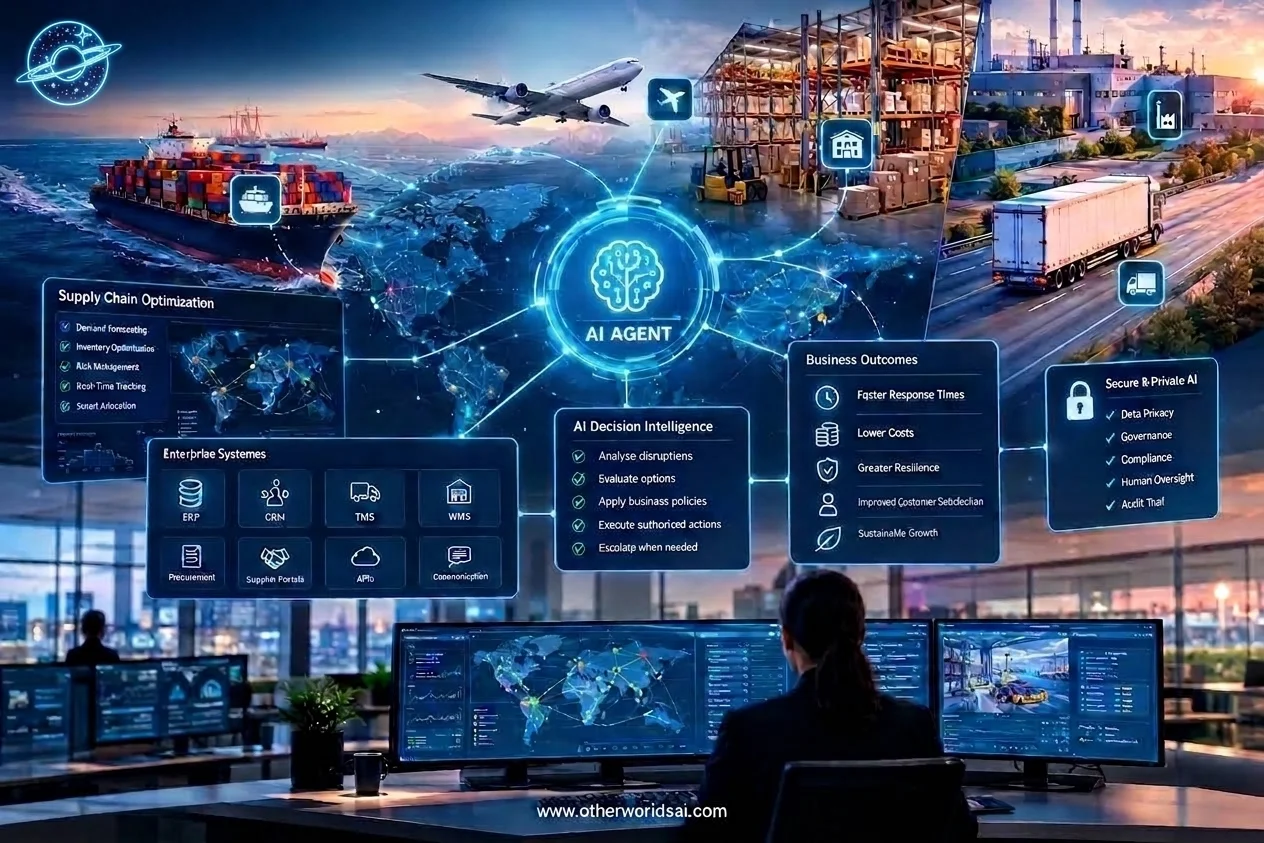
An AI agent isn't simply a chatbot. Modern AI agents can interpret requests, access business information, communicate with customers, schedule appointments, process transactions, interact with software, and execute multi-step workflows.
These systems require both intelligence and infrastructure.
A cloud-based AI agent can take advantage of powerful centralized models and large GPU clusters.
But a smaller local model could potentially handle certain functions directly on a user's device or within an enterprise environment.
For example, an enterprise AI architecture could eventually divide workloads between:
Cloud AI: complex reasoning, large-scale model processing, intensive workloads.
Private AI: confidential company information, internal workflows, sensitive documents, and proprietary data.
Edge AI: low-latency tasks running directly on devices.
AI agents: orchestration across these different computing environments.
This distributed approach could become increasingly important as companies deploy AI throughout their operations.
AI Infrastructure Is Becoming a Strategic Business Asset:
The combination of Crusoe and PrismML highlights a larger transformation in the AI economy. AI is no longer only about developing better models.
The competitive landscape increasingly includes:
- GPU availability
- Data center capacity
- Electricity
- Cooling
- Networking
- AI inference costs
- Model compression
- Edge computing
- AI security
- Data privacy
- Enterprise AI deployment
- AI agent infrastructure
In other words, the AI stack is becoming much broader.
Crusoe's massive fundraising demonstrates the value investors are placing on the physical infrastructure required to operate AI at scale.
PrismML's technology demonstrates another route: make the intelligence itself more efficient so that less infrastructure is required.
The Efficiency Race Has Begun:
The next phase of artificial intelligence may not simply be about building bigger models. It may be about getting more intelligence from every watt, every GPU, every gigabyte of memory, and every device.
That means AI optimization will increasingly matter alongside raw model size.
Techniques such as model compression, quantization, distillation, efficient inference, specialized AI hardware, and edge deployment could reduce the resources needed to operate sophisticated AI systems.
At the infrastructure level, modular data centers could help deploy computing capacity faster.
At the model level, compression could make advanced AI substantially more portable.
Together, these developments point toward an AI ecosystem that is simultaneously becoming larger at the infrastructure layer and smaller at the device layer.
What It Means for Businesses:
For companies adopting AI, the key question is no longer simply which AI model to use.

Move Over Nvidia: Anthropic and Samsung Team Up to Break the AI Chip Monopoly
Businesses should increasingly consider where their AI workloads should run.
- A company handling sensitive customer records may prioritize private AI infrastructure.
- A manufacturer may benefit from edge AI that can operate with minimal latency.
- A customer-service operation may use AI agents connected to cloud-based models.
- A financial institution may require a combination of secure infrastructure, local processing, and centralized computing.
The optimal architecture will depend on the workload, security requirements, latency requirements, regulatory environment, and cost structure.
This is where customized AI agent development and private AI infrastructure become increasingly important.
The OtherworldsAI Perspective:
At OtherworldsAI, we see this convergence as an important part of the next generation of enterprise artificial intelligence.
The future of AI will not be defined by a single model, a single cloud provider, or a single type of hardware.
Instead, businesses will increasingly build AI systems around their specific requirements.
That can include private AI agents, custom AI models, AI-powered web and mobile applications, enterprise automation, on-premises AI deployment, and secure AI infrastructure.
The rise of enormous AI data centers shows that centralized computing will remain critical.
The development of tiny, compressed LLMs shows that intelligence is also moving closer to the user.
The real opportunity lies in connecting these worlds.
Conclusion: AI Is Getting Bigger—and Smaller:
Crusoe and PrismML represent two sides of the same AI transformation.
Crusoe is investing billions in the physical infrastructure needed to support the explosive growth of AI computing.