
To Make Humanoid Robots Smarter, Engineers Are Now Reading Human Brain Waves.
Are Brain Waves the Next Unlock for Physical AI?
Inside a San Leandro warehouse, a startup called Encord is betting that the biggest constraint on humanoid robots isn't the model — it's the sheer scarcity of real-world data, right down to what's happening inside a trainer's head.
$110M: Total funding raised by Encord across three rounds
5PB: Multimodal data Encord now manages, up from 1PB a year ago
400M+ AI robots projected to come online industry-wide by 2030
1: Inside the Warehouse Where Robots Learn to Feel:
The frontier of physical AI right now looks like a game of Jenga in a California warehouse.
At Encord's San Leandro facility, a robotic trainer named Andrew Ceja carefully pulls wooden blocks from a tottering tower while wearing a headset that tracks what he sees — standard practice for collecting robot training data. What isn't standard is that his headset also measures his brain waves as he works.
Encord, a data-tooling company that trains AI models for the physical world, is one of a small but growing number of startups betting that the next real constraint on humanoid and warehouse robotics isn't model architecture. It's the sheer scarcity of real-world physical training data — and Encord has decided to manufacture the data that doesn't yet exist, rather than just manage what customers already have.
2: The Data Bottleneck Nobody Saw Coming:
**Robotics has run into the same wall **that stalled every generation of AI before it: there isn't enough real-world data to learn from.
Self-driving car companies collect physical-world data themselves, but that approach is notoriously hard to scale. Training from ordinary video helps, but it lacks the fidelity of real-world sensor data. Vineeth Velmurugan, Encord's head of robot learning and a veteran of OpenAI's robot lab and warehouse automation firm Berkshire Grey, estimates the industry needs a data set roughly five times the size of YouTube's entire video corpus to break through.
"The data simply does not exist," he said — which is exactly why data generation has become a business in its own right, not just a research problem.
3: Reading the Brain to Teach the Machine:
The brain-wave headset on Ceja's head was built by Zander Labs, a German neurotechnology startup betting that mental-state data can make training sets meaningfully more useful. Zander Labs' technology — built around its portable Zypher EEG suite and passive brain-computer interface research — is designed to detect mental states like error, intent, and surprise directly from brain activity, then translate that signal into structured data.
Lucas Gehrke, the Zander neuroscientist supervising Encord's trial, says the amount of brain activity a person expends during a task offers a real-time signal for model builders trying to figure out exactly when a task demands their highest-effort model rather than a cheaper, faster one. The work with Encord is still an early trial: build an initial brain-wave-tagged data set, run it through customer robotics models, and see whether performance actually improves before scaling it up.
4: Egocentric Video, Leader-Follower Rigs, and the Labor Behind "Automation"
Manufacturing physical-world data is, ironically, still an intensely human process.
● Egocentric video: pilots wear cameras collecting first-person footage across factories worldwide, often layered with additional camera angles and sensor data.
● Leader-follower rigs: paired robotic arms, one human-controlled and one that mimics it, used to generate data on tasks like pouring coffee or stacking poker chips — Velmurugan says "every humanoid company has asked us for these pieces."

Meta's Next Big Bet: This New App Lets You Build Games Simply by Typing a Prompt
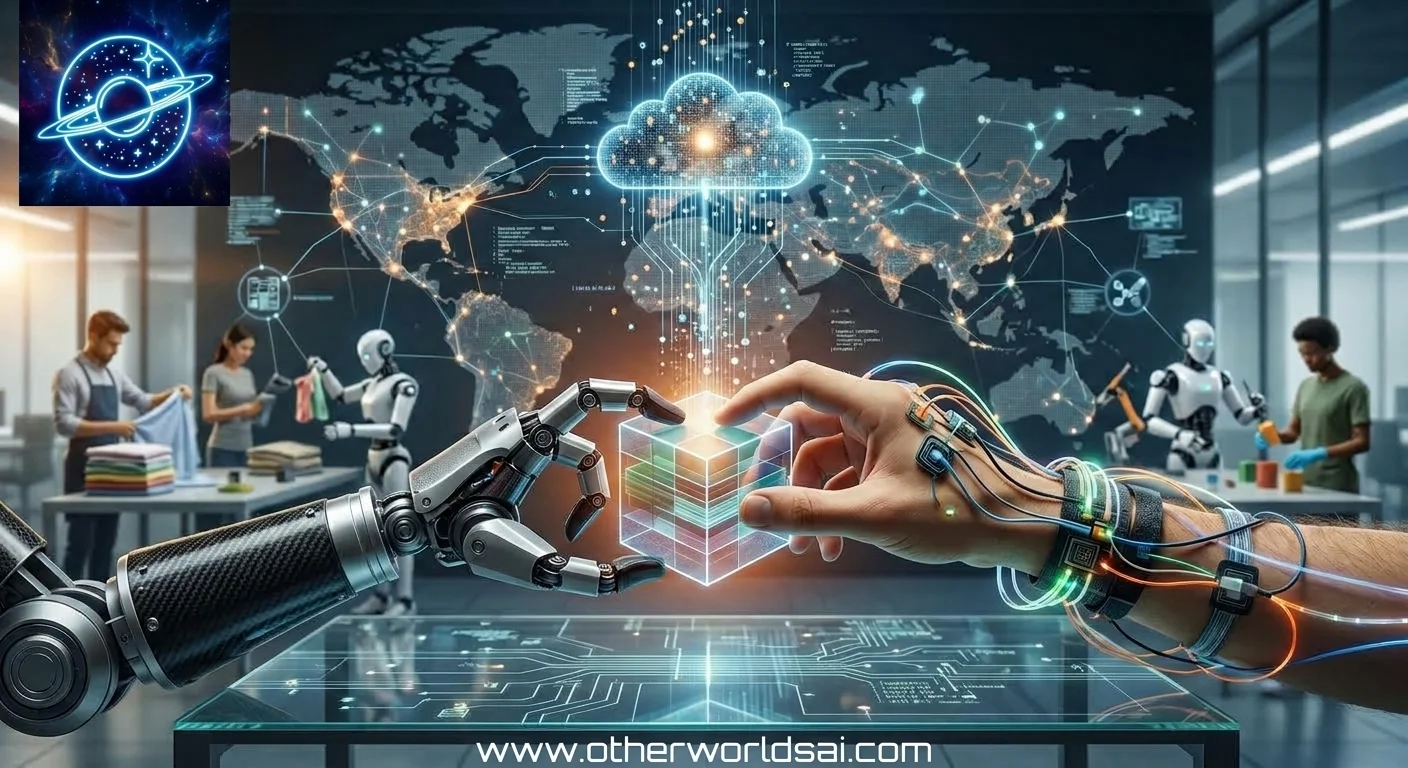
● Forearm sensors: electrical muscle-signal sensors aim to build a 3D picture of hand position that ordinary video of hands manipulating objects typically misses.
Support our research
Independent analysis fueled by you.
● Dense annotation: video tagged with plain-language physical descriptions — "right hand tightens bolt" — which Velmurugan estimates is worth 100 times as much as unlabeled "junky ego data" for training specific tasks.
The gap between human dexterity and robotic hardware is still stark. Pincers remain far less dexterous than human fingers and lack the degrees of freedom people take for granted — a limitation visible in tasks like plugging and unplugging ethernet cables from the back of a server, exactly the kind of precision work data center operators most want automated.
You can have the most sophisticated model in the world, but it will still fail if the data feeding it is incomplete, inconsistent and misaligned with real-world conditions. That's the problem we solve.
—Ulrik Stig Hansen, co-founder and co-CEO, Encord
5: Why This Data Costs So Much More Than Text:
The comparison to large language models breaks down fast once the bill arrives. LLM developers built their models by scraping text off the open internet at close to zero marginal cost. Physical training data can't be scraped — it has to be manufactured, one Jenga tower and one coffee pour at a time, and Velmurugan puts the cost of Encord's densely annotated data at roughly 20 times more than unlabeled footage.
That math still works out in the company's favor given the performance gains, but it fundamentally changes the economics of building physical AI compared to the chatbot era it's often compared to.
6: The Funding Behind the Physical AI Data Race:
Investors are treating the data layer, not just the models, as the place to place a bet. Encord closed a $60 million Series C earlier this year, led by Wellington Management, pushing its total funding to roughly $110 million and its valuation to $550 million.
The company says the volume of data on its platform has grown from about one petabyte to more than five petabytes in twelve months, revenue from physical AI customers grew tenfold over the same period, and it now works with more than 300 physical AI teams globally, including Woven by Toyota, Zipline, and Skydio.
Industry analysts cited alongside the round project more than 400 million AI robots coming online within four years, with the physical AI market surpassing $30 billion over the same window — the scale of demand Encord and rivals like Zander Labs are racing to feed with data that, unlike text, has to be built by hand.
The Real Lesson Isn't About Robots — It's About Data Readiness.
Encord's co-CEO put it plainly: the most sophisticated model in the world still fails if the data feeding it is incomplete, inconsistent, or misaligned with real-world conditions. Physical AI companies are learning that lesson the hard way, at a cost of 20 times more per data set. Most businesses adopting AI face a smaller version of the exact same problem — a powerful model connected to messy, disconnected, or incomplete business data will underperform no matter how advanced it is.
Agent+, Otherworlds AI's Business AI Platform, is built around that same principle — aligning AI agents with your actual operational data and workflows from day one, for $297/month, powered by Google Opal automated workflows.
When your data needs are more specialized, our custom enterprise AI builds pick up where Agent+ leaves off.
See what Agent+ can do for your business at otherworldsai.com