
Why the Next Big AI Breakthrough Isn't Happening in a Lab—It's Happening on Solar Farms:
Gritt Exits Stealth With $34M to Put AI-Powered Robots on Solar Job Sites:
How two Carnegie Mellon roboticists are using generalizable AI—not custom hardware—to solve construction's labor crunch, starting with solar panels.
$34M: Total Funding Raised
4-5x: Faster Panel Installation
2.8 GW: Solar Contracted in 18 Months
Why the Next Big AI Breakthrough Isn't Happening in a Lab—It's Happening on Solar Farms:
1: The Problem: Not Enough Hands for a Booming Build-Out:
Solar and battery deployment is accelerating worldwide, but the workforce to install it isn't keeping pace.
Energy independence and climate goals are driving one of the largest infrastructure build-outs on the planet. The bottleneck isn't demand or capital anymore—it's labor. There simply aren't enough skilled workers to install panels fast enough to meet the pace countries and companies are setting for themselves.
Industrial robots have historically struggled outside of tightly controlled factory settings. Construction sites are unstructured, unpredictable, and constantly changing—exactly the kind of environment that has kept robotics out of the field. Gritt, founded by CEO Puneet Puri and CTO Vishal Dugar, believes the newest generation of AI models has finally changed that equation.
2: The Approach: Off-the-Shelf Hardware, AI-Native Intelligence:
Instead of engineering robots from scratch, Gritt builds an intelligence layer on top of equipment that already exists.
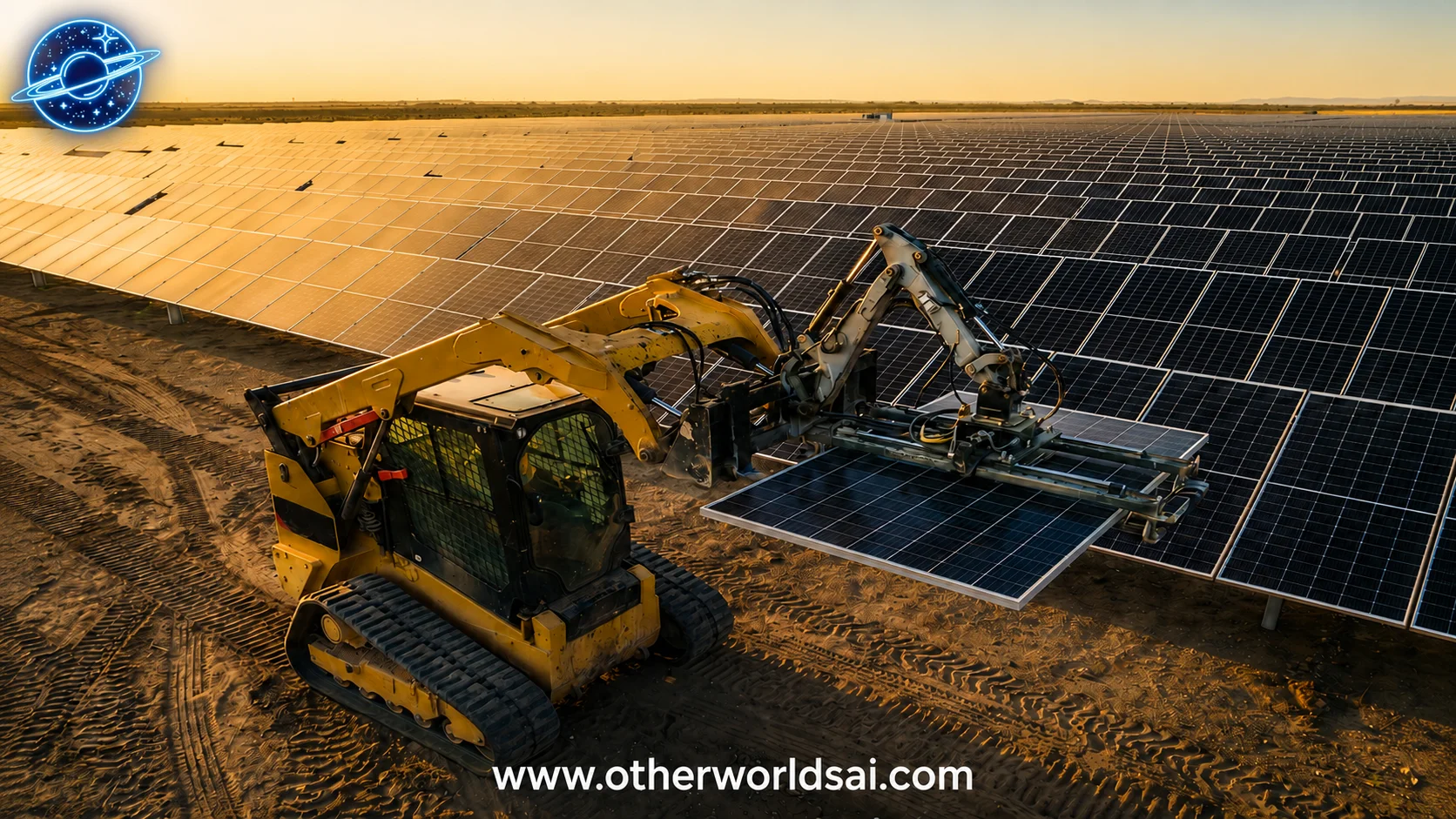
Gritt doesn't manufacture its own robots. It rents skidders and robotic arms from established manufacturers like Kawasaki and layers its own AI models on top to control them. The first task: unloading heavy glass solar panels, carrying them to their mounting frames, and positioning them with sub-millimeter accuracy so human crews can fasten them in place.
The results are striking. An eight-person crew installing panels manually can typically place around 800 panels a day. With Gritt's systems assisting, that same crew can install 3,000 to 4,000 panels in the same window—a four-to-five-fold increase in throughput.
“There are people who used to build rockets that went into space and had infinite budget for the smallest little part, and then there are people who know what it means to get into dirty, dull, and dangerous jobs and scale them like mad. These guys are in the second camp.”
— Andrew Beebe, Partner, Obvious Ventures
3: The Traction: Real Contracts, Real Deployments:
Gritt already has two systems live in the field and a pipeline that stretches well beyond installation.
The company is currently contracted to help install 2.8 gigawatts of solar capacity over the next 18 months, working with three of the top ten power construction companies in the US. Gritt aims to have 48 systems operating within six months. Customers cite two consistent benefits: easier staffing at remote sites where labor is scarce, and fewer injuries from repeatedly lifting 100-pound panels overhead.

Meta's Next Big Bet: This New App Lets You Build Games Simply by Typing a Prompt
Gritt is not alone in this space—competitors like Luminous Robotics, Cosmic, and China's Trinabot are building their own proprietary hardware. Gritt's bet is that skipping hardware R&D and focusing purely on the AI intelligence layer will let it move faster and scale leaner.
4: The Bigger Vision: From One Task to a Physical AI Layer:
Panel installation is just the entry point. Gritt wants to become a general-purpose intelligence layer for the entire job site.
The founders describe what made this possible in one word: generalizability. Puri notes that training the system to stack cinder blocks once took weeks—training it on a new task like tying rebar took just a day, using the same underlying software pipeline. That reusability is the whole thesis.
Next up: teaching the system to fasten panels, drill posts, and build the racks panels sit on, followed by other labor-intensive construction tasks like rebar tying. Longer term, Gritt wants its sensors and models to do more than manipulate objects—flagging an open trench before a storm hits, or catching missing inventory before it becomes a delay. As Puri puts it, Gritt aims to become "this layer of physical AI" that both performs dexterous labor and helps site managers make better decisions.
Physical Labor Shortages Aren't Just a Construction Problem. ** Gritt's bet is that generalizable AI,** not single-purpose hardware, is what finally makes automation work in messy, real-world environments. That's the same shift reshaping knowledge work: instead of building a bespoke tool for every task, businesses now need one intelligence layer that can adapt across workflows, vendors, and edge cases without a custom engineering team behind it.
That's exactly what Otherworlds AI's Agent+ platform delivers for growing businesses — a generalizable, automated AI layer (built on Google Opal workflows) that plugs into your operations for $297/month, with custom enterprise AI builds available for teams that need more. No robotics degree required.
Explore Agent+ at otherworldsai.com and see what an adaptable AI layer can do for your business.
Support our research
Independent analysis fueled by you.