
Devin's Creator Says AI Coding Agents Shouldn't Replace Humans — So Why Is His Agent Writing 89% of the Code?
Is Devin a "Coding Buddy" or a Replacement? Scott Wu Explains.
Introduction: A $26 Billion Bet on AI That Still Needs Humans:
In a year when tech CEOs are racing to announce AI-driven layoffs, Cognition's Scott Wu is making a different kind of headline. His two-year-old AI coding agent startup just raised $1 billion at a staggering $26 billion valuation — and its founder is out here saying that replacing human programmers was never the point.
Cognition is the maker of Devin, widely regarded as one of the first and most capable AI coding agents ever built. Devin can take on tasks end to end, write and debug code autonomously, and is already responsible for the majority of code shipped at Cognition itself. Yet Wu insists the vision has always been augmentation, not replacement. In an era of aggressive AI narratives, that's a quietly radical position.
$1B :Raised at $26B valuation in 2026: 89% : of Cognition's code committed by Devin AI
Jr–Mid : Engineer skill level Devin operates at today
Section 1: The $1 Billion Raise — What Cognition's Valuation Says About the AI Agent Market:
Cognition's latest funding round is one of the most significant AI investments of 2026. Raising $1 billion at a $26 billion valuation for a two-year-old company would be remarkable in any market — in the context of AI coding agents, it reflects just how seriously investors are betting on autonomous software development as the next frontier of enterprise technology.
The announcement came alongside a bold vision statement from the company. In its blog post, Cognition described a future of 'self-driving software development' — a world where AI agents don't just assist developers but increasingly own the software lifecycle from specification to deployment. It's a sweeping claim, and one that has both excited and unsettled the developer community.
"We are shifting to a world of self-driving software development" — Cognition, 2026 fundraise announcement.
But Wu is careful to frame the vision in human terms. Despite the autonomous rhetoric, he stresses that human judgment, creativity, and oversight remain at the center of how Devin is designed to work. The $1 billion isn't a bet against programmers — it's a bet that programmers empowered by agents will build faster, better, and at greater scale than anyone has before.
Section 2: Scott Wu — The Prodigy Who Codes and the CEO Who Cares:
To understand why Wu is so emphatic about not replacing programmers, it helps to understand where he came from. By any measure, Wu is one of the most accomplished competitive programmers of his generation. As a second-grader, he won a nationwide math competition designed for seventh-graders. That early win launched a childhood defined by math olympiads and programming tournaments.
Wu started coding at the age of nine. That foundation didn't just build technical skill — it built a deep, personal relationship with the act of creation through code. The tournaments also introduced him to a cohort of young prodigies who would go on to reshape the AI industry, including Scale AI founder Alexandr Wang.
"We are all programmers ourselves. I started coding when I was nine." — Scott Wu, CEO of Cognition.
This background shapes his philosophy on AI agents in a fundamental way. Wu isn't a detached executive who views programmers as a cost center to be optimized away. He is a programmer, and he built Devin with a programmer's emotional understanding of what coding means to the people who do it. When he says he doesn't want AI to take the joy of programming away from people, he means it personally.
Section 3: Devin as a 'Buddy' — The Philosophy Behind the Agent:
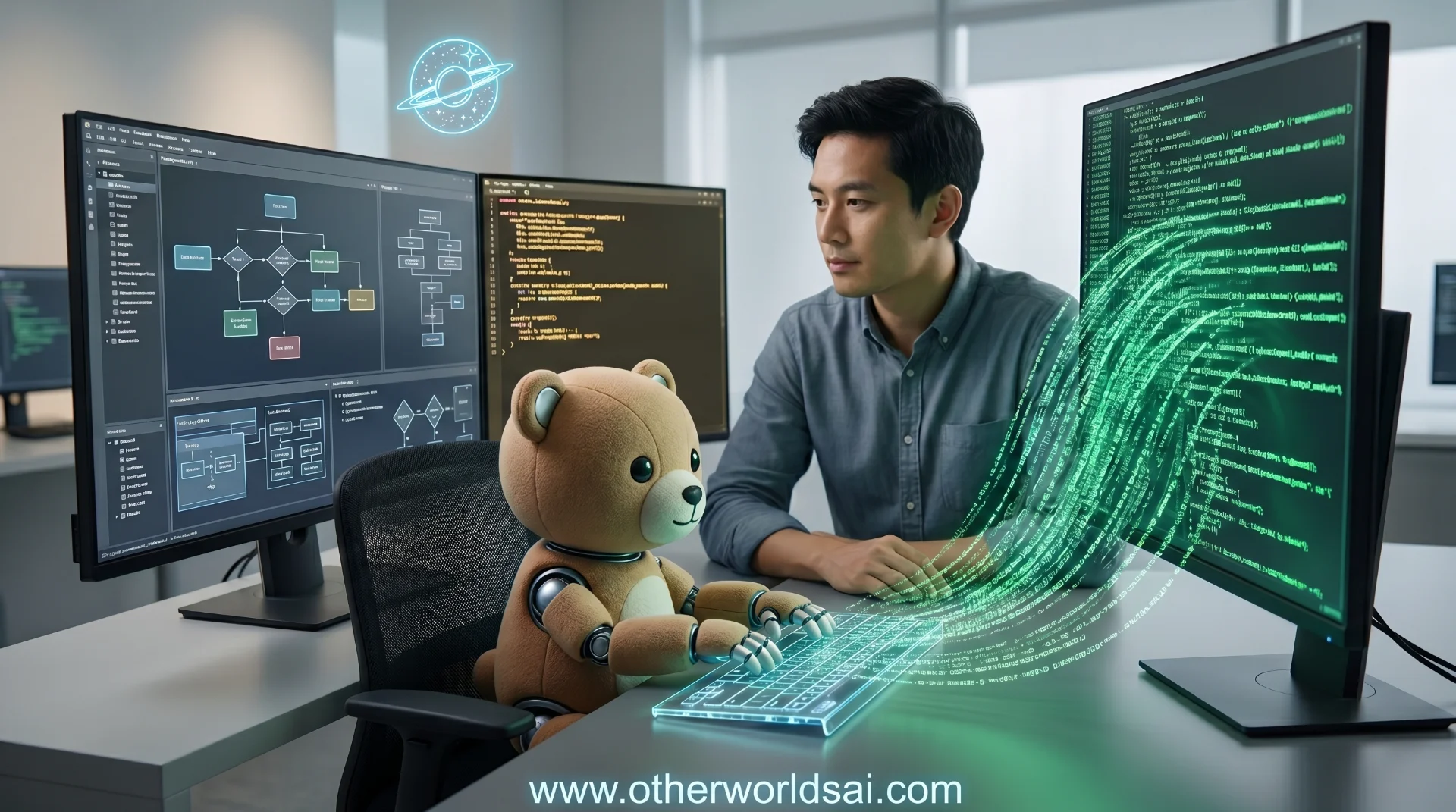
**Wu has a disarmingly simple way of explaining **what Devin is supposed to be. On his desk, he keeps a small stuffed animal holding a computer — his own unofficial Devin mascot. It's a physical reminder of the mental model he had when building the product. "When we started building Devin, we really just thought of it as: this is your buddy who helps you build more." — Scott Wu, CEO of Cognition
The 'buddy' framing is intentional and important. It positions Devin not as a replacement workforce but as a collaborator — something that sits alongside a developer rather than in front of them, taking over. In an industry where the dominant narrative has been about AI displacing white-collar workers, Wu is deliberately pushing a different story.
Wu draws an analogy to the history of software development itself. Just as visual development environments abstracted programming away from raw machine instructions — making software creation accessible to more people — he views AI agents as another layer of abstraction. The goal isn't to remove humans from the process; it's to move humans further up the value chain, from implementation to ideation.
"Most software engineers love building software. They get to build things from nothing. They can make their whole idea and turn it into a product, turn it into an experience." — Scott Wu, CEO of Cognition.
Devin, in Wu's n,visio is there to protect that experience — not eliminate it. By handling the tedious, repetitive, and maintenance-heavy work that drains developers' energy, the agent is supposed to free up more time for the creative, high-judgment work that engineers actually find fulfilling.
Section 4: What Devin Actually Does — 89% of Cognition's Code:
The numbers tell a striking story about how far AI coding agents have already come. Cognition reports that 89% of the code committed by its engineers was written by Devin. The remaining 11% came from local agents running in Windsurf — the AI coding competitor Cognition acquired last year.
In practical terms, Devin is already functioning as the primary engineer at its own company. That's a remarkable proof of concept — and a compelling sales pitch to enterprise customers who are watching AI coding tools mature from novelty to necessity.
But Wu is transparent about the current limits of what Devin can do independently. When working autonomously, he rates Devin's performance as somewhere between a junior and a mid-level engineer, depending on the task. It's not a limitation he's embarrassed about — it's a calibration he thinks is important for customers and the industry to understand.
"It works at somewhere between a junior and a mid-level engineer, depending on the task at hand." — Scott Wu on Devin's current capabilities
The tasks where Devin genuinely excels are the ones many engineers are happy to hand off:
• Legacy code modernization: bringing old systems up to current standards and frameworks.
Meta's Next Big Bet: This New App Lets You Build Games Simply by Typing a Prompt
• Platform migrations: moving applications from one infrastructure to another.
Support our research
Independent analysis fueled by you.
• Long-tail maintenance: the backlog of fixes, updates, and patches that accumulate in every codebase.
• Repetitive implementation tasks: boilerplate, scaffolding, and standardized code patterns.
These are exactly the tasks that drain developer morale and crowd out creative work. By absorbing them, Devin isn't stealing jobs — it's clearing space for the work that most engineers got into the field to do.
Section 5: Windsurf, Recursive Agents, and the Road to Self-Driving Software:
Cognition's acquisition of Windsurf last year was a significant strategic move. Windsurf is an AI coding environment that competes directly with tools like Cursor and GitHub Copilot. By bringing it under the Cognition umbrella, Wu gains both a complementary product and a broader distribution channel — and the ability to offer a more complete AI-assisted development stack to enterprise customers.
The concept of 'recursive' AI agents is where the conversation gets genuinely futuristic. Recursive agents are AI systems that learn from their own outputs, improve their own capabilities over time, and — in theory — gradually move up the skill ladder without human retraining. It's the logical extension of the self-driving software vision, and it's become one of the most discussed concepts in AI research circles in 2026.
"I think we are in for a wild ride." — Scott Wu on the future of recursive AI agents Wu is bullish on the potential but measured in his expectations. He sees agents expanding beyond software into fields like customer service and medicine — but consistently frames that expansion through the lens of augmentation. In every domain, he believes, the role of the agent should be to take on toil so that human professionals can focus on the work that requires genuine judgment, empathy, and creativity.
Section 6: The Bigger Question — Augmentation or Displacement?
Wu's position puts him in an interesting minority among AI company founders. In 2026, the dominant narrative from the C-suite has been one of aggressive workforce substitution — AI agents replacing customer service teams, AI models taking over content creation, and now AI coding agents standing in for software engineers. Layoff announcements citing AI have become a near-daily occurrence.
Wu explicitly distances Cognition from that trend. He doesn't want coders to lose their jobs, and he's built Devin's product philosophy around the idea that human oversight and human creativity are features, not temporary workarounds until the AI gets good enough to go fully autonomous.
"It should always be up to the human what to do. You really see this in software engineering, but I think it's true in all these other professions too." — Scott Wu, CEO of Cognition.
Whether that philosophy holds as Devin's capabilities continue to improve is the central tension in the story. If recursive agents do begin to operate at senior engineer level and above — taking on architecture decisions, security design, and novel problem-solving — the augmentation narrative becomes harder to sustain. The industry will need honest frameworks for thinking about what human contribution looks like in a world of increasingly capable AI coding agents.
For now, Wu's bet is that the answer isn't less human involvement — it's different human involvement. More vision. More judgment. More creativity. Less toil. If he's right, the $26 billion valuation may look conservative in a few years. If the augmentation promise gives way to displacement, the reckoning will extend far beyond Cognition's boardroom.
Conclusion: The Buddy System — Why Devin's Philosophy Matters Beyond the Valuation:
Cognition's $1 billion raise and $26 billion valuation are the numbers that dominate the headline. But the more important story may be the philosophical position Scott Wu is staking out in a moment when the tech industry is under intense scrutiny for its relationship with human workers.
Wu is making a bet that the most durable AI products are ones that make humans more powerful, not ones that make humans unnecessary. Devin, the teddy-bear buddy on his desk, is the physical embodiment of that belief — a collaborator, not a replacement. The 89% of code it writes at Cognition isn't a preview of a world without programmers. It's an argument for a world where programmers spend their time on the 11% that matters most.
"Code and software has been the first to move, but we'll see this happen in all these other industries. It should always be up to the human what to do." — Scott Wu, CEO of Cognition.
Whether the rest of the AI industry follows that lead — or races past it in pursuit of full automation — will define the next chapter of how AI and human workers coexist.
For developers watching closely, Wu's message is worth holding onto: the best AI coding agent isn't the one that replaces you. It's the one that frees you to build something only you could imagine.
Cognition AI · Scott Wu · Devin AI coding agent · AI replacing programmers · AI software development 2026 · Cognition $1 billion funding · AI coding tools · Windsurf acquisition · self-driving software · AI augmentation vs replacement · AI junior developer · recursive AI agents