
Tesla's $25 Billion Bet: How Elon Musk Is Transforming Tesla Into an AI and Robotics Powerhouse:
Goodbye Model S, Hello Optimus: Tesla is Gutting Its Fremont Factory to Build Humanoid Robots. Elon Musk’s Biggest Gamble Yet: Is Tesla Becoming the World’s First True Robotics Company?
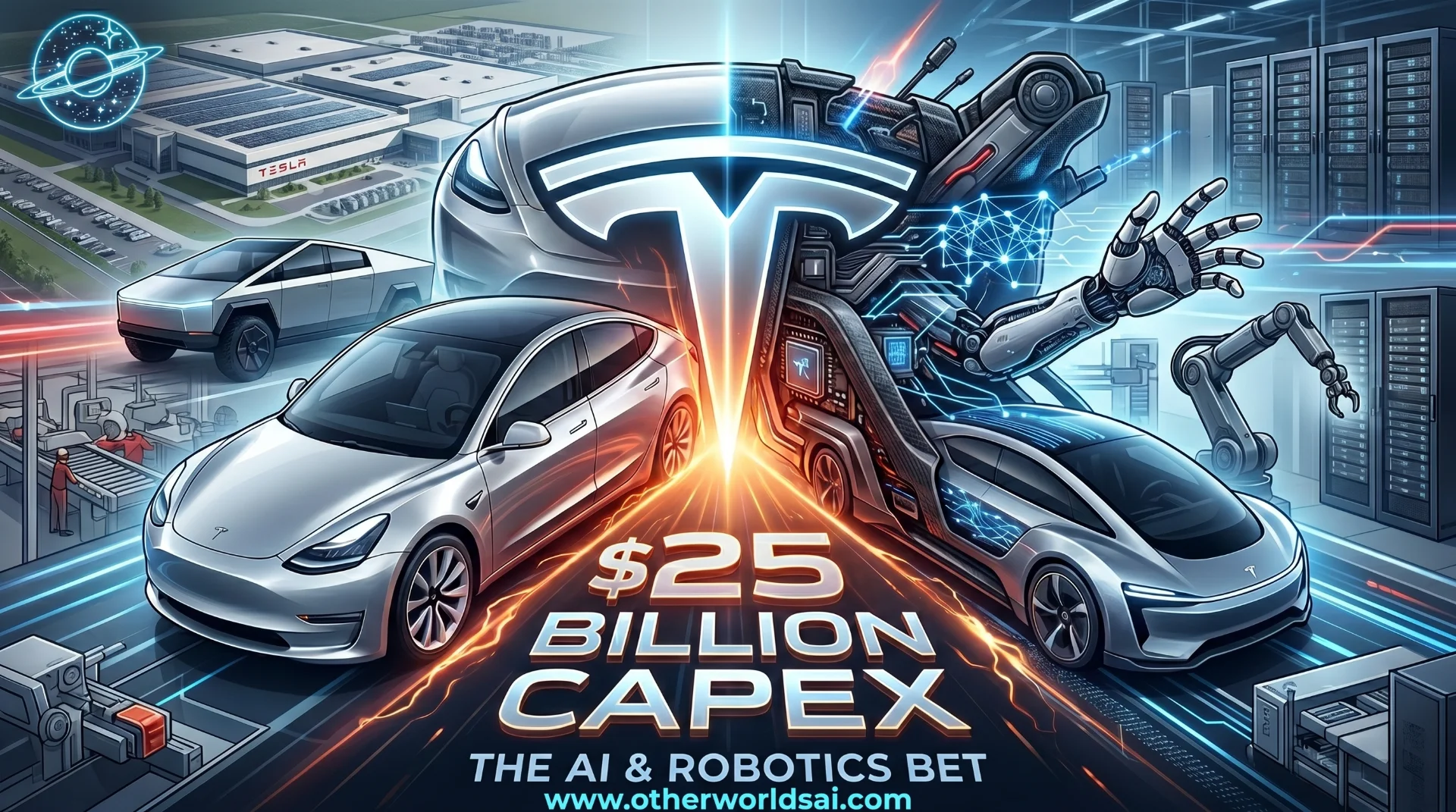
Elon Musk just dropped a bombshell that is sending shockwaves through the investment world. At Tesla's first-quarter earnings call, the company's CEO announced that Tesla's capital expenditures will surge to $25 billion in 2026 — a figure so staggering it is three times higher than any annual capex budget the company has ever committed to before.
This is not a minor course correction. It is a full-throttle pivot that signals Tesla's most aggressive transformation since the company first rolled an electric vehicle off an assembly line.
The message to investors, competitors, and the broader tech industry is unmistakable: Tesla is no longer just an electric vehicle company. Under Musk's direction, it is rapidly evolving into a vertically integrated AI, robotics, and autonomous technology company — one that is willing to burn through extraordinary capital today to dominate the industries of tomorrow.
"With 2026, we're going to be substantially increasing our investments in the future. You should expect a very significant increase in capital expenditures — but I think well justified for a substantially increased future revenue stream." — Elon Musk
The Numbers Breakdown: What $25 Billion Actually Means:
To fully appreciate the scale of this announcement, context is everything. Tesla's capital expenditure history tells a story of steady but measured growth: $8.9 billion in 2023, $11.3 billion in 2024, and $8.5 billion in 2025. The leap to $25 billion in 2026 is not an evolution — it is a financial earthquake that triples the company's previous annual spending on physical assets, infrastructure, and long-term investments.
Tesla had already signaled aggressive spending intentions earlier this year. In January, the company announced plans for capital expenditures in excess of $20 billion in 2026 to fund its AI initiatives, compute infrastructure, data centers, and manufacturing expansion. The revised $5 billion upward revision to $25 billion suggests that these initiatives are already demanding more resources than initially anticipated — and that Tesla's ambitions are growing faster than its original projections.
On a quarterly basis, Tesla remains disciplined for now. Q1 2026 capital expenditure came in at $2.5 billion, broadly in line with previous quarters. But CFO Vaibhav Taneja has warned that the company will move into negative free cash flow territory later in 2026 — a direct consequence of the accelerating spend. Despite this, Tesla enters the investment cycle from a position of notable financial strength, sitting on $44.7 billion in cash, cash equivalents, and short-term investments at the close of Q1.
"While this may seem like a lot, and we will have the impact of negative free cash flow for the rest of the year, we believe this is the right strategy to position the company for the next era." — CFO Vaibhav Taneja
Where the Money Is Going: AI, Robotics, and Beyond EVs:
Tesla's $25 billion capex plan is not a single investment — it is a multi-front offensive across some of the most competitive and high-stakes sectors in the global economy. Here is where the capital is being deployed and why each allocation matters for Tesla's long-term strategy.
Artificial Intelligence Infrastructure is the cornerstone of Tesla's transformation. A significant portion of the capex will be directed toward AI training, chip design, and computing infrastructure — the foundational layer that powers everything from Tesla's autonomous driving systems to its robotics programs. Tesla is investing heavily in proprietary silicon, signaling its intention to reduce dependence on third-party chip suppliers and build competitive AI hardware in-house.
The Optimus humanoid robot represents Tesla's most audacious moonshot. Tesla's iconic Fremont, California factory is undergoing a significant transition — ending production of the Tesla Model S and Model X to make way for Optimus humanoid robot manufacturing at scale. Even more significantly, Tesla has broken ground on a dedicated Optimus manufacturing facility outside its Austin, Texas headquarters. Musk has stated the company plans to scale internal Optimus production for testing before making the robot available for commercial use outside Tesla, tentatively planned for sometime in the following year.
The Robotaxi business is another major capex destination. Tesla's autonomous robotaxi operations are receiving dedicated investment as the company races to build out the infrastructure, software, and vehicle fleet needed to compete in the rapidly expanding self-driving transportation market. Combined with ongoing investments in battery technology, energy storage, and AI silicon supply chains, Tesla's capex strategy is designed to secure competitive advantages across multiple technology vectors simultaneously.
A brand-new semiconductor research fab in Austin is perhaps the most forward-looking investment of all. By building proprietary semiconductor research and fabrication capabilities in-house, Tesla is laying the groundwork for long-term silicon independence — a strategic priority that has become increasingly critical in the era of global chip shortages and geopolitical supply chain disruptions.
Tesla in the Context of Big Tech's AI Spending War:
Tesla's $25 billion commitment is bold — but in the context of the broader technology industry's AI spending war, it is not without precedent. Musk himself was quick to note that Tesla is far from alone in dramatically scaling its capital expenditure ambitions. Amazon has projected $200 billion in capital expenditures in 2026, spread across AI, chips, robotics, and low-earth orbit satellites. Google is slated to spend between $175 billion and $185 billion in 2026, up from $91.4 billion the previous year.
What makes Tesla's position unique is the breadth of its vertical integration. While Amazon and Google are primarily cloud and software companies that rely on third-party hardware ecosystems, Tesla is simultaneously building physical AI products — robots, autonomous vehicles, and energy systems — alongside the software and compute infrastructure to power them. This combination of hardware manufacturing expertise and AI development ambition is rare in the technology industry and may ultimately prove to be Tesla's most durable competitive advantage.
"Tesla's $25B capex plan puts it in the same conversation as the world's biggest tech spenders — but with a physical product pipeline that Amazon and Google simply cannot match."
Investor Reaction: Optimism, Caution, and the Road Ahead:
Wall Street's reaction to the earnings call was a study in conflicting signals. Tesla shares initially surged approximately 4% following the release of an unexpected $1.4 billion in free cash flow — a figure that pleasantly surprised analysts who had braced for weaker results.
However, those gains were swiftly erased in after-hours trading as Musk and CFO Taneja laid out the full scope of the $25 billion capital expenditure plan and confirmed that the company would move into negative free cash flow territory before year's end.
For long-term Tesla bulls, the spending plan is a reason for optimism, not alarm. The bull case is straightforward: a company that invests aggressively in AI, autonomous vehicles, humanoid robotics, and next-generation semiconductors today is positioning itself to capture enormous revenue streams tomorrow. Tesla's $44.7 billion cash reserve provides a substantial financial cushion that allows the company to sustain elevated spending without existential risk — at least in the near term.
For skeptics, the risks are equally clear. Capex of this magnitude, paired with a period of negative free cash flow, demands flawless execution across multiple simultaneously-scaling initiatives — Optimus manufacturing, robotaxi deployment, chip development, and AI infrastructure. Any meaningful delays or cost overruns in even one of these programs could put significant pressure on Tesla's balance sheet and shareholder confidence.
The Bigger Picture: Tesla's Evolution From EV Maker to AI Company:
Strip away the earnings call jargon and the quarterly metrics, and what remains is a remarkably clear strategic vision. Elon Musk is not trying to build a better electric car company. He is trying to build the world's first truly vertically integrated AI and physical intelligence company — one that controls its own chips, its own software, its own robots, its own energy ecosystem, and its own transportation network.
The $25 billion capex commitment is the financial manifestation of that vision. Every dollar allocated to Optimus production, robotaxi infrastructure, AI silicon, and semiconductor R&D is a dollar invested in making that vision real — in transforming Tesla from a company that makes electric vehicles into a company that shapes how humans live, work, and move in an AI-powered world.
Whether that vision succeeds at this extraordinary scale of investment remains the defining question for Tesla investors, analysts, and observers worldwide. But one thing is certain: Elon Musk has never lacked for ambition — and with $25 billion committed to the future of AI and robotics, he is making the biggest bet of his career.
"Tesla is no longer just an EV company. It is an AI company with a car division — and a $25 billion budget to prove it."