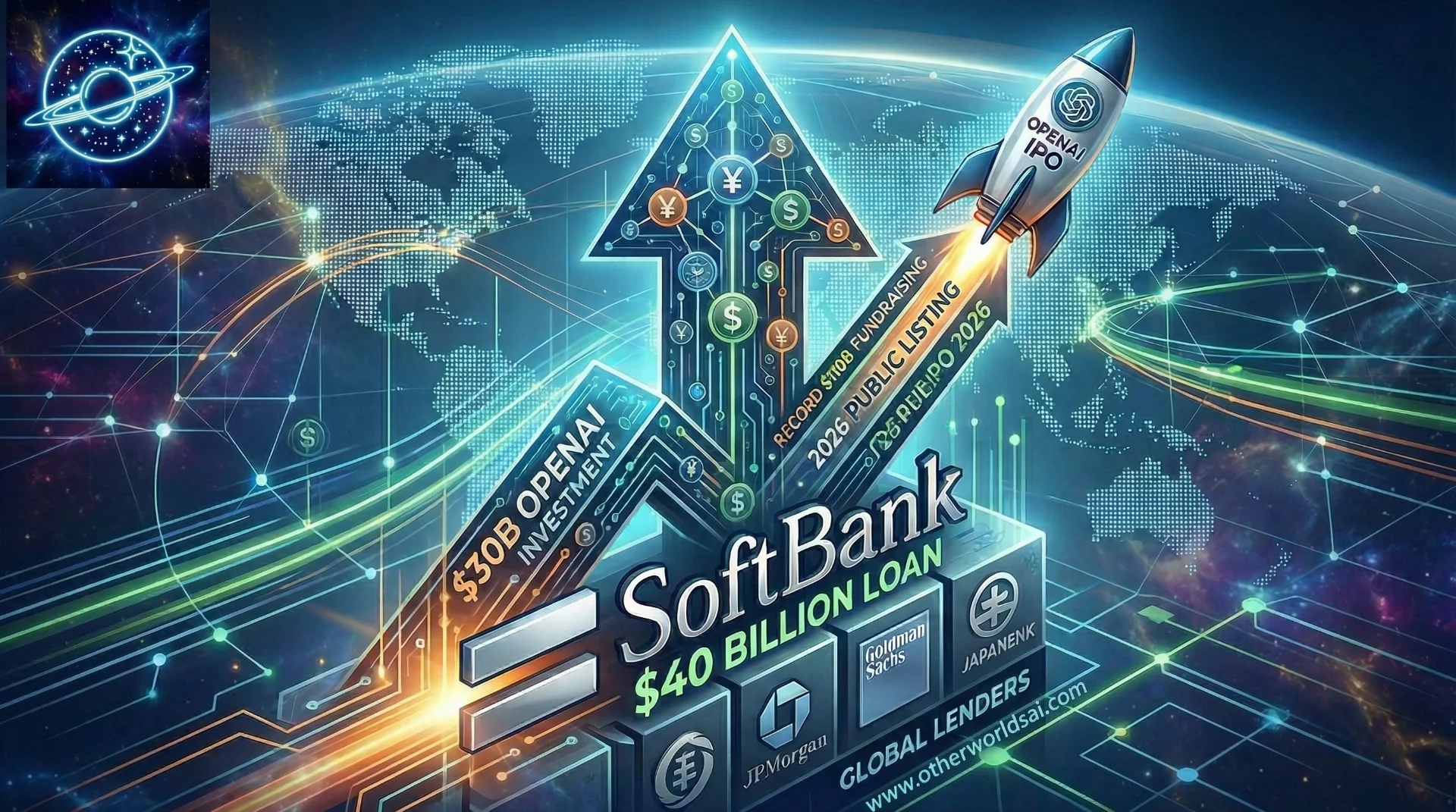

The $40B "Secret": Why SoftBank’s New Loan Points to a 2026 OpenAI IPO:
The least surprising development in artificial intelligence finance is the one taking shape right now.
A $40 Billion Loan, a Record Raise, and a Very Clear Signal:
The global race to dominate artificial intelligence has produced many extraordinary financial moments — but few as structurally revealing as the one SoftBank announced on Friday. The Japanese technology conglomerate has secured a $40 billion unsecured loan to cover its $30 billion commitment to invest in OpenAI, the maker of ChatGPT, as part of OpenAI's record-breaking $110 billion fundraising round — the largest private capital raise in the history of the technology industry.
What makes this loan extraordinary is not its size alone — it is its structure. The debt is unsecured, meaning SoftBank has pledged no specific assets as collateral. It carries a 12-month repayment term. And it is being provided by some of the most sophisticated institutional lenders on the planet: JPMorgan Chase, Goldman Sachs, and four major Japanese banks. For a loan of this magnitude to be structured this way, the lenders have to believe one thing above all else: that SoftBank will have the liquidity to repay it within a year.
Did anyone seriously think this was just a routine financing arrangement?
For those tracking the intersection of AI and global capital markets closely, the structure of this loan is not merely a financial footnote. It is a calculated signal — one that points unmistakably toward a single near-term catalyst: the OpenAI IPO in 2026. And understanding why requires looking carefully at the numbers, the timeline, and the institutions that said yes.
The 12-Month Clock: Why the Repayment Term Is the Real Story:
A 12-month unsecured loan at this scale is not a standard treasury operation. It is a structured bet on a specific liquidity event. Reports from CNBC and other leading financial outlets have pointed consistently to 2026 as the year OpenAI is expected to pursue its public listing. If the OpenAI IPO proceeds on that timeline — and becomes one of the largest listings in stock market history — SoftBank would receive a substantial return on its equity stake, providing more than enough liquidity to retire the $40 billion debt well within the 12-month window.
The lenders have essentially underwritten this loan the same way they would underwrite an IPO. JPMorgan Chase and Goldman Sachs have deep, institutional visibility into public market pipelines. Their willingness to lend $40 billion without collateral, with a 12-month term, is the clearest signal yet that Wall Street's most sophisticated institutions believe the OpenAI public listing is not a question of if — it is a question of when, and the answer is this year.
OpenAI's $110 Billion Raise: What the Numbers Actually Mean:
OpenAI's record-breaking $110 billion fundraising round is not just a financial milestone — it is a statement about where the AI industry believes value creation is headed. No private technology company has raised this much in a single round. The sheer scale of the raise validates OpenAI's position not merely as the company behind ChatGPT, but as a platform-level infrastructure play — the kind of foundational bet that institutional capital makes once in a generation.
For SoftBank, the $30 billion commitment in this round was not an impulsive move. It was the continuation of a long-term thesis built around CEO Masayoshi Son's conviction that artificial general intelligence will produce returns that justify unprecedented concentration of capital. Son has made this argument publicly and repeatedly. The $110 billion raise, and SoftBank's central role within it, is the most dramatic expression of that thesis yet.
SoftBank's $60 Billion Total Bet: The Full Picture:
The $30 billion commitment announced as part of this round brings SoftBank's total investment in OpenAI to well over $60 billion — a figure that, when stated plainly, is almost difficult to absorb. This is a single investor placing over $60 billion into a single AI company. It represents the most concentrated technology bet in venture capital history, and it has been built deliberately, across multiple rounds, over several years.
That concentration is either visionary or reckless — and the answer will be determined largely by what happens when OpenAI eventually faces public market scrutiny. A successful ChatGPT IPO would not just validate SoftBank's thesis. It would redefine how the market thinks about AI company valuations, infrastructure moats, and the economics of large language model deployment at scale. The stakes could not be higher for either party.
What a 2026 OpenAI IPO Would Mean for the AI Sector:
If OpenAI goes public in 2026, it will be the defining market event of the AI supercycle. The listing would likely set records, trigger a re-rating of every comparable AI company in public and private markets, and provide the ultimate test of whether the extraordinary valuations assigned to foundation model companies over the past three years reflect durable economic reality or accumulated hype.
For SoftBank specifically, the IPO represents the liquidity event that makes the entire financial architecture of this transaction work. The $40 billion unsecured loan gets repaid. The $60 billion total investment gets a public market valuation. And Masayoshi Son's long-running argument — that betting on transformative technology at scale, absorbing the short-term losses, and waiting for the inflection point is the only strategy worth executing — receives either its most spectacular vindication or its most costly refutation.
The Lenders' Calculus: Why JPMorgan and Goldman Said Yes:
The decision by JPMorgan Chase and Goldman Sachs to lead a $40 billion unsecured loan is not a routine transaction — it is a statement of institutional conviction. Both firms have unparalleled visibility into IPO pipelines, public market appetite, and the operational trajectory of the companies they finance. Their participation in this loan almost certainly reflects internal analysis that includes detailed OpenAI IPO timing scenarios, valuation modelling, and risk-adjusted assessments of SoftBank's ability to repay.
The addition of four major Japanese banks to the lending consortium further underscores the breadth of institutional confidence behind this deal. SoftBank is Japan's most prominent technology investor, and a lending group of this composition — spanning Wall Street and Tokyo — signals that the conviction behind the OpenAI IPO thesis extends well beyond any single market or financial system.
Key Takeaways: The SoftBank–OpenAI Story at a Glance:
Here is a summary of the key developments covered in this article:
-
$40 billion unsecured loan: SoftBank secured the debt from JPMorgan Chase, Goldman Sachs, and four Japanese banks — with no collateral and a 12-month repayment term.
-
$30 billion OpenAI commitment: The loan covers SoftBank's investment in OpenAI's latest funding round — the largest private capital raise in technology history.
-
$110 billion valuation: OpenAI's record-breaking round set a new benchmark for private AI company valuations globally.
-
12-month repayment signal: The short-term, unsecured structure strongly implies lenders are pricing in an OpenAI IPO within the year as the primary liquidity event.
-
$60 billion total bet: SoftBank's cumulative investment in OpenAI now exceeds $60 billion — the most concentrated single-company technology bet in venture capital history.
-
2026 IPO timeline: Reports from CNBC and other outlets have consistently pointed to 2026 as the expected window for OpenAI's public listing.
-
JPMorgan & Goldman Sachs: Their participation as lead lenders on an unsecured $40 billion facility reads as institutional validation of the OpenAI IPO timeline.
-
Masayoshi Son's thesis: SoftBank's concentrated AI bet reflects Son's long-held conviction that transformative technology rewards those willing to absorb short-term risk at scale.
Conclusion: The Bet That Was Always Going to Come Due:
At some point, someone at SoftBank probably looked at the numbers and decided the window was now. The $30 billion commitment was made. The $40 billion loan was secured. The 12-month clock was set. Maybe the IPO would arrive on schedule. Maybe the lenders would never have reason to worry.
The structure of this deal suggests they are not worried. Given everything at stake in the global AI race — the technology, the capital, the strategic advantage, and the institutional reputations of every bank that signed on — the idea that JPMorgan, Goldman Sachs, and four Japanese banks would extend $40 billion unsecured without a clear path to repayment was always implausible. That path has a name, and it is the OpenAI IPO.
For AI founders, investors, and technology executives navigating an increasingly complex global landscape, the message embedded in this transaction is unambiguous:
the organisations that understand the full arc of the AI capital cycle — and position themselves accordingly before the public markets arrive — will be best placed to define the decade ahead.
Support our research
Independent analysis fueled by you.